
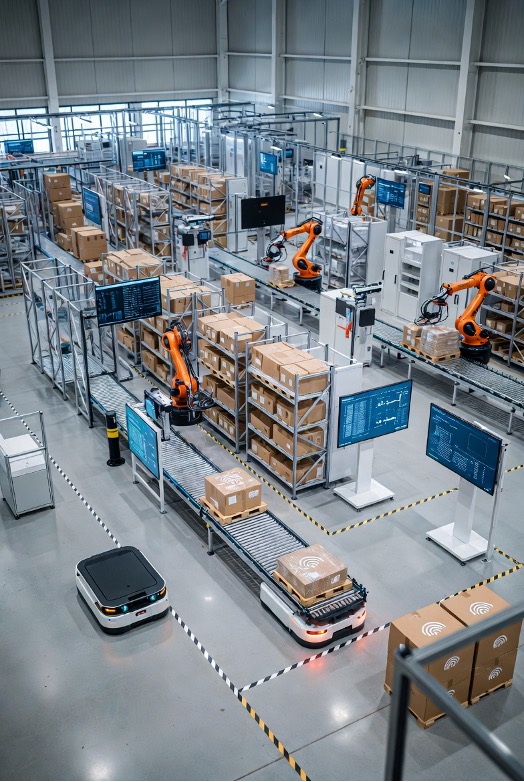
Automating material handling with robots requires more than simply selecting the right robot. It also involves organizing how materials are transported, stored, moved, and managed throughout your factory or logistics center.
Material handling covers everything from the arrival of raw materials to internal material flow and the outbound shipment of finished products. Poorly designed automation can lead to downtime, bottlenecks, and increased operational costs.
In this article, we examine the most important logistics factors that companies should consider to ensure that robotic automation in material handling maximizes return on investment, safety, and operational efficiency.
➡️ Related URT article on robotic material handling applications:
FACTORS IN ROBOTIC MATERIAL HANDLING APPLICATIONS WITH YASKAWA MOTOMAN
1. Material flow design
Before automating, it is essential to understand the material flow:
- Inbound → Production → Storage → Outbound
This requires mapping movement routes, transfer points, and expected cycle times.
The goal is to minimize redundant movements and ensure that the robot is always performing productive tasks.
2. Integration with management systems
Material handling robots must be integrated with systems such as:
- WMS (Warehouse Management System)
- MES (Manufacturing Execution System)
- ERP (Enterprise Resource Planning)
These systems coordinate inventory, movement routes, and dispatch priorities in real time, preventing errors, duplication, and delays.
3. Selecting the right robot type
Depending on the material handling operation, different robot types may be considered:
🔹 Autonomous Mobile Robots (AMRs/AGVs) – ideal for internal transport of pallets and loads between stations without fixed infrastructure.
🔹 Robotic manipulators – suitable for pick & place operations, palletizing, and loading/unloading.
🔹 AS/RS systems and stacker cranes – for automated vertical storage and retrieval.
The selected solution directly impacts logistics flow efficiency, integration requirements, and space utilization.
4. Material traceability and localization
Automated systems must ensure that every material unit can be:
- identified (barcodes, RFID),
- located in real time,
- transferred without errors.
This prevents losses, picking errors, and ensures on‑time delivery.
5. Communication between robotic systems
In operations with multiple robots (AMRs/AGVs or robotic manipulators):
- A central coordinator (or AGV controller) must optimize routes to minimize traffic and collisions.
- Real‑time planning allows task redistribution when unexpected events occur.
This reduces waiting times and ensures continuous logistical flow.
6. Physical space and layout
Robotic automation requires:
- sufficiently wide paths for AMRs and AGVs,
- optimized loading and unloading zones,
- shelving designed for robotic handling.
Poorly planned layouts can increase cycle times and complicate operations.
7. Safety and regulatory compliance
When automating material handling with robots:
- Implement sensors and safety systems to prevent collisions with operators or equipment.
- Maintain clear signage and dedicated zones when humans and robots share the same space.
- Comply with industrial safety standards for robotic environments.
This not only protects personnel but also prevents operational downtime and legal penalties.
FAQs
Which robot is best for transporting heavy materials?
Autonomous mobile robots (AMRs/AGVs) or robotic stacker cranes are best suited for heavy loads in large facilities.
Do I need special infrastructure to automate logistics?
It depends on the system. AMRs do not require physical guides, while AS/RS systems may need dedicated infrastructure.
Can a picking robot work with existing systems?
Yes, if it is integrated with your WMS/MES using standard communication protocols and route planning.
Logistics considerations checklist
- ☐ Is the material flow mapped and optimized?
- ☐ Is the selected robot suited to the load type and volume?
- ☐ Is integration with WMS, MES, and ERP in place?
- ☐ Are identification and traceability systems used (RFID/barcodes)?
- ☐ Does the layout facilitate robotic movement?
- ☐ Has safety for operators and robots been fully evaluated?