
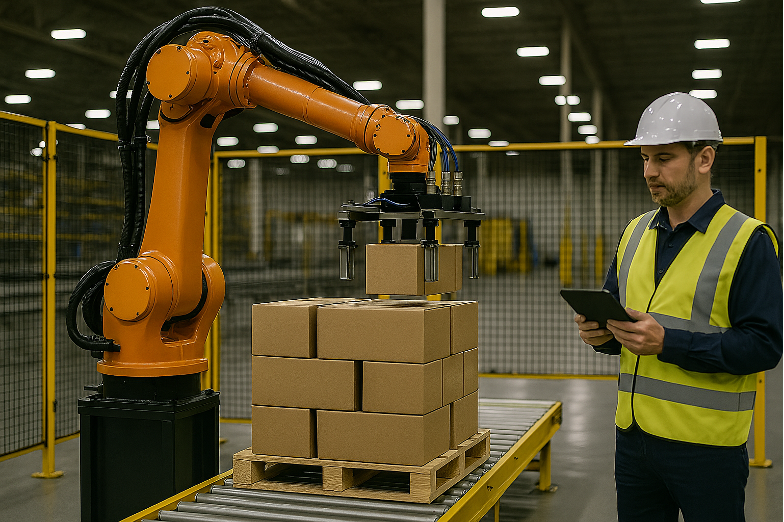
End of line automation is where most manufacturing plants first encounter a decision that is harder than it looks. The problem is visible — operators handling heavy loads repetitively, inconsistent pallet patterns, throughput that drops every time a format changes or a shift ends. The solution appears obvious: install a robot. But the companies that approach end of line automation this way often find themselves with a system that handles their most predictable scenario well and struggles with everything else.
The more useful question is not whether end of line automation is the right answer, but which part of the line, to what degree, and under what conditions. Full robotic automation and a well-designed semi-manual solution are not alternatives on a quality spectrum — they are different tools for different operating environments. Choosing between them correctly requires understanding what each is actually optimized for.
Why End of Line Automation Decisions Go Wrong
End of line operations attract automation investment partly because the problems are easy to see and easy to quantify. Operator fatigue, repetitive lifting, inconsistent pallet patterns, and throughput that collapses during demand peaks are all visible, measurable, and emotionally compelling when presenting a business case to management.
The problem is that the same visibility that makes the case easy to build also makes it easy to oversimplify. A capital expenditure comparison — robotic cell cost versus manual workstation cost — looks clean on a spreadsheet. It becomes complicated when you add the variables that the spreadsheet does not capture: product mix variability, seasonal volume swings, pattern changes driven by customer requirements, the real cost of changeovers, and the actual relationship between operators and the automation system during its first year of operation.
Two predictable failure modes result from this oversimplification.
The first is over-automation: a fully robotic end of line cell designed for stable, high-volume, single-format production that encounters the reality of a plant running eight SKUs with frequent pattern changes and seasonal volume that swings by 40%. The robot handles the main scenario adequately and becomes a source of delays and interventions for everything else.
The second is under-automation: a company that acknowledges its product mix complexity and concludes that automation is too risky, leaving operators in physically demanding positions where injury rates, absenteeism, and turnover silently erode margin for years. The cost of that decision never appears in a single line item — it is distributed across HR, health and safety, quality variation, and production inconsistency.
Both failures share the same root cause: the decision was made against the current snapshot of the operation rather than against the actual operating profile of the line across a full year, including its variability, its peaks, and its likely evolution.
The Five Variables That Define the Right End of Line Strategy
A structured end of line automation decision works from five operational variables. These need to be measured from real production data — not estimated, and not taken from the nominal specification of the line.
1. Production Volume and Stability
Volume is the most obvious input, but stability matters more than the average. A line averaging 500 pallets per day with a standard deviation of 50 is a different automation problem from a line averaging 500 pallets per day with a standard deviation of 250.
High-volume, stable production is the environment where full end of line automation delivers its strongest results. The robot runs at consistent utilization, the program rarely changes, and the cell justifies its capital cost through throughput and labor displacement. Low-volume or highly variable production reduces robot utilization and increases the proportion of time the cell spends in changeover, adjustment, or standby.
2. Product and Format Variability
Every format change on a robotic end of line costs time. The time depends on how the cell is designed — a cell with a recipe-based HMI and a quick-change gripper platform can complete a format change in under ten minutes; a cell with hardcoded programs and a fixed end-effector can require an hour or more of technical intervention.
Before specifying a robotic end of line cell, the format change frequency and complexity need to be characterized precisely: how many different formats does the line run, how often does it switch between them, and what does a format change require in terms of gripper adjustment, pattern reprogramming, and downstream conveyor settings? The answers to these questions drive both the gripper specification and the HMI requirements, and they determine whether the cell’s changeover capability matches the line’s actual operating profile.
For context on how packaging format complexity affects robot selection specifically, see our article on which robot to choose when your line handles multiple packaging formats.
3. Ergonomic and Safety Risk
End of line palletizing is consistently among the highest-risk manual operations in food, beverage, and consumer goods manufacturing. Repetitive heavy lifting, sustained awkward postures, and the physical demands of sustained pace across a shift produce injury rates that are both measurable and often underreported. According to the International Federation of Robotics, palletizing and end of line handling remain among the top drivers of industrial robot adoption in consumer goods manufacturing globally.
The ergonomic case for end of line automation is frequently strong enough to justify investment independently of the productivity argument. When a risk assessment identifies operators performing lifts above the recommended thresholds hundreds of times per shift, the regulatory compliance cost of not automating — engineering controls, modified duty programs, injury claims, turnover — often exceeds the annualized cost of a robotic cell.
4. Downstream Consistency Requirements
Lines that feed shipping with strict commitments — retail-ready pallets, timed collection windows, mixed-SKU distribution center requirements — benefit disproportionately from the consistency that robotic end of line automation provides. A robot builds pallets to a defined pattern every cycle, regardless of shift, operator experience, or time of day. That consistency has value downstream that does not appear in the palletizing KPIs but shows up in fewer distribution center rejections, fewer repalletizing events at the customer, and lower freight damage rates.
If the downstream process is tolerant of variability — a plant shipping to a single internal warehouse, for example — the value of robotic consistency is lower and the case for semi-manual solutions strengthens.
5. Future Commercial Evolution
The most common source of post-installation regret in end of line automation is a cell designed for the current product portfolio that immediately encounters new SKUs the system was not built to handle. Marketing introduces new formats. Retailers request different pallet configurations. New contract volumes change the throughput requirements.
A cell designed around the current state of the line without consideration for likely evolution will require costly redesign or workarounds within two to three years. The right specification asks: what is the realistic range of formats and volumes this line needs to handle over the next five years? The answer drives the gripper platform, the HMI architecture, and the payload and reach specification of the robot.
When Full End of Line Automation Is the Right Choice
Full robotic end of line automation delivers its strongest results when most of the following conditions apply:
- Production volume is high enough to keep the robot at consistent utilization across one or more shifts
- Palletizing patterns are relatively standardized and format changes are infrequent or manageable within the cell design
- Manual handling poses clear ergonomic risk that engineering controls alone cannot adequately address
- Downstream processes require consistent pallet quality across all shifts and demand periods
- The operation runs or plans to run multiple shifts, including unattended periods
- The commercial roadmap indicates stable or growing volume in the product categories the cell will handle
In these conditions, a robotic palletizing cell does more than move boxes. It stabilizes the end of line, removes the throughput dependency on manual labor availability, and creates the consistent output quality that downstream logistics operations require. For a detailed comparison of robotic palletizing against conventional mechanical systems, see our article on industrial robots versus traditional palletizing systems.
The robots most commonly used in end of line palletizing are 4-axis articulated models with payloads in the 100–450 kg range — the ABB IRB 760 and IRB 460, the FANUC M-410 series, and the KUKA KR 700 PA are the standard platforms for most food, beverage, and consumer goods applications. For mixed-case or layer-picking applications that require greater flexibility, 6-axis robots with vision guidance are increasingly used at higher cost.
When a Semi-Manual Solution Delivers Better Return
Semi-manual end of line solutions — mechanical assists, lift tables, ergonomic guides, partial conveyor automation, collaborative robot assistance — are not a compromise. In the right operating environment, they are the correct answer.
A semi-manual approach typically delivers better results when:
- Product mix variability is high enough that a robotic cell would spend a significant proportion of its time in changeover
- Volumes are below the threshold that justifies a dedicated robotic cell’s capital cost
- The plant needs a solution that operators can adapt to format changes without engineering support
- The operation runs a single attended shift where labor availability is not a constraint
- The budget available is insufficient for a full robotic cell but adequate for meaningful ergonomic improvement
The value of a semi-manual solution in a high-mix environment is that it improves the human operators’ working conditions and consistency without imposing the format-change constraints of a robotic cell. An operator assisted by a lift table and a guided conveyor system performs the same ergonomic-risk reduction that a robot would achieve at a fraction of the capital cost — and adapts to format changes instantly.
The caveat is that semi-manual solutions do not provide the throughput consistency and unattended operation capability that robotic cells do. They are a better answer for the right operating profile, not a universally cheaper alternative.
The Staged Approach: Starting Semi-Manual and Scaling to Full Automation
For plants where current volumes or format complexity make full end of line automation difficult to justify, a staged approach is often the most financially sound strategy. The first investment improves ergonomics and consistency with semi-manual equipment. The second investment — made when volume justifies it or format complexity reduces — adds robotic automation to the highest-volume, most stable product lines.
This approach has three advantages. It delivers immediate ergonomic and quality improvement without the capital risk of a robotic cell that may be underutilized in the near term. It gives the plant time to understand its product evolution before locking in a cell architecture. And it allows the team to develop familiarity with automation concepts before managing a fully robotic system.
The risk is commitment: a staged approach only delivers its intended result if the second stage is actually funded and executed. Plants that install semi-manual solutions as a permanent substitute for automation they need but cannot justify yet tend to stay in that position indefinitely. The staged approach requires a clear trigger — a volume threshold, a product rationalization event, a new contract — that will initiate the robotic investment.
For a broader framework on building the internal case for automation when the primary driver is not volume growth, see our article on justifying robotic automation without higher production volume. For a structured method to evaluate which process in your plant should be automated first, including end of line candidates, see our guide on which process to robotize first for the fastest ROI.
How to Compare the Two Options Objectively
The comparison between full end of line automation and a semi-manual solution should include five variables, evaluated over the expected useful life of the investment — typically seven to ten years — not just the first year of operation.
Total cost of ownership, not just capital expenditure. A robotic cell costs more upfront but requires less ongoing labor and produces more consistent output. A semi-manual solution costs less upfront but requires ongoing labor and produces more variable results. The break-even point depends on volume and labor cost, and it needs to be calculated for the actual operating profile of the line, not the average.
Flexibility, measured by the real cost of format changes. How long does each changeover take, how often does it happen, and what does the production loss during changeover cost? A semi-manual system handles format changes faster; a well-designed robotic cell can be competitive if the HMI and gripper platform are specified correctly.
Safety and ergonomic compliance, including the cost of not acting. Injury rates, workers’ compensation, absenteeism, and modified duty programs have a cost that is often excluded from automation investment calculations because it is distributed across multiple budget lines. Including it in the comparison frequently changes the outcome.
Output quality and downstream cost. Consistent pallet quality reduces downstream handling costs, distribution center rejection rates, and freight damage. This value is real but rarely quantified in the investment case.
Growth capacity. A robotic cell can run additional shifts without proportional labor increases. A semi-manual system cannot. If the commercial plan includes volume growth, the capacity of each option to absorb that growth at marginal cost is a relevant variable.
FAQ
Does end of line automation always improve ROI?
No. End of line automation delivers the strongest ROI when volume is stable, format changes are manageable within the cell design, ergonomic risk is high, and downstream consistency requirements are significant. In high-mix, low-volume, or highly seasonal operations, a semi-manual solution often delivers better return on the specific capital available.
Is a semi-manual end of line solution just a temporary phase before full automation?
Not necessarily. In some operations, a semi-manual solution is the correct permanent answer because the operating profile — format mix, volume variability, single-shift attendance — does not justify a robotic cell’s capital cost and ongoing management complexity. The staged approach is a deliberate strategy for plants that expect their operating profile to evolve; it is not the right framing for every situation.
What production volume typically justifies a robotic palletizing cell?
There is no universal threshold, because the answer depends on labor cost, shift structure, and format complexity as much as on volume. A rough starting point: if the line runs more than one shift and produces more than 200 pallets per day with a manageable format range, the economics of a robotic cell are usually favorable. Below that, the calculation depends heavily on the specific cost structure of the operation.
How long does a format change take on a robotic end of line cell?
It depends entirely on the cell design. A cell with a recipe-based HMI and a properly specified quick-change gripper platform can complete a format change in under ten minutes. A cell with hardcoded programs and a fixed end-effector can require an hour or more of technical support. This variable should be specified and tested before acceptance — not discovered after commissioning.
What data should I collect before making an end of line automation decision?
The minimum dataset for a credible decision includes: actual throughput by shift and by season over the last twelve months, number of formats and changeover frequency, current injury rates and ergonomic assessment results, downstream rejection or repalletizing rates linked to pallet quality, and the commercial volume forecast for the next three to five years. These numbers reveal the actual operating profile of the line and make the comparison between full and semi-manual automation quantifiable rather than qualitative.
Talk to URT About Your End of Line Project
At URT, we supply industrial robots — new and refurbished — for end of line palletizing and packaging automation across food, beverage, consumer goods, and industrial manufacturing.
If you are evaluating whether full end of line automation fits your operation, what configuration is appropriate for your format mix and volume profile, or which robot models are available within your project budget, contact URT. We will give you a direct, technical answer based on your actual production requirements.