Tag Archives: industry 4.0

How Does Predictive Maintenance Influence the Reliability and Lifespan of Robotic Systems in Industrial Automation?

Not only the choice of the robot, but also its maintenance throughout its entire lifecycle, is a critical factor in achieving high performance within automated industrial production lines. To maximize the availability and reliability of automated systems, traditional maintenance approaches—whether preventive or reactive—are often not enough. For this reason, more and more industrial sectors are

Read More

How to Optimize Energy Consumption in Industrial Robots Without Losing Speed

In many industrial environments, energy efficiency is often perceived as a trade‑off: lowering consumption usually means reducing performance. However, in modern robotic automation, this is no longer true. Optimizing the energy consumption of industrial robots without sacrificing speed, precision, or productivity is entirely achievable—as long as you address the right factors. The key is not

Read More

HOW ARE INDUSTRIAL ROBOTS TRANSFORMING CONTEMPORARY ART AND CREATIVE MANUFACTURING?

Subtitle From monumental sculpture to algorithmic painting: real applications where industrial robotics becomes an artistic tool. Slug industrial-robots-contemporary-art-creative-manufacturing Meta description Discover how industrial robots are revolutionizing contemporary art, sculpture, and creative manufacturing with precision, scale, and new expressive possibilities. Introduction For decades, industrial robots have been associated exclusively with production lines, welding, palletizing, or machining.

Read More

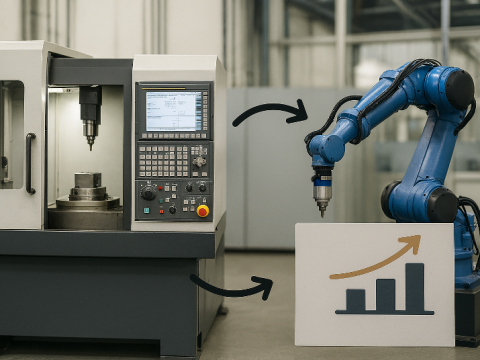
How to Calculate the Real ROI When Replacing a CNC Machine with a Robot + Spindle

For years, CNC machinery has been the benchmark for precision in industrial machining. However, the evolution of robotics — especially refurbished robots equipped with high‑performance spindles — is reshaping the landscape. More and more factories are now asking themselves: Is it really worth replacing a CNC with a robotic milling cell? The answer depends on

Read More

HOW DOES ROBOTIC AUTOMATION AFFECT INDUSTRIAL CYBERSECURITY WHEN ROBOTS ARE CONNECTED TO CORPORATE NETWORKS OR THE CLOUD?

For a long time, industrial robots operated in isolated environments, disconnected from the rest of a company’s systems. Today, that reality has changed. The need for remote monitoring, production data collection, predictive maintenance and traceability has led to connecting robots to corporate networks and even cloud platforms. As a result, a relatively new concern has

Read More

IS YOUR PROCESS TRULY READY FOR AUTOMATION WITH A REFURBISHED ROBOT?

The truth is that not every industrial task benefits from robotic automation—and even fewer are genuinely compatible with a refurbished robot. The key lies in understanding whether your process meets the fundamental technical conditions that professionals use to evaluate automation projects: aspects such as geometry, repeatability, production volume, accessibility, safety, and the overall stability of

Read More

NEW ROBOTS IN MANUFACTURING STARTUPS: THE FAST TRACK TO AUTOMATION

For years, industrial robotics seemed reserved for large corporations with massive budgets. Today, that reality has changed. Advances in technology, easier programming, and flexible financing have made automation accessible even to manufacturing startups from their earliest stages. According to the International Federation of Robotics (IFR), over 30% of new industrial robot installations in 2024 were

Read More

INTEGRATING COLLABORATIVE SAFETY IN HYBRID LINES: CHALLENGES AND BEST PRACTICES

In the modern factory, the best of two worlds comes together: the robustness of traditional industrial robots and the flexibility of collaborative robots, or cobots. This fusion—a hybrid human-robot line—offers great advantages but also raises critical challenges: safety, ergonomics, production flow, and adaptability to change. For brands like KUKA, ABB, or FANUC, which you manage

Read More

WHAT SPECIFIC IMPROVEMENTS WOULD WE SEE IN EFFICIENCY, QUALITY, OR COSTS WITH THE INTEGRATION OF A ROBOTIC SOLUTION?

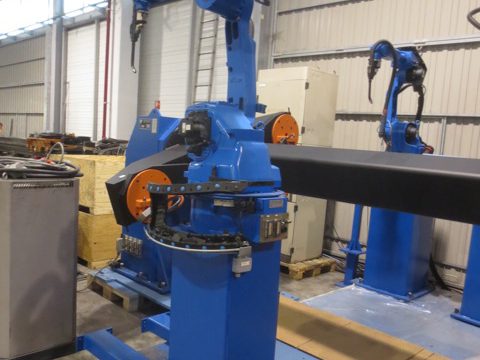
The integration of a robotic welding solution does not simply replace manual labor, but transforms the entire production process. The benefits are mainly reflected in three key areas, which are constantly monitored by the industry: production efficiency, weld quality, and operating costs per part. These improvements are recognized worldwide and proven by the actual performance

Read More

PREDICTIVE VS CORRECTIVE MAINTENANCE IN INDUSTRIAL ROBOTS

Industrial robots, like any machinery, require regular maintenance. But the key question is: do we act before a failure occurs or after it? Predictive maintenance redefines efficiency by anticipating breakdowns and optimising resources. Corrective: The Traditional Model Corrective maintenance takes place after a failure: when a servomotor stops, an axis loses calibration or a controller

Read More