
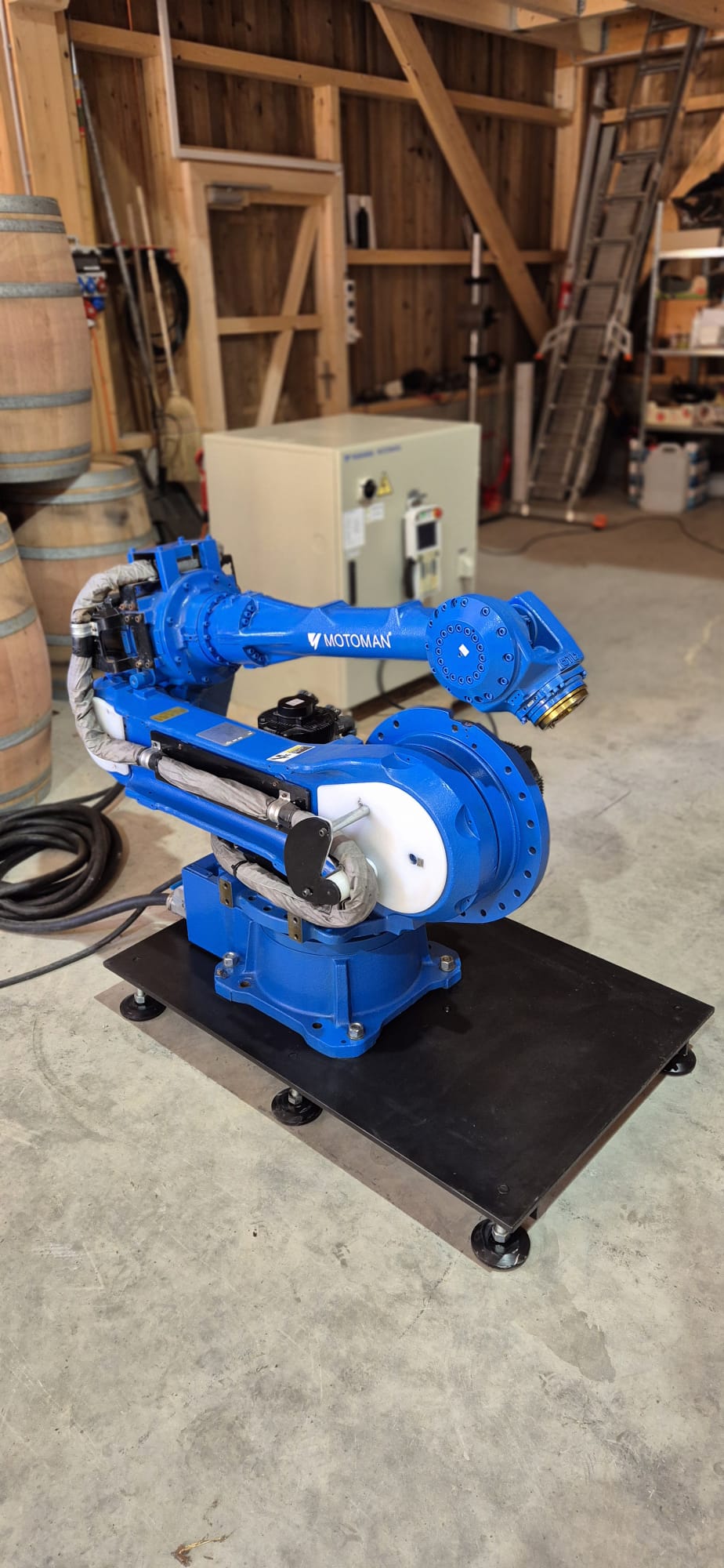
One of the most common starting points in industrial automation projects begins with a reassuring statement:
“The process works fine as it is.”
Ironically, this is often where the real problems start.
Many manual processes appear stable only because human operators continuously compensate for imperfections: adjusting positions, correcting variations, interpreting visual cues, and making small decisions on the fly. When a robot is introduced, those compensations disappear. What was once acceptable in a manual process can become a repeated failure point in an automated cell.
This is why process readiness for robotic automation matters as much as robot selection. A robot can repeat a defined process with precision, but it cannot compensate for a process that was never properly standardized.
1. Assuming a manual process can be automated without redesign
A frequent mistake is believing that a manual process can be automated exactly as it is. In reality, many manual operations are not truly standardized. They rely on informal adjustments, operator experience, and tacit knowledge that has never been translated into measurable process rules.
Robots do not interpret or improvise. They execute exactly what they are programmed to do. If a process is unstable or inconsistent from the start, automation does not fix it; it simply exposes its weaknesses more consistently.
For example, a human operator may naturally adjust the position of a part before loading it, apply slightly different pressure depending on resistance, or correct an imperfect orientation without thinking about it. A robot needs those conditions defined in advance through fixtures, references, sensors, tolerances, or process redesign.
2. Ignoring real process tolerances
In manual work, small variations in position, orientation, or force are often corrected subconsciously by the operator. Once automated, those same variations can turn into geometric errors, misalignments, gripping issues, or sequence faults.
When tolerances are not measured and defined beforehand, the robot is often blamed for being “inaccurate,” when the real issue is that the process was never geometrically coherent enough to be repeated without human correction.
In a palletizing cell, for instance, a human can compensate for slightly deformed boxes or inconsistent product orientation. A robot depends on stable references, repeatable positioning, and predictable product presentation. Without those conditions, the problem is not robot accuracy; it is process definition.
3. Underestimating environmental influence
Lighting changes, dimensional variability in parts, dust accumulation, vibration, temperature shifts, and inconsistent material flow are all factors that human operators learn to handle over time.
A robot does not adapt unless the process is explicitly designed to absorb those variations. Automating without reviewing environmental conditions often leads to unrealistic reliability expectations, unnecessary system complexity, and avoidable commissioning problems.
This is especially relevant in applications involving vision systems, welding, machine tending, packaging, or pick-and-place operations, where small environmental changes can affect detection, positioning, gripping, or cycle stability.
4. Selecting a robot based only on reach and payload
Choosing a robot purely based on reach and payload, without considering process dynamics, is a costly mistake.
Manual processes that appear simple can hide:
- Sudden accelerations
- Direction changes
- Intermittent contacts
- Part instability during handling
- Fixture or tooling limitations
When transferred to a robot, these dynamics can generate unexpected loads, vibration, positioning issues, or long-term reliability problems. The result is not always immediate failure. More often, it appears as premature wear, reduced performance, unstable cycle times, or recurring adjustments.
Reach and payload define only part of the selection process. A realistic automation assessment must also consider cycle requirements, tooling weight, center of gravity, path complexity, acceleration, duty cycle, available floor space, and integration with the rest of the production line.
5. Expecting the robot to “fix” the process
Based on Eurobots’ experience as an automation provider, many problems attributed to the robot actually originate from decisions made before the robot ever arrives.
A used industrial robot does not correct a process; it reproduces the process as defined. When automating a process that “works fine” manually, the real question is not whether the robot can perform the movement. The real question is whether the process is ready to be repeated hundreds or thousands of times without human correction.
This distinction is critical. If the manual process depends on judgement, improvisation, or constant micro-adjustments, the automation project must address those dependencies before implementation.
6. Lack of clear success criteria
Manual process acceptance is often subjective. A part “looks good,” an operator knows when to make a correction, or an experienced technician understands when a result is acceptable.
Automation requires objective, measurable criteria. Before implementation, the company should define what success means in practical terms:
- Acceptable tolerance ranges
- Maximum allowed scrap or rework rate
- Required cycle time stability
- Quality acceptance criteria
- Downtime and intervention limits
- Expected operator involvement
When success metrics are not defined upfront, projects enter a grey zone where the system never seems to meet expectations, even when it is technically operating correctly.
7. Automating too early
Not every manual process should be automated immediately. Some processes first require:
- Better fixtures
- Improved part design
- Layout reorganization
- More stable product presentation
- Clearer quality criteria
- Defined process tolerances
Automating without addressing these fundamentals simply moves complexity onto the industrial robot, when the root cause lies in the process design itself.
In many cases, the best automation decision is not to install the robot immediately, but to prepare the process so that automation can work reliably once implemented.
Key insight
Robotic automation does not fail because it replaces people. It fails when it tries to replace human adaptability without redesigning the process around repeatability, measurement, and control.
A process that works manually is not automatically a good candidate for automation. A process that is well defined, standardized, and fully understood is far more likely to deliver value from day one.
Key takeaways
- Manual processes often rely on hidden human corrections.
- Robots execute exactly what is defined; they do not interpret informal process knowledge.
- Lack of standardization becomes visible after automation.
- Real tolerances must be measured, not assumed.
- Environmental conditions can directly affect robotic reliability.
- Robot selection must consider dynamics, not only payload and reach.
- Clear success criteria are essential before implementation.
- Some processes must be improved before automation makes sense.
FAQ
Why do manual processes that work well fail when automated?
Because human operators continuously compensate for variability. Robots do not adapt unless the process is explicitly designed to handle variation through fixtures, references, tolerances, sensors, or clear process rules.
Can a robot improve an unstable process?
No. A robot reproduces the process as defined. If the process is unstable, automation will usually amplify its weaknesses rather than fix them.
What is the biggest mistake in robotic automation projects?
The biggest mistake is assuming the robot is responsible for problems that actually originated in process design decisions made before automation.
How do tolerances affect robot reliability?
Unanalyzed tolerances become positioning errors, gripping problems, sequencing faults, and quality deviations. Proper tolerance analysis is essential for stable automation.
Is every manual process suitable for automation?
No. Some processes require redesign, better tooling, improved layout, or simplification before robotic automation makes sense.
When should a company automate a manual process?
A company should automate when the process is standardized, repeatable, measurable, and capable of being executed consistently at scale without constant human correction.
Evaluate your process before automating it
Thinking about automating a process that “already works”? Before investing in a robot, make sure the process is truly ready to be automated.
Contact URT to evaluate process readiness, identify hidden risks, and design automation systems that deliver results from day one.