
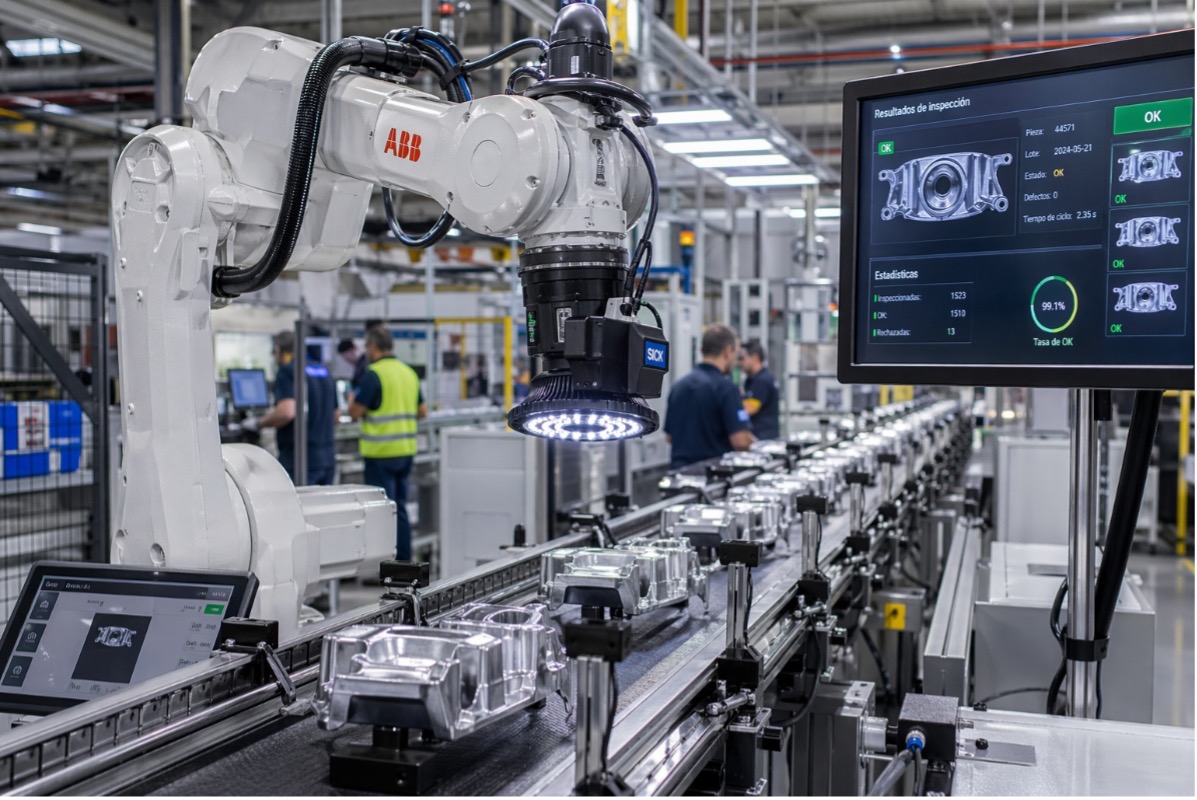
It is possible to automate quality control using machine vision and industrial robots without stopping or slowing down production—as long as the solution is designed around the real manufacturing process, not the other way around.
When inspection is properly integrated, the robot positions the part, the camera captures critical information, and the software determines within seconds whether the product is compliant or not.
The result is not just faster inspection, but also earlier defect detection, improved traceability, and higher repeatability.
Why Manual Quality Control Often Becomes a Bottleneck
In many plants, the main limitation of quality control is not a lack of technical expertise, but manual process variability.
Operators may inspect parts correctly, but:
- fatigue increases over time
- shifts change
- defect interpretation varies
- inspecting 100% of parts is not feasible
Machine vision applies consistent inspection criteria, while robots ensure that each part is:
- positioned the same way
- inspected at the same angle
- checked following the same sequence
This combination is especially effective when inspecting:
- presence or absence of components
- position and orientation
- labels and codes
- surface finish
- visible deviations
It also enables companies to move from sampling inspection to more frequent or in‑line inspection without increasing labor.
What a Robotic Inspection Cell Actually Does
A robotic inspection cell does not replace a company’s quality standards—it translates them into a repeatable sequence.
The process typically follows these steps:
- Define what must be checked
- The robot positions the part or sensor
- The camera or sensor captures images or 3D data
- Software compares results against defined tolerances or rules
In practice, this allows detection of:
- assembly defects
- reference errors
- missing screws or components
- incorrect label placement
- color differences
- surface damage
- geometric deviations
Using 2D, 3D, or specialized optical sensors, the inspection detail can be adapted to the product’s risk level.
According to the International Federation of Robotics, part handling is one of the most widespread industrial robot applications. This is critical, because many inspections depend on consistent handling and positioning before measurement.
When It Makes Sense to Automate Inspection
Not every inspection task should be automated immediately. Automation becomes relevant when one or more of the following conditions apply:
- repetitive inspection tasks
- identifiable and measurable defects
- pressure to increase throughput
- difficulty maintaining consistent criteria across shifts
- high cost of errors (scrap, rework, returns, claims, customer risk)
Another strong driver is lack of traceability.
If a plant knows a part failed but cannot identify when, where, or under which conditions, a robotic inspection cell can generate valuable process data.
In industries such as automotive, electronics, and industrial equipment, traceability is critical—not only to detect defects, but to document results and react quickly.
Types of Machine Vision Used in Industry
Industrial machine vision is not a single technology.
- 2D vision systems
- presence / absence checks
- position verification
- code reading
- 3D vision systems
- volume and geometry analysis
- deformation detection
- complex shape inspection
Camera‑guided vision systems, as described by vendors such as Cognex and Basler, do more than “see”: they convert images into actionable data that guides robots or validates quality conditions.
Sensor selection depends on:
- defect type
- cycle time
- lighting conditions
- surface finish
- available space
Reflective, dark, or shiny parts often require careful optical and lighting design.
How to Prevent Inspection from Slowing Down Production
The most common mistake is not technical—it is trying to inspect too much, too early.
Best practices include:
- defining critical characteristics first
- prioritizing defects with the highest cost or risk
- separating in‑line inspection from release inspection
- balancing cycle time with inspection depth
When robot, sensor, decision logic, and layout are well designed, inspection becomes a process safeguard rather than a bottleneck.
The goal is not inspection for its own sake, but stable production with less variation and fewer surprises.
What Managers Should Evaluate Before Investing
Before approving an automated inspection project, managers should validate the following points:
- Which defects must be detected and acceptance criteria
- Maximum allowable cycle time
- Integration with quality and traceability systems
- Real part variability
- Responsibility for maintaining cameras, lighting, recipes, and patterns
A proof of concept is especially important. The system must prove it can detect what truly matters under real conditions: dust, vibration, reflections, tolerances, and production speed.
Many companies succeed by starting with a pilot cell with clear scope and simple KPIs:
- detection rate
- false rejects
- cycle time
- scrap avoided
- shift‑to‑shift stability
FAQ
Does machine vision replace quality inspectors?
No. It automates repetitive checks and allows quality teams to focus on validation, root‑cause analysis, and process improvement.
Is it possible to inspect 100% of parts?
It depends on cycle time, defect type, and sensor technology. In many lines, full inspection is feasible if critical characteristics are well defined.
Can a robotic cell handle product variation?
Yes, if the system is designed with flexible tooling, vision‑guided recipes, and variability analysis from the start.
What does the company gain beyond defect detection?
Traceability, process data, repeatability, and a stronger foundation to reduce scrap and rework.
Checklist: Is Your Process Ready for Automated Inspection?
- ✅ Defects are clearly defined and measurable
- ✅ Parts can be positioned consistently (robot or fixture)
- ✅ Cycle time requirements are known
- ✅ Lighting and surface finish are understood
- ✅ Traceability requirements are defined
- ✅ A pilot or proof of concept is planned
At URT, we help companies across multiple industries implement industrial robotics solutions focused on real results: higher productivity, improved quality, fewer errors, and safer operations.
We work on applications such as:
- palletizing
- assembly
- part handling
- welding
- measurement and inspection
- machining and robotic milling
Our approach combines technical expertise, process knowledge, and a practical view of automation.
It is not just about adding robots—it is about selecting the right solution to improve performance, optimize investment, and integrate efficiently into real production environments.
👉 If your company is evaluating quality automation, improving a manual inspection process, or moving toward a more competitive factory, URT can help identify the right solution for your goals.