
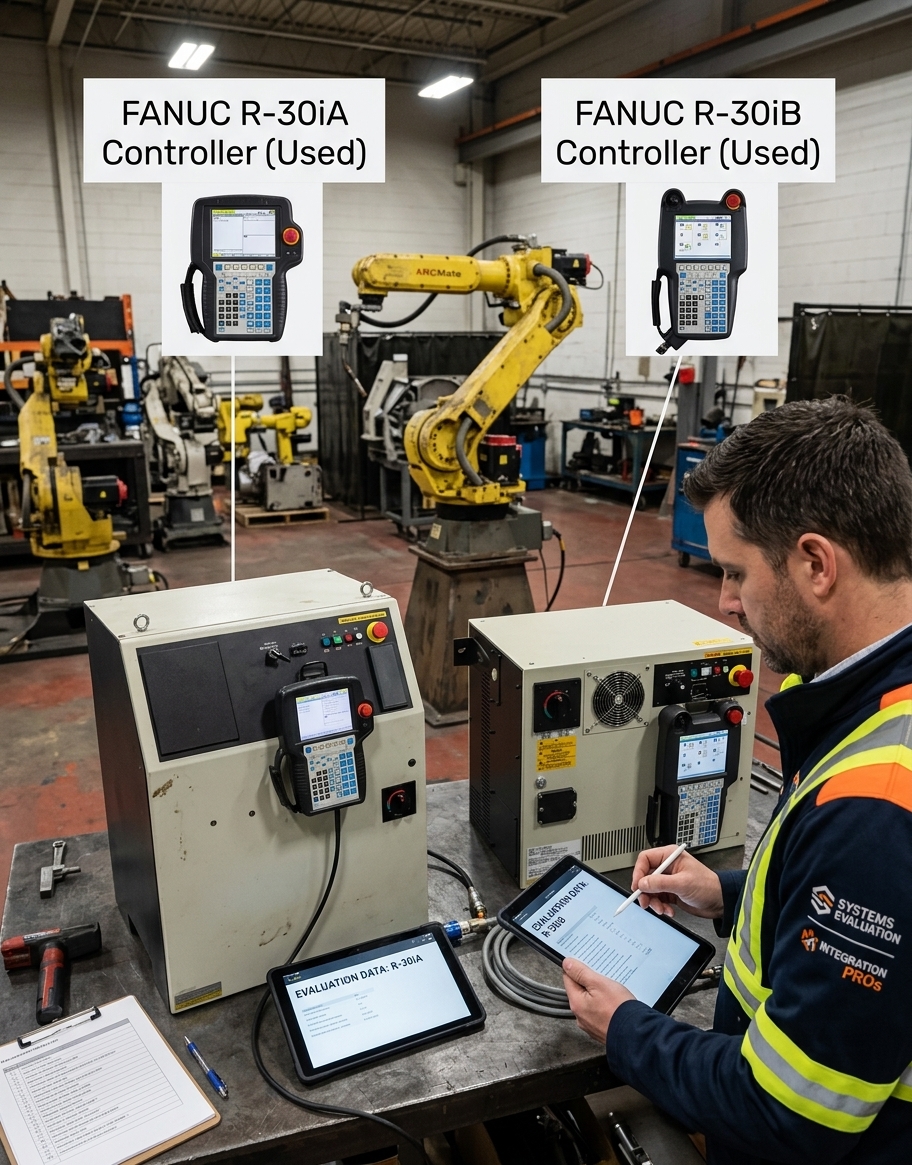
A FANUC controller comparison between R-30iA and R-30iB should not start with the assumption that the later generation is automatically the better used-robot purchase. The controller affects robot compatibility, installed software, communications, safety architecture, maintenance knowledge, spare parts, backups, and integration work. A mechanically sound robot can still become an expensive project when its controller does not fit the production environment.
Conversely, buyers should not automatically reject an older controller simply because a later generation exists. When the system matches the application, the plant can support it, and the technical team evaluates it properly before installation, age alone does not determine whether the investment makes sense.
The practical decision is therefore not simply R-30iA versus R-30iB. Buyers need to identify which complete robot-controller configuration creates an acceptable level of integration, maintenance, and production risk.
Start the FANUC Controller Comparison With the Complete Configuration
Used robot buyers should resist treating R-30iA and R-30iB as two fixed specifications. Controller generation is only the starting point. Cabinet configuration, robot model, installed software, application options, communication hardware, safety functions, teach pendant configuration, and peripheral equipment can all affect what a particular system can do.
This distinction matters especially on the used market. Two FANUC robots advertised with the same controller generation may not contain the same software or hardware options. Buyers should never assume that a controller previously configured for one production environment contains everything another application requires.
FANUC’s official information provides the appropriate reference point for controller and robot documentation. Buyers evaluating a particular used system should verify its actual configuration against official FANUC information rather than treating the controller designation as confirmation of every required feature.
Verify the robot-controller pairing first
The first question is not which controller is newer. The buyer needs to establish whether the offered controller correctly matches the exact robot model and configuration under consideration.
Used equipment can pass through several owners, integrators, storage locations, and refurbishment processes. Buyers therefore need to evaluate the robot arm and cabinet as a matched system. Model identification, controller identification, software configuration, connection hardware, and available documentation should agree before the buyer treats the equipment as production-ready.
This is also why purchasing an attractive robot arm first and solving the controller problem later can create unnecessary risk. Buyers should evaluate the total system before committing to the purchase.
Integration Is a Critical Part of a FANUC Controller Comparison
Controller generations matter because the robot must communicate with equipment outside the FANUC cabinet. A production robot may exchange signals and data with a PLC, safety equipment, machine tool, welding source, vision system, conveyors, sensors, positioners, or other automation equipment.
The buyer therefore needs to determine whether the specific used controller has the hardware, software, and communication configuration required by the intended cell. Never assume that an individual used unit includes a feature simply because FANUC offered that capability within a controller family.
Existing plant standardization changes the decision
A plant already operating several R-30iA systems may have technicians familiar with that environment, established backup procedures, existing spare parts, known integration methods, and internal troubleshooting experience. An R-30iB-based system may still make sense, but the plant should evaluate the later generation alongside those existing capabilities.
The reverse can also apply. A facility standardized around later FANUC equipment may find that introducing an older controller adds another platform for maintenance personnel to support. That can affect training, spare-parts planning, troubleshooting, software management, and recovery after downtime.
Controller standardization is therefore an operational variable rather than a preference. Buyers comparing different manufacturers as well as controller generations can apply the same principle described in URT’s FANUC vs Yaskawa Motoman comparison: the platform needs to fit the plant’s application and support environment.
Check peripheral compatibility individually
A used robot rarely enters production alone. The controller may need to interface with existing I/O, networks, tooling, process equipment, and safety systems. These interfaces can create the difference between an apparently inexpensive robot and a system that remains economical through commissioning.
Before purchase, the integrator should identify every important interface and determine what the offered controller actually contains. This review exposes missing hardware, software, licensing, or engineering work while the project team can still estimate those costs accurately.
Software Options Can Change the FANUC Controller Comparison
Used robot listings naturally emphasize the physical equipment: robot arm, cabinet, and teach pendant. For production use, the software configuration can matter just as much.
The project team should check application-specific functions, communication capabilities, safety functionality, vision-related requirements, and other options against the intended process. An R-30iA or R-30iB cabinet alone does not confirm that the system contains every function the new cell requires.
This creates a procurement risk. A lower purchase price can lose its advantage if the project subsequently requires additional engineering, software changes, replacement hardware, or a different controller configuration.
Include backups in the purchase discussion
The availability and condition of system backups also deserve attention. Buyers should establish which configuration records and backups come with the robot and confirm that they correspond to the equipment under evaluation.
Clear configuration information can simplify commissioning and future recovery. When a used robot arrives without reliable configuration records, the integrator may need additional engineering time to establish exactly what the system contains and how the previous application used it.
Software and compatibility form part of the broader evaluation described in URT’s guide to refurbished robot compatibility with existing systems. The project team should resolve controller compatibility before finalizing cell design rather than discovering conflicts during commissioning.
R-30iB Being Later Does Not Automatically Make It the Better Purchase
Buyers may reasonably prefer later-generation equipment when other conditions are equal. Used industrial robots, however, rarely offer equal mechanical condition, configuration, price, application history, documentation, or integration requirements.
An R-30iB controller paired with a poorly suited robot or missing required options can create more project risk than a correctly configured R-30iA system that already matches the application. Likewise, a low-priced R-30iA system can become poor value when its controller environment demands excessive integration or support work.
The useful comparison is therefore not simply old versus new. Buyers need to compare the total cost and risk of placing each system into reliable production.
Mechanical condition still matters
A controller comparison should not distract buyers from the robot arm itself. The technical review should cover mechanical condition, application history where known, maintenance condition, cabling, connectors, and other components that can affect reliability.
A later controller cannot compensate for a robot with mechanical problems. Similarly, an excellent robot arm does not eliminate controller compatibility problems.
Buyers deciding how much weight to give equipment age can also review URT’s comparison of new versus refurbished robots. The relevant comparison is total project suitability rather than age or purchase price alone.
Supportability Belongs in the FANUC Controller Comparison
The controller becomes particularly important after commissioning when production stops unexpectedly. A plant needs a realistic way to diagnose the system, obtain support, restore backups, source necessary components, and return the cell to production.
For an older system, buyers should investigate parts and support instead of assuming either that components will be unavailable or that they will always be easy to obtain. Availability can depend on the exact component, controller configuration, region, and support channel.
Internal capability also matters. If the maintenance team understands one FANUC controller generation well but has little experience with another, that knowledge gap creates an operational cost even when the equipment quotation does not show it.
Put downtime risk into total cost of ownership
A used robot that costs less at purchase but requires difficult-to-source components, unfamiliar troubleshooting, or extensive external support may not remain the lower-cost option over its production life. Buyers need to account for the consequences of downtime as well as the initial equipment cost.
The purchase decision should therefore include the robot, controller, integration effort, required options, commissioning, training, spares, and support strategy. URT’s discussion of total cost of ownership for used robots provides a broader framework for making that comparison.
Specification Verification Before Cell Design
A numerical comparison table can create false confidence when the buyer has not identified the exact R-30iA and R-30iB configurations under consideration. The project team should verify controller specifications against the actual equipment instead of inferring them from the generation name.
Before finalizing tooling, electrical design, network architecture, or safety integration, verify the controller identification, cabinet configuration, exact robot model, installed software and options, teach pendant, communication requirements, power requirements, and required peripheral interfaces. Use official FANUC documentation whenever the project requires controller-specific technical information.
Buyers should also distinguish R-30iB from later R-30iB Plus configurations. Do not automatically attribute functions associated with R-30iB Plus documentation to every standard R-30iB controller encountered on the used market. Confirm the exact controller designation and configuration before making design decisions.
What to Verify Before Buying an R-30iA or R-30iB System
Use the following checklist before requesting a final integration quotation. Its purpose is to identify unknowns that could turn into commissioning cost or downtime after the robot arrives.
- Exact robot model: Confirm the complete model designation rather than relying on a robot family name.
- Controller identification: Confirm the controller generation and specific cabinet or configuration supplied with the robot.
- Robot-controller pairing: Confirm that the arm and controller form a compatible system.
- Software configuration: Identify the functions and options actually installed instead of assuming them from the controller generation.
- Communication requirements: Compare the controller configuration with the PLC, process equipment, and networks required in the new cell.
- Safety architecture: Determine how the controller will fit the planned cell safety system and identify the engineering work that connection requires.
- Peripheral equipment: Check compatibility with tooling, vision, welding equipment, positioners, sensors, or other devices relevant to the application.
- Backups and documentation: Establish which system backups, configuration information, and documentation come with the equipment.
- Mechanical condition: Evaluate the robot arm and associated cabling rather than judging the package only by controller generation.
- Parts and support: Investigate the support path for the specific equipment under consideration.
- Internal capability: Determine whether maintenance and engineering personnel can support the controller or need additional training.
- Total project cost: Include integration, commissioning, missing options, training, spares, and expected support requirements in addition to purchase price.
For a broader procurement review, URT’s guide to what to consider when buying refurbished robots covers the equipment-level checks that should accompany the controller evaluation.
FAQ
What should a FANUC controller comparison include?
A useful comparison should cover more than controller generation. Buyers should examine the exact robot-controller pairing, installed software and options, communication requirements, peripheral compatibility, backups, maintenance capability, support strategy, and total integration cost.
Is the FANUC R-30iB newer than the R-30iA?
Yes. R-30iB belongs to a later FANUC controller generation than R-30iA. For a used robot buyer, however, generation alone does not determine suitability. The buyer still needs to verify the exact robot-controller combination, installed options, integration requirements, and support situation.
Should I automatically choose an R-30iB robot over an R-30iA robot?
No. A later controller generation can offer advantages, but the purchasing decision should consider the complete system. Mechanical condition, software configuration, application fit, peripheral compatibility, maintenance capability, and total integration cost can matter more than controller age alone.
Can an R-30iA still make sense for a production cell?
Yes, when the specific robot and controller configuration meet the application requirements and the plant has an acceptable support and maintenance strategy. Buyers should verify compatibility and lifecycle risks rather than assuming that an older controller is automatically unsuitable or economical.
Do all used R-30iB controllers have the same options?
Buyers should not assume that they do. Used systems can differ in software, hardware, communication, and application configuration. Check the installed configuration of the individual controller before specifying the system for a new application.
Is R-30iB the same as R-30iB Plus?
No. Buyers should treat R-30iB and R-30iB Plus as distinct controller designations. When evaluating used equipment, confirm the exact controller rather than transferring features from R-30iB Plus documentation to a standard R-30iB system.
What is a major risk when buying a used FANUC controller?
A significant risk is purchasing a system based on robot condition and price before verifying controller compatibility with the intended cell. Missing options, unsuitable communications, support requirements, or undocumented configurations can add integration work that the original equipment price did not include.
What information should I request from a used robot supplier?
Request enough information to identify the exact robot and controller configuration and understand what comes with the system. Review the controller identification, robot model, installed configuration, available backups and documentation, equipment condition, peripherals, and the information your integrator needs to confirm compatibility.
Talk to URT About FANUC Controller Comparison
If you are evaluating a FANUC controller comparison for a used robot purchase, contact URT. We will give you a direct, technical answer based on your actual production requirements.