
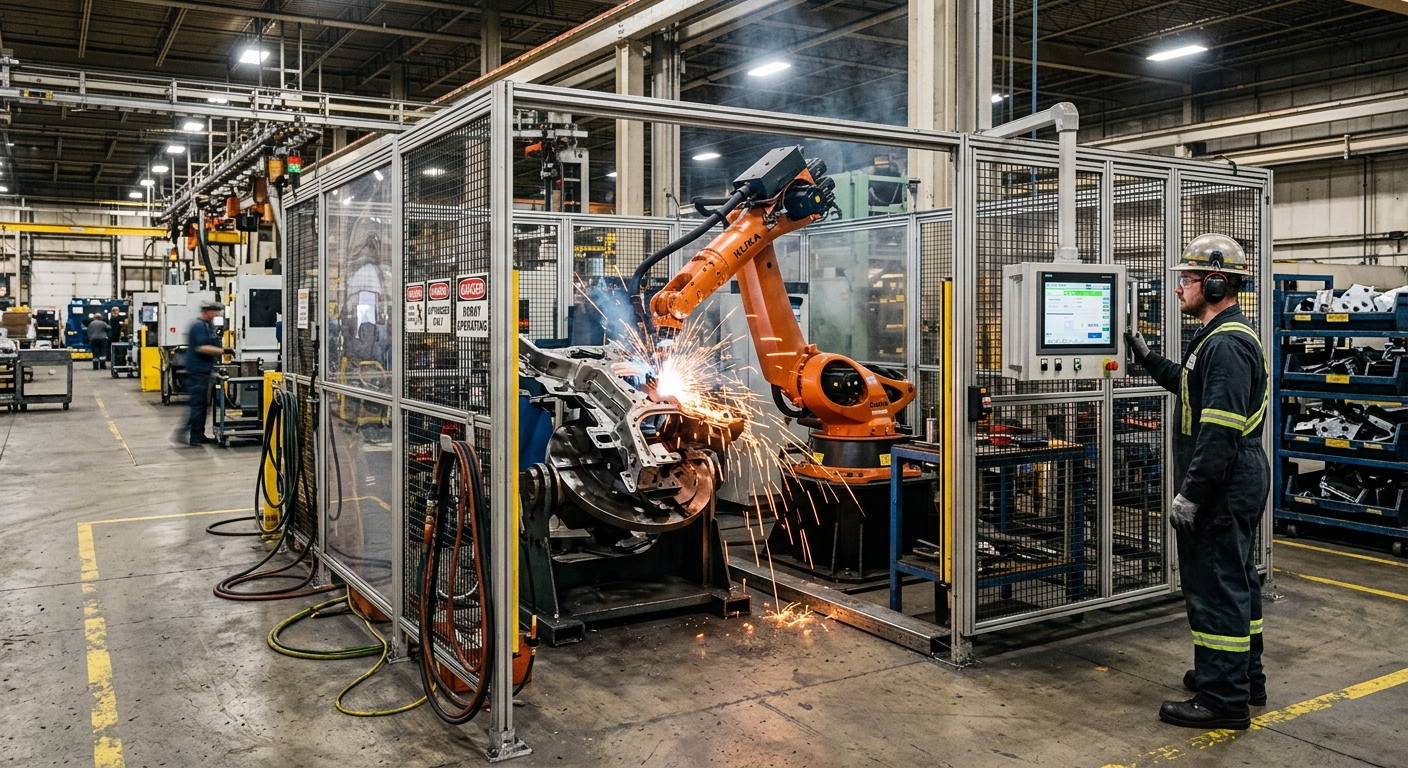
The production day starts before the robot moves.
A normal day of robotic cell operation involves much more than a robot repeating programmed movements. Startup conditions, material flow, operator decisions, changeovers, minor stops, maintenance, and recovery all affect how much useful production the cell delivers.
A robot can remain powered for most of a shift without producing acceptable parts for most of that time. The cell may wait for material, fixtures, connected machines, or operator input. Small interruptions can accumulate and turn available production time into lost capacity.
For plant managers and engineers, the useful question is not how long the robot runs. The useful question is how much of the production day becomes stable, repeatable output and what prevents the cell from producing during the rest of the shift.
Startup Sets the Conditions for the Rest of the Shift
The first production risks appear before the robot enters automatic operation. The robot may be ready, but the cell also depends on tooling, fixtures, sensors, material, safety devices, connected machines, and the correct production program.
The production team needs a consistent way to prepare the cell for operation. Exact startup procedures depend on the robot, controller, application, and cell design, so operators should follow the documentation and training created for that installation.
From an operations perspective, consistency matters more than speed alone. If one shift starts without delay while another spends time correcting fixture positions, finding material, selecting recipes, or clearing communication faults, the plant has a startup variation problem.
That variation can become expensive because it repeats every day. A few minutes of uncertainty at each shift change can reduce available production time even when the robot itself has no fault.
Operator Readiness Matters at Startup
Operators need to recognize the normal state of the cell before starting production. They should also understand which conditions they can handle through approved operating procedures and which conditions require maintenance or automation support.
This distinction helps prevent repeated resets from becoming the normal response to unexplained faults. It also gives the plant clearer information about the types of problems that interrupt startup.
Steady Production Depends on the Whole Cell
Once the cell reaches steady production, the robot becomes the most visible part of the process. It is not necessarily the part that controls output.
Parts must arrive in the correct position. Fixtures must locate them consistently. Grippers or process tooling must perform correctly. Connected machines must complete their own cycles, and finished parts must leave the work area without blocking the next cycle.
A fast robot cannot increase production if it spends time waiting for an upstream machine. A repeatable robot cannot correct inconsistent part presentation unless the cell includes a controlled method for handling that variation.
This is why production teams should evaluate the complete cell cycle rather than robot motion alone. URT’s article on whether automation improves quality or repeats the same mistake faster explains why process stability must support the automation.
Waiting Time Can Matter More Than Robot Speed
Consider a handling cell where the robot finishes its sequence and waits for the next part. Reducing robot motion time may make the program faster, but it will not increase line output if the next part still arrives at the same time.
The same issue appears when a robot waits for a machine cycle, fixture confirmation, pallet exchange, operator action, or downstream clearance. In these situations, the constraint sits outside the robot motion itself.
Plants therefore need to separate productive time from waiting time. Useful production data can distinguish normal operation from blocked, starved, faulted, changeover, and planned-stop conditions. The exact categories will vary by process, but the objective remains the same: identify where the production day actually goes.
Small Interruptions Reveal Whether the Cell Is Production-Ready
No production day runs under perfect conditions. Parts can arrive incorrectly. Sensors can detect unexpected conditions. Tooling can require attention. An upstream machine can stop, or downstream equipment can become unavailable.
These interruptions reveal how well the cell handles real production. A well-planned system helps operators understand what stopped, where the problem started, and what action their training allows them to take.
A poorly planned cell can turn a minor interruption into extended downtime. Operators may struggle to determine whether the cause comes from the robot, tooling, process, safety system, or another machine.
Integration planning should therefore include recovery from normal production faults. The team should consider alarms, operator information, access, training, spare parts, documentation, and escalation routes before the cell enters regular production.
Repeated Stops Need a Cause, Not Just a Reset
A reset can restore production after some expected conditions, but repeated resets should not replace fault analysis. If the same interruption occurs across several shifts, the plant needs to identify the underlying cause.
The problem may come from unstable material, sensor alignment, tooling wear, a program condition, a connected machine, or another part of the production process. Tracking the cause allows the team to address the source instead of repeatedly treating the symptom.
URT’s guide to robotic automation KPIs after implementation provides a broader framework for measuring whether a robotic system delivers the expected production result.
Changeovers Test Whether the Cell Is Truly Flexible
Many manufacturers choose robotic automation because they expect the cell to handle several products or production recipes. That flexibility only creates value when the complete cell can change from one valid production condition to another without excessive adjustment.
A new product may require more than a different robot program. Operators may need to change tooling, fixtures, process parameters, material presentation, inspection settings, pallet patterns, or connected-machine recipes.
The controller may store many programs, but that does not automatically make the production system flexible. The cell must also manage the physical and process changes that come with each product.
Plants that run smaller batches or many product variants should pay particular attention to changeover performance. Frequent format changes can consume a large part of the production day even when every individual robot cycle runs correctly.
Changeover Variation Is an Operational Warning
If the same changeover takes ten different forms depending on the operator or shift, the process needs attention. Unclear instructions, manual adjustments, inconsistent tooling setup, or uncertain acceptance conditions can all create variation.
This lost time affects capacity. It can also weaken the business case for automation if the original project assumed that the robot would support frequent product changes with limited interruption.
Production teams should therefore measure changeover time separately from equipment faults. Treating both as generic downtime makes it harder to identify the right improvement.
Recovery Separates a Good Demonstration From a Good Production Cell
A cell can perform perfectly during an acceptance demonstration and still struggle during everyday production. The difference often appears after an interruption.
When production stops midway through a sequence, the robot, workpiece, fixture, tooling, and connected equipment may no longer occupy the positions that the normal program expects. The recovery strategy needs to account for the state of the entire system.
Good recovery design gives trained personnel a controlled way to understand the cell state and restore production. Poor recovery design forces operators to rely on trial and error, repeated program restarts, or unnecessary technical intervention.
Safety takes priority during every recovery action. Personnel should follow the cell’s validated procedures, manufacturer instructions, and plant safety requirements. OSHA’s hazardous energy control guidance provides useful safety context for servicing and maintenance work where unexpected energization or stored energy could create risk.
When Specialist Support Is Necessary
Operators should not diagnose every abnormal condition themselves. Some problems require automation engineers, maintenance specialists, the system integrator or manufacturer support.
Plants should define these escalation paths before a serious stop occurs. Clear ownership reduces the time spent deciding who should investigate a controller fault, communication problem, safety-system issue, or recurring process interruption.
If the cell depends on one person who understands every recovery condition, the plant also carries a staffing risk. Training and documentation should spread essential operating knowledge across the appropriate production and maintenance teams.
Maintenance Protects Production Time
Maintenance can look like lost production when the plant focuses only on the minutes that equipment stops. A better view considers what happens when the plant delays inspections, ignores developing problems, or lacks the parts and skills needed for recovery.
The robot arm represents only one maintenance area. Tooling, cables, hoses, fixtures, sensors, safety equipment, and application-specific equipment can all affect cell availability.
Each component requires the maintenance approach specified by its manufacturer and the cell documentation. Plants should not copy service intervals or procedures from unrelated equipment simply because the cells perform similar tasks.
The goal is not to maximize maintenance activity. The goal is to control predictable production risk and catch problems before they create longer interruptions.
Spare Parts Influence Recovery Time
A relatively simple component can stop a complete cell if the plant cannot replace it quickly. Spare-parts planning therefore needs to consider more than component price.
The team should evaluate how critical each component is, how quickly the plant can obtain it, whether technical support remains available, and how much production the cell could lose while waiting.
Controller age and peripheral equipment also matter. An older robot may continue to perform its task well, but the plant still needs to understand the support situation around the controller, software, communication hardware, and other cell components.
Used and Refurbished Robots Add Another Daily Operating Question
A used or refurbished robot can make commercial sense when its condition and integration requirements match the application. Its daily production value still depends on more than the purchase price.
Before putting a used robot into service, the buyer needs to consider mechanical condition, controller version, software, spare parts, support, and compatibility with the existing cell. These factors influence how easily the plant can maintain and recover the system after a problem.
An older controller may work correctly in the application but require more planning around communication, parts, and internal maintenance capability. A lower equipment price does not remove those operating requirements.
URT’s guide to refurbished robot compatibility with existing systems explains why buyers should evaluate the robot as part of the full production environment rather than as a standalone machine.
In some cases, a newer platform may offer the lower-risk choice if the plant depends heavily on current support, software compatibility, or equipment standards. Used and refurbished equipment works best when the buyer evaluates those conditions before the robot reaches production.
The End of the Shift Should Measure Output, Not Motion
At the end of a shift, robot running time gives only part of the performance picture. Operations teams need to know how much acceptable production the cell completed and what consumed the remaining available time.
The cell may have lost time because of upstream starvation, downstream blockage, changeovers, tooling issues, planned maintenance, quality problems, operator intervention, or equipment faults. Grouping all of these losses under “robot downtime” hides the real causes.
Quality matters as much as operating time. A robot can continue cycling while the process produces unacceptable parts. High utilization has little value if the cell creates scrap or rework.
For this reason, a plant should define success before commissioning. The team needs a baseline and clear indicators that connect cell performance to the original production problem.
Measure the Constraint You Actually Want to Improve
A cell installed to reduce machine idle time needs different success measures from a cell installed to improve consistency or reduce manual handling. The plant should choose indicators that match the reason for the investment.
Useful measures can include acceptable output, downtime by cause, cycle consistency, changeover time, quality losses and equipment availability. No single number describes every robotic cell.
When the plant understands where time goes, managers can direct improvement work toward the real constraint instead of asking the robot to move faster by default.
What a Full Production Day Can Reveal
A full shift exposes problems that robot specifications cannot show. Payload, reach, controller capability, and robot condition matter, but they operate inside a production system that also includes people, tooling, processes, and connected equipment.
Use the following questions to review the cell as a production system rather than as an isolated robot.
- Does each shift start the cell in a consistent way?
- Does the robot regularly wait for material or upstream equipment?
- Does downstream equipment block production?
- Do fixtures and part presentation remain consistent?
- Can trained operators identify common production faults clearly?
- Does the team record and investigate repeated stops?
- Do product changeovers follow a predictable process?
- Does the plant know when to escalate a problem to specialist support?
- Does the maintenance team understand critical spare-parts needs?
- Do production KPIs measure acceptable output rather than robot motion alone?
If several answers reveal uncertainty, increasing robot speed may not solve the problem. The real constraint may sit in the process, tooling, material flow, connected equipment, recovery strategy, or maintenance organization.
A productive robotic cell does not simply repeat a motion all day. It maintains controlled conditions around that motion and gives the production team a clear way to respond when those conditions change.
FAQ
Does a robotic cell normally run continuously throughout a shift?
Not necessarily. Material flow, machine cycles, product changes, planned maintenance, process interruptions and other events all affect production time. Plants should measure useful output rather than assume that powered-on time equals productive time.
What usually causes a robotic cell to lose production time?
Many causes sit outside the robot itself. Material shortages, downstream blockages, tooling, fixtures, sensors, connected machines, changeovers, maintenance, and process instability can all reduce cell output.
Why can a fast robot still produce a slow cell?
The complete production sequence determines cell throughput. If a machine cycle, fixture, material supply, operator action or downstream process creates the constraint, faster robot movement may have little effect on total output.
Should operators reset the cell whenever it stops?
No. Operators should follow the approved recovery procedures for the specific cell and work within their training. Repeated or unexplained faults require investigation rather than continual resetting.
How should a plant measure daily robotic cell performance?
The right measures depend on why the plant installed the cell. Useful indicators can include acceptable production, availability, downtime by cause, cycle consistency, quality losses, and changeover performance.
When should a plant call for specialist support?
A plant should escalate problems when the fault falls outside operator training, repeats without a clear cause or involves controller, safety, communication, programming, or equipment conditions that require qualified technical diagnosis.
Can a used or refurbished robot perform well in daily production?
Yes, when the robot’s mechanical condition, controller, software, spare parts, support and integration requirements fit the application. Buyers should evaluate those conditions before comparing options on purchase price alone.
Talk to URT About Robotic Cell Operation
If you are evaluating robotic cell operation, contact URT. We will give you a direct, technical answer based on your actual production requirements.