
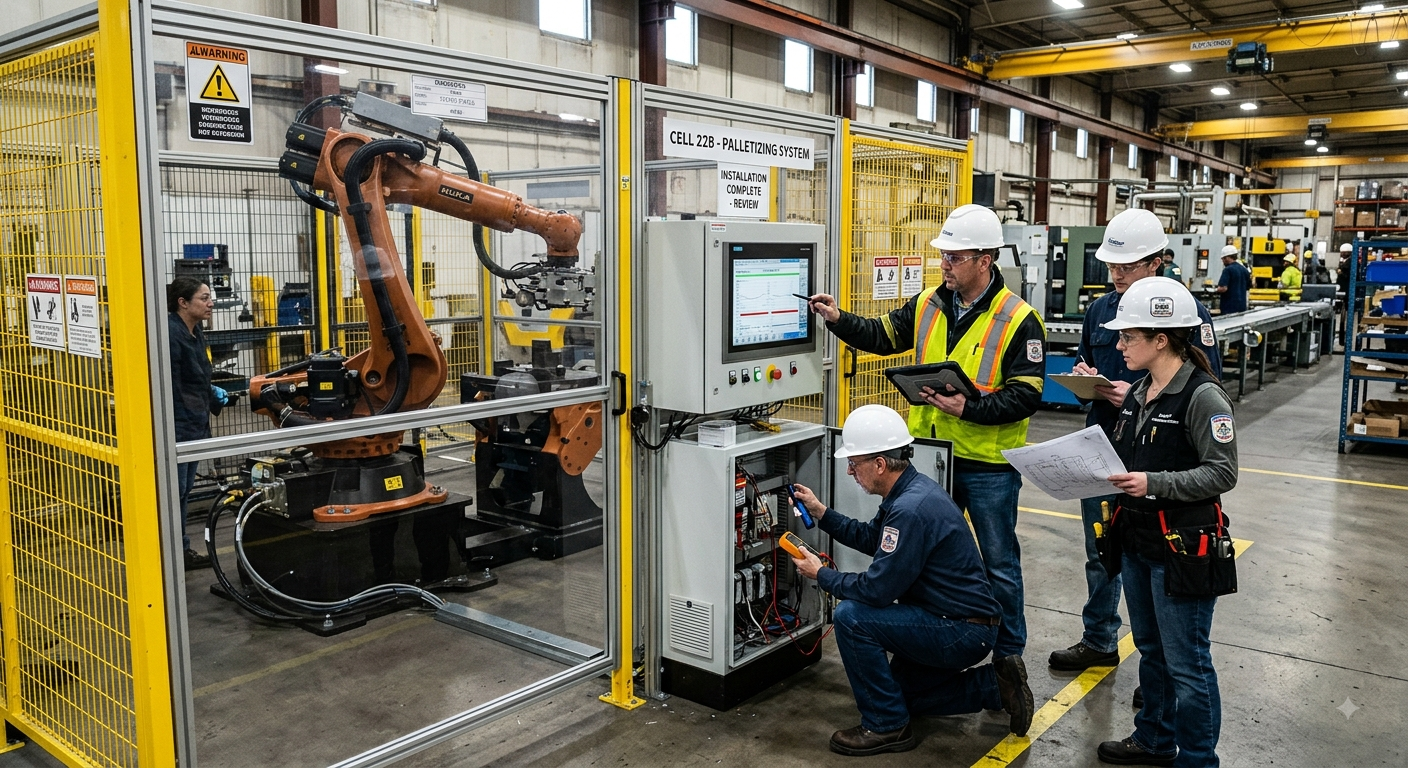
A robotic cell can pass installation and still struggle in production. The most important post-installation robot challenges often appear only after operators begin running normal shifts, product variation enters the cell, minor faults occur, and maintenance teams have to recover the system without the integrator standing beside them. Installation proves that the equipment can operate; sustained production tests whether the plant can operate and support it.
This distinction matters because the business case depends on what happens after commissioning. A cell that performs correctly during acceptance but loses time to difficult recovery, inconsistent inputs, insufficient training, or unavailable spare parts may deliver very different results from those expected during project approval.
The transition from an integration project to a production asset therefore needs its own plan. The technical question changes from “Does the cell work?” to “Can we keep it working under real production conditions?”
Commissioning Is Not the Same as Stable Production
Commissioning confirms that the robot, tooling, controls, safety functions, interfaces, and surrounding equipment can perform the intended sequence. It is an essential stage, but it does not reproduce every condition the cell will experience during months of production.
Normal manufacturing introduces variation. Parts arrive at tolerance limits. Operators change shifts. Tooling wears. Sensors become contaminated. Production schedules change. Upstream machines stop unexpectedly, and downstream equipment may not be ready when the robot completes its cycle.
These conditions expose weaknesses that may not be obvious during controlled acceptance tests. The robot itself may be functioning correctly while the cell still suffers repeated interruptions because part presentation, fixtures, peripheral equipment, or recovery procedures are not sufficiently stable.
This is why acceptance criteria should extend beyond demonstrating automatic operation. The plant needs to understand how the cell behaves during representative production, including normal variation and foreseeable interruptions.
The distinction is also important when evaluating integration responsibility. URT’s guide to important factors when integrating a new robot provides additional context on the variables that need to be considered as the robot becomes part of the wider production system.
Small Production Variations Become Automation Problems
One of the first post-installation surprises is discovering how much variation operators previously managed without documenting it. A person may automatically reposition a slightly misaligned component, compensate for a fixture that does not close consistently, or recognize when an incoming part needs additional attention.
A robot normally follows the programmed logic and responds to the information available through sensors and controls. If the process contains variation that was never included in the cell design, production interruptions can follow even though the robot repeats its programmed movement correctly.
Part presentation can become the hidden constraint
Parts must arrive in conditions that the tooling and sensing strategy can handle. Changes in position, orientation, geometry, surface condition, packaging, or upstream handling can affect whether the robot can grip or process them consistently.
When presentation is unstable, the answer is not automatically to modify the robot program. The plant should identify the source of the variation first. Better fixturing, improved upstream control, additional sensing, or a different presentation method may be more appropriate than continually adding exceptions to the program.
Fixtures and tooling need production-level repeatability
A fixture that is acceptable for manual production may create problems after automation. Human operators can make small corrections that a robotic sequence was never designed to make.
The same principle applies to end-of-arm tooling. Grippers, welding torches, vacuum systems, sensors, tool changers, and other cell components are part of the production system. Their condition can affect performance even when robot motion remains accurate.
Automation does not remove process variation. It makes uncontrolled variation easier to see because the robot consistently expects the conditions for which the cell was designed.
Fault Recovery Becomes a Daily Operational Issue
A cell should not be judged only by how it runs when nothing goes wrong. The practical test is also what happens after a stopped conveyor, failed sensor signal, incorrectly positioned part, interrupted cycle, tooling issue, or upstream machine fault.
If every minor interruption requires an automation engineer or external integrator, the cell may develop a support dependency that was not included in the original ROI calculation. A short production fault can become extended downtime when operators know how to run the automatic sequence but do not know how to identify the condition preventing restart.
Recovery logic therefore matters almost as much as normal automatic logic. The system should make fault conditions understandable to appropriately trained personnel, and the plant should have defined responsibilities for operator-level recovery, maintenance intervention, and specialist escalation.
This does not mean every operator should have unrestricted programming or maintenance access. Different roles require different competencies and authorization levels. The objective is to make common, permitted recovery actions clear while ensuring technical or safety-critical interventions are handled by qualified personnel.
Plants preparing their internal teams can review what training staff need to operate and maintain an industrial robot. Training should reflect the tasks people will actually perform after the integrator leaves, rather than treating all users as if they need the same level of access.
Maintenance Capability Starts Affecting Uptime Immediately
Robot maintenance is sometimes treated as a future issue because the equipment has just been installed. In practice, maintenance readiness matters from the first production shifts because the robotic cell contains much more than the manipulator.
Tooling, sensors, cables, connectors, pneumatic equipment, safety devices, fixtures, conveyors, process equipment, and control interfaces can all create stoppages. A fault attributed initially to “the robot” may originate elsewhere in the integrated system.
The maintenance team therefore needs enough system knowledge to separate robot faults from cell faults. Without that capability, troubleshooting can become slow and dependent on trial and error.
Documentation needs to be usable, not merely delivered
Backups, electrical information, system documentation, component identification, software information, and operating instructions should be organized so the responsible team can access them when needed. A documentation package has limited operational value if the people responding to downtime cannot find the correct information.
The plant should also know which components require external specialist support. Internal capability does not mean attempting every repair. It means knowing what the team can diagnose or recover safely, when escalation is required, and who should be contacted.
A broader approach to minimising downtime in robotic automation should therefore include both equipment condition and the plant’s ability to respond when production stops.
Spare Parts and External Support Become Part of the Production Risk
Availability becomes important only when a component fails, which makes spare-parts planning easy to postpone during an installation project. After the cell enters production, however, the time required to identify, source, configure, and replace a critical component can directly affect downtime.
The appropriate spare-parts strategy depends on the cell. A component should not be stocked simply because it belongs to the robot. The plant should consider how critical the component is, whether an alternative exists, how quickly it can be sourced, and what production consequence follows if it is unavailable.
The same logic applies to technical support. Before production depends heavily on the cell, the plant should know who supports the robot platform, controller, process equipment, tooling, PLC, safety system, and other critical elements. A complex cell can involve several technical disciplines, and the correct support contact may depend on where the fault originates.
This becomes particularly relevant with older or refurbished equipment. Controller generation, software, installed options, communication hardware, and spare-parts availability should have been considered before purchase, but they continue to affect the support strategy after installation.
For plants building that strategy, URT’s guidance on spare parts for robotic maintenance provides a useful framework for treating parts availability as an uptime issue rather than an isolated purchasing task.
The Original ROI Has to Survive Real Production
A project can meet its technical acceptance criteria without delivering the business result expected in the investment case. The difference often comes from assumptions that looked reasonable before installation but change once production begins.
Cycle time is one example. A robot may complete its programmed movement within the expected time while the full cell waits for material, machine signals, pallet changes, operator intervention, quality checks, or downstream equipment. Measuring only robot motion can therefore hide the actual production constraint.
Uptime creates the same problem. A fast automatic cycle does not create value while the cell is stopped. Frequent short interruptions can reduce productive capacity even when no single failure appears serious enough to attract management attention.
The plant should compare actual performance against the KPIs used to justify the project. Depending on the application, those may include productive uptime, cycle stability, scrap and rework, machine utilization, changeover performance, operator intervention, quality consistency, and downtime causes.
The purpose is not to prove that the original forecast was right. It is to identify where the cell is creating value and where production conditions are preventing it from doing so.
When the Problem Is Not the Robot
Repeated stoppages can create pressure to change the robot program, replace equipment, or increase technical support. That response can be expensive if the real constraint is an unstable process.
If parts arrive inconsistently, fixtures do not locate them repeatably, upstream equipment produces variation, or downstream flow repeatedly blocks the cycle, changes to robot motion may treat the symptom rather than the cause. The plant needs to separate robot performance from full-cell performance.
The same principle applies to quality. A robot can repeat a programmed action, but it cannot guarantee a good process when the inputs are uncontrolled. Welding quality, for example, also depends on part fit-up, fixture repeatability, process parameters, torch access, and other application conditions. Handling depends on part presentation and gripper performance. Machine tending depends on machine availability, part location, and interface logic.
There are also situations where further automation should be delayed. If the first cell still depends heavily on external support, process variation remains uncontrolled, or production teams have not established stable operating and maintenance routines, expanding the same automation concept may reproduce those weaknesses at a larger scale.
Stabilizing the existing installation can provide better information for the next investment than immediately adding more equipment.
What to Check During the Post-Installation Period
This checklist is best used as an operational review rather than a one-time sign-off. Production, maintenance, engineering, and the integrator should use it to identify where the cell still depends on assumptions or individual knowledge.
- Production stability: Confirm that real parts, normal product variation, and actual shift conditions remain within the assumptions used to design the cell.
- Fault patterns: Record recurring stops instead of treating each interruption as an isolated event.
- Recovery: Confirm that authorized personnel understand the permitted recovery procedure for common production faults.
- Training: Verify that operators, maintenance personnel, and engineering staff have training appropriate to their responsibilities.
- Documentation: Make sure system information, backups, component identification, and support contacts are accessible to the relevant teams.
- Maintenance ownership: Define which issues can be handled internally and which require specialist support.
- Spare-parts exposure: Identify components whose unavailability could create unacceptable production downtime.
- Cell performance: Measure the complete production cycle rather than robot movement alone.
- Process variation: Investigate whether recurring faults originate in the robot, tooling, fixture, incoming material, upstream equipment, or downstream flow.
- Business results: Compare actual production performance with the KPIs used to approve the project.
These checks also help separate temporary ramp-up problems from structural weaknesses. A new installation may require adjustment as real production conditions become visible, but recurring faults should generate corrective action rather than becoming accepted as part of normal operation.
When Specialist Support Is Needed
Internal training should reduce unnecessary dependency on external support, but it should not eliminate specialist involvement where the issue exceeds the plant’s competence or authorization. Controller problems, safety-system changes, complex programming issues, repeated unexplained faults, integration changes, and modifications to the production process may require qualified technical support.
Specialist involvement is particularly important when a proposed correction changes how equipment interacts. A modification that appears local to the robot may affect PLC logic, tooling, safety functions, machine interfaces, cycle sequencing, or recovery behavior.
The plant should avoid allowing temporary production workarounds to become permanent operating methods without technical review. If operators repeatedly need unusual interventions to keep the cell running, that is useful diagnostic information. It may indicate that the process, program, tooling, or interface needs a controlled engineering change.
The objective after installation is therefore not zero external support. It is controlled support: clear internal responsibilities, defined escalation routes, appropriate documentation, and access to the technical expertise required when the problem exceeds routine production recovery.
FAQ
Why can a robotic cell have problems after successful installation?
Installation and acceptance testing cannot reproduce every production condition. Real shifts introduce part variation, equipment interruptions, tooling wear, operator differences, upstream delays, and recovery situations that can expose weaknesses in the full cell.
Does frequent robot downtime mean the robot itself is unreliable?
Not necessarily. A robotic cell includes tooling, sensors, fixtures, controls, safety equipment, process equipment, and upstream and downstream interfaces. The source of recurring downtime should be identified before assuming the manipulator is responsible.
How much training does a plant need after robot installation?
Training should match responsibilities. Operators need the knowledge required for normal operation and permitted recovery, while maintenance and engineering personnel may require deeper diagnostic, programming, or system knowledge. The appropriate level depends on the cell and the plant’s support model.
Should spare parts be planned immediately after installation?
Critical parts and support requirements should be considered before production depends on the cell. The decision about what to stock should reflect component criticality, sourcing time, alternatives, and the production consequence of extended unavailability.
When should the integrator be called after installation?
Specialist support is appropriate when the issue exceeds internal competence or authorization, when faults repeatedly return without a clear cause, or when proposed changes affect programming, controls, safety functions, interfaces, or the wider cell architecture.
How do you know whether the automation project is delivering its expected ROI?
Compare actual production results with the KPIs defined for the project rather than judging success from whether the robot is running. Uptime, cycle stability, scrap, rework, machine utilization, operator intervention, changeover performance, and maintenance costs may all affect the business result depending on the application.
Should a company automate another process before the first cell is fully stable?
Not automatically. If recurring faults, uncontrolled process variation, training gaps, or support dependency remain unresolved, expanding automation can reproduce the same problems. Stabilizing the first installation can provide better technical and operational information for the next project.
Talk to URT About Post-Installation Robot Challenges
If you are evaluating post-installation robot challenges, contact URT. We will give you a direct, technical answer based on your actual production requirements.