Tag Archives: Special Offers used robots

What level of accuracy and repeatability can you expect from an industrial robot?

Spec sheets vs shop-floor reality On paper everything looks precise. In production you face tolerances, scrap risk, manual tweaks, and material variability. The honest question is: “Will the robot actually be more accurate than what we do today?” Accuracy vs repeatability Repeatability The robot’s ability to return to the same point over and over. Typical
Read More

How Dependent Does My Process Become on Software Instead of Hardware?

This question rarely appears when a robot first arrives on the production floor. It emerges months later. When everything works. When the cell is producing. When nobody questions the arm, the gearbox, or the repeatability anymore. The doubt appears in front of a screen: A pending update. A license about to expire. A file that

Read More

WHAT LEVEL OF INTERNAL TRAINING DOES A COMPANY NEED TO AVOID FULL DEPENDENCE ON THE SUPPLIER AFTER AUTOMATING WITH INDUSTRIAL ROBOTS?

In many companies, the decision to automate is not held back by the cost of the robot or by floor space, but by a less visible—yet decisive—concern: technical dependency. The question is not always stated openly, but it quickly emerges in any investment committee: What happens when the supplier leaves? Robotic automation introduces powerful technology,

Read More

INDUSTRIAL ROBOTS VS. TRADITIONAL PALLETIZING SYSTEMS

Palletizing is one of the most critical stages at the end of the production line. Although it is often perceived as a simple process, in practice it involves occupational risks, production bottlenecks, and hidden operational costs. For many years this process has been handled using traditional systems: manual palletizing, semi‑automatic solutions, or low‑flexibility dedicated machines.

Read More

REFURBISHED MOBILE ROBOTS: THE NEW ERA OF FLEXIBLE AUTOMATION

Modern industry demands flexible, reconfigurable, and fast automation. Factories can no longer rely solely on fixed production lines; they need solutions that adapt in hours, not months. This need has given rise to a powerful combination: refurbished mobile robots integrated with used industrial robotic arms. This approach delivers the agility required by Industry 4.0—without the

Read More

HOW FAR CAN I SCALE PRODUCTION WITHOUT REBUILDING THE ENTIRE CELL?

It’s a question that rarely appears at the beginning of a project. It usually comes after the first success: The cell works. Cycle times are stable. Quality is consistent. And for the first time, the team trusts the system. Then someone asks: “What if we double production?” It’s not an innocent question — it’s a

Read More

HOW DOES ROBOTIC AUTOMATION AFFECT INDUSTRIAL CYBERSECURITY WHEN ROBOTS ARE CONNECTED TO CORPORATE NETWORKS OR THE CLOUD?

For a long time, industrial robots operated in isolated environments, disconnected from the rest of a company’s systems. Today, that reality has changed. The need for remote monitoring, production data collection, predictive maintenance and traceability has led to connecting robots to corporate networks and even cloud platforms. As a result, a relatively new concern has

Read More

DOES AUTOMATION IMPROVE QUALITY… OR JUST MAKE THE SAME MISTAKE FASTER?

There’s an awkward moment in some automation projects when no one really wants to look too closely at the first batches. The parts come out quickly. The robot never stops. Productivity indicators look great. And yet… something feels off. The defect that used to appear sporadically now shows up with impeccable regularity. There’s no debate:

Read More

REFURBISHED ROBOTS VS. NEW ROBOTS: WHEN TO CHOOSE EACH ONE?

In today’s industrial market, both new and refurbished robots have a legitimate and distinct role within automation strategies. Neither option is universally better; instead, each suits particular technical, operational, and financial requirements. The right decision shouldn’t be based on personal preference, but should come from a careful, comparative analysis that takes into account measurable criteria

Read More

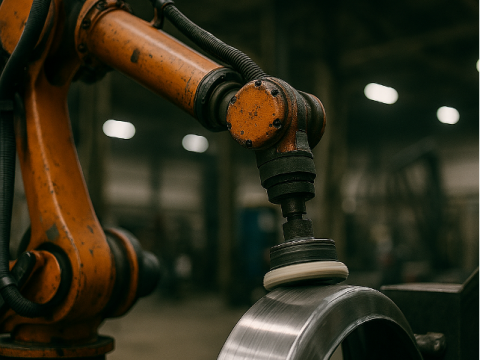
POLISHING, AND FINISHING PROCESSES: WHAT YOU NEED TO KNOW BEFORE INTEGRATION

In the industrial sector, sanding, polishing, and surface finishing might seem like straightforward tasks, but they actually involve a significant level of technical complexity. Each piece requires consistent pressure, precise motions, a uniform rhythm, and an attentive approach to detail—qualities that are difficult to maintain manually over many hours of work. This is where an

Read More