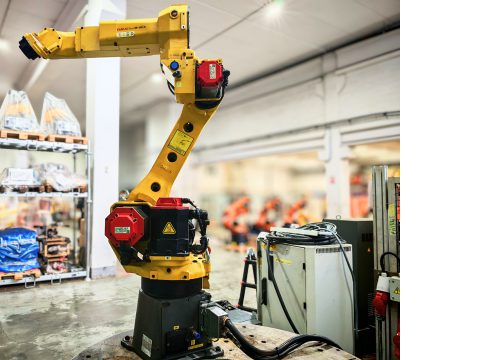
Tag Archives: Used fanuc robots

How Dependent Does My Process Become on Software Instead of Hardware?

This question rarely appears when a robot first arrives on the production floor. It emerges months later. When everything works. When the cell is producing. When nobody questions the arm, the gearbox, or the repeatability anymore. The doubt appears in front of a screen: A pending update. A license about to expire. A file that
Read More

WHAT LEVEL OF INTERNAL TRAINING DOES A COMPANY NEED TO AVOID FULL DEPENDENCE ON THE SUPPLIER AFTER AUTOMATING WITH INDUSTRIAL ROBOTS?

In many companies, the decision to automate is not held back by the cost of the robot or by floor space, but by a less visible—yet decisive—concern: technical dependency. The question is not always stated openly, but it quickly emerges in any investment committee: What happens when the supplier leaves? Robotic automation introduces powerful technology,

Read More

INDUSTRIAL ROBOTS VS. TRADITIONAL PALLETIZING SYSTEMS

Palletizing is one of the most critical stages at the end of the production line. Although it is often perceived as a simple process, in practice it involves occupational risks, production bottlenecks, and hidden operational costs. For many years this process has been handled using traditional systems: manual palletizing, semi‑automatic solutions, or low‑flexibility dedicated machines.

Read More

REFURBISHED MOBILE ROBOTS: THE NEW ERA OF FLEXIBLE AUTOMATION

Modern industry demands flexible, reconfigurable, and fast automation. Factories can no longer rely solely on fixed production lines; they need solutions that adapt in hours, not months. This need has given rise to a powerful combination: refurbished mobile robots integrated with used industrial robotic arms. This approach delivers the agility required by Industry 4.0—without the

Read More

REFURBISHED ROBOTS VS. NEW ROBOTS: WHEN TO CHOOSE EACH ONE?

In today’s industrial market, both new and refurbished robots have a legitimate and distinct role within automation strategies. Neither option is universally better; instead, each suits particular technical, operational, and financial requirements. The right decision shouldn’t be based on personal preference, but should come from a careful, comparative analysis that takes into account measurable criteria

Read More

THE 5 SIGNS THAT YOUR MIG/MAG WELDING IS READY FOR AUTOMATION

MIG/MAG welding is one of the most widely used manufacturing processes, but when performed manually it often leads to significant variation. Deciding to automate is not just about bringing new technology into the factory – it’s about determining whether your process is technically and operationally ready for a robot to deliver real, tangible improvements. There

Read More

PREDICTIVE MAINTENANCE IN INDUSTRIAL ROBOTS: SENSORS, DATA AND MINIMISING DOWNTIME

At the heart of many automated factories, a group of robots works tirelessly for hundreds of hours on end. But what happens if one of these machines fails unexpectedly? An unplanned stoppage can cost thousands of euros per hour, result in lost orders and delayed deliveries. This is where predictive maintenance steps in: instead of

Read More

ROBOROBOTS IN PRECISION AGRICULTURE: ACCESSIBLE TECHNOLOGY WITH REFURBISHED UNITSTS IN PRECISION AGRICULTURE: ACCESSIBLE TECHNOLOGY WITH REFURBISHED UNITS

Modern agriculture faces a challenge: producing more with fewer personnel and ever-increasing costs. Automation has become a necessity, not a luxury. However, many producers—especially medium and small ones—believe that bringing robotics to the field is beyond their reach. The reality is different: refurbished industrial robots are opening a new era for precision agriculture, offering advanced,

Read More

KUKA KR 510 R3080 (KRC4): Heavy-Duty Power for Demanding Industrial Lines

The KUKA KR 510 R3080, part of KUKA’s QUANTEC/FORTEC family, is one of the most powerful high-payload industrial robots available on the market. Designed to handle extremely large and heavy parts—with a nominal payload of around 510 kg and a reach exceeding 3 meters—it offers a combination of strength, reach, and repeatability that makes it

Read More

AUTOMATING RECYCLING: RECONDITIONED ROBOTICS AT THE SERVICE OF THE CIRCULAR ECONOMY

Industrial recycling is undergoing a quiet but profound transformation. Until recently, the separation and processing of materials largely relied on traditional manual or mechanical methods. Today, thanks to robotics, these tasks are becoming automated, increasing efficiency and reducing workplace risks. What is truly innovative, however, is that much of this automation is being achieved using

Read More