
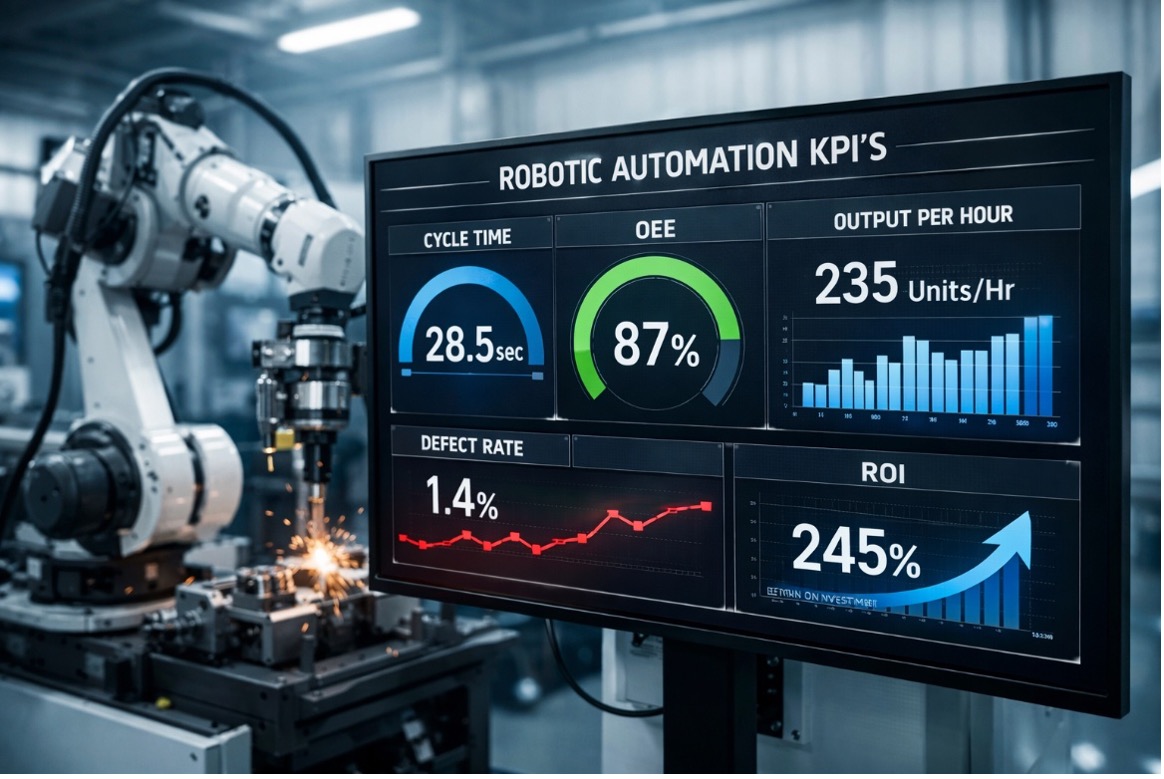
Implementing robotic automation in an industrial plant is not only about purchasing a robot or installing a cell. The real question is whether the system delivers measurable value after implementation.
To evaluate that value, companies need clear robotic automation KPIs. These key performance indicators show whether automation is improving productivity, quality, availability, safety, cost control, and process stability.
Without baseline metrics, automation performance becomes difficult to judge. A robotic cell may look technically successful, but the business impact remains unclear if the company cannot compare performance before and after implementation.
The most useful KPIs answer practical questions:
- Did automation reduce cycle time?
- Did product quality improve?
- Did machine availability increase?
- Did scrap or rework decrease?
- Did the system reduce operational costs?
- Is the robot being used effectively?
This article explains the main KPIs to measure in a robotic automation project and how to interpret them in a realistic industrial context.
What is a KPI in robotic automation?
A KPI, or key performance indicator, is a measurable value used to evaluate whether an automation system is meeting its intended objectives.
In robotic automation, KPIs help determine whether a robotics investment is performing as expected. They connect technical performance with business results, showing whether the system is improving productivity, quality, availability, safety, or cost efficiency.
The most important point is that KPIs should be defined before automation begins. If no baseline exists, the company cannot accurately measure improvement after implementation.
1. Productivity and efficiency KPIs
Cycle time
Cycle time measures how long a robot or automated cell takes to complete one operation. It is one of the most direct indicators of automation performance.
Shorter cycle times can improve productive output, but cycle time should not be evaluated in isolation. A faster process is not valuable if it increases defects, creates instability, or causes more downtime.
Cycle time should be compared against:
- The previous manual process
- The expected takt time
- The required production rhythm
- The stability of repeated cycles
Throughput
Throughput measures how many units, parts, or cycles are completed in a defined period. It is usually expressed as units per hour, units per shift, or units per day.
This KPI is useful when the goal of automation is higher output. However, in mature plants, throughput may not be the only priority. A robotic automation project can also be successful when output remains stable but quality, repeatability, and process control improve.
OEE
OEE, or Overall Equipment Effectiveness, measures how effectively equipment is being used. It combines three elements:
- Availability: how much time the system is available for production.
- Performance: how closely the system runs to its expected speed.
- Quality: how many produced parts meet the required standard.
A high OEE indicates that the robotic cell is not only running, but running reliably, at the expected speed, and with acceptable quality output.
2. Robot and system utilization KPIs
Robot utilization
Robot utilization measures how much time the industrial robot is actively working compared with the time it is available.
Low utilization does not always mean the robot is a poor investment. It may indicate that the robot is waiting for upstream or downstream processes, operators, materials, fixtures, or quality checks. In that case, the KPI reveals a system-level constraint rather than a robot-level problem.
Robot utilization should be interpreted together with line balance, operator interaction, material flow, and downtime data.
Downtime
Downtime measures how much time the robotic cell is stopped due to failures, adjustments, missing parts, alarms, maintenance, or process interruptions.
Downtime should be separated into categories. A single total downtime number is less useful than knowing the causes behind it.
Useful downtime categories include:
- Mechanical failures
- Robot alarms
- Tooling or gripper issues
- Sensor or vision problems
- PLC or communication errors
- Material flow interruptions
- Operator intervention
- Planned maintenance
This distinction matters because each cause requires a different corrective action.
3. Quality and precision KPIs
Defect rate
Defect rate measures the number or percentage of non-conforming parts produced by the automated process.
One of the main reasons companies implement robotic automation is to reduce variation. A well-designed robotic cell should improve consistency by reducing manual variability, stabilizing movement, and repeating the same process under controlled conditions.
If defect rate does not improve after automation, the issue may be related to process design, tooling, part presentation, tolerances, programming, or inspection criteria.
Rework rate
Rework rate measures how many parts or cycles need to be repeated, corrected, or reprocessed after the initial operation.
This KPI is important because rework often hides the real cost of poor process stability. A production line may appear to meet output targets, while still consuming extra time, labor, material, and inspection effort behind the scenes.
Reducing rework is often one of the clearest signs that automation is improving process control.
Repeatability
Repeatability measures whether the robot can perform the same operation consistently over time.
In industrial robotics, repeatability is not only a robot specification. The full process must also be repeatable. Fixtures, part positioning, tooling, sensors, and environmental conditions all influence whether the automated operation produces stable results.
4. Financial impact KPIs
Cost reduction
Cost reduction measures the difference between operating costs before and after automation.
Relevant cost areas include:
- Labor allocation
- Scrap
- Rework
- Downtime
- Maintenance interventions
- Energy use
- Quality inspection
- Overtime
A realistic cost analysis should include both obvious and hidden costs. In many automation projects, the strongest savings are not only labor-related. They may come from fewer defects, more stable production, lower scrap, and reduced unplanned stops.
Return on investment
Return on investment, or ROI, measures how long it takes for the automation investment to pay for itself through measurable benefits.
ROI should be calculated using real operational data, not only expected production increases. Depending on the project, ROI may come from:
- Higher output
- Lower scrap
- Reduced rework
- Less downtime
- Improved quality consistency
- Lower operator dependency
- Better use of floor space
- Improved delivery reliability
For companies evaluating the financial side of automation, a robotic ROI calculator can help compare investment costs against measurable operational benefits.
5. Safety, compliance, and workforce KPIs
Safety incidents
Safety performance is a critical KPI in robotic automation. Companies should track accidents, near misses, safety stops, emergency stops, and unsafe interventions before and after automation.
Effective automation should help reduce exposure to repetitive, dangerous, or ergonomically difficult tasks. However, safety must be designed into the system through proper guarding, risk assessment, safety logic, operator training, and compliance with relevant standards.
Operator intervention
Operator intervention measures how often human assistance is needed to keep the robotic cell running.
Frequent interventions may indicate problems with part presentation, tooling, programming, process stability, sensor reliability, or operator interface design. This KPI is useful because it shows whether the system is truly autonomous or only technically automated.
Employee acceptance
Employee acceptance is not always easy to quantify, but it matters. Automation projects can fail operationally when operators and maintenance teams do not trust the system, understand it, or feel prepared to work with it.
Useful signals include:
- Training completion
- Operator feedback
- Number of support requests
- Maintenance team confidence
- Frequency of manual overrides
6. Traceability and process control KPIs
Error events
Error event tracking helps identify recurring problems in the robotic cell. Instead of treating every stop as an isolated incident, error data allows the team to detect patterns.
Useful error data includes:
- Alarm type
- Time of occurrence
- Product variant
- Operator shift
- Recovery time
- Frequency of recurrence
This helps separate random incidents from systematic process issues.
Process stability
Process stability measures whether the automated system performs consistently over time. It combines several indicators: cycle time variation, quality variation, intervention frequency, downtime patterns, and repeatability.
This KPI is especially important when the goal of robotic automation is not only higher output, but greater predictability and control.
How to choose the right robotic automation KPIs
Not every automation project needs the same KPIs. The right indicators depend on the goal of the project.
If the objective is higher output, throughput and cycle time are essential. If the objective is quality improvement, defect rate and rework rate matter more. If the objective is operational stability, downtime, intervention frequency, repeatability, and process variation become more relevant.
A good KPI framework should include:
- Baseline data before automation
- Clear targets after implementation
- Metrics linked to business objectives
- Regular review intervals
- Ownership for each KPI
- Corrective actions when results are below target
FAQ
When should a company start measuring robotic automation KPIs?
A company should start measuring KPIs before implementing automation. Baseline data is essential for comparing performance before and after the robotic system is installed.
Are the same KPIs valid for every robotic automation project?
No. KPIs should match the objective of the project. A project focused on higher throughput needs different indicators from a project focused on quality, traceability, safety, or process stability.
Which KPI is most important in robotic automation?
There is no single most important KPI for every project. Cycle time, OEE, defect rate, downtime, ROI, and robot utilization can all be important depending on the automation goal.
How often should automation KPIs be reviewed?
KPIs should be reviewed regularly, usually weekly or monthly, depending on production volume and process criticality. Critical systems may require daily monitoring.
Can robotic automation improve quality without increasing production volume?
Yes. Automation can improve quality by reducing process variation, stabilizing execution, improving repeatability, and making performance easier to measure.
Checklist for measuring automation success
- Define clear automation objectives before implementation.
- Establish baseline metrics before installing the robotic system.
- Measure cycle time and throughput.
- Track OEE, availability, performance, and quality.
- Measure defect rate and rework rate.
- Track downtime by cause, not only total downtime.
- Measure robot utilization in the context of the full production line.
- Compare operating costs before and after automation.
- Track safety incidents, stops, and operator interventions.
- Review KPIs regularly and connect them to corrective actions.
Measure automation success with the right indicators
Robotic automation only creates measurable value when its performance is tracked correctly. The right KPIs help determine whether the system is improving productivity, quality, stability, safety, and cost efficiency.
Contact URT to evaluate automation objectives, define relevant KPIs, and measure whether a robotic automation project is delivering real operational value.