
Robotic milling has become an increasingly discussed topic in industrial manufacturing, particularly in sectors where part size, geometry, and variability make traditional manual processes difficult to control. While robotic milling is not a universal replacement for machine tools, it can be a highly effective alternative when companies need flexibility, reach, and repeatability that manual operations struggle to provide.
This article explains how robotic milling works, what it is realistically suited for, and when it can be a better option than manual milling, trimming, or deburring. The goal is not to promote robotic milling as a one-size-fits-all solution, but to clarify where it delivers real value and where its technical limits must be respected.
What Robotic Milling Really Is
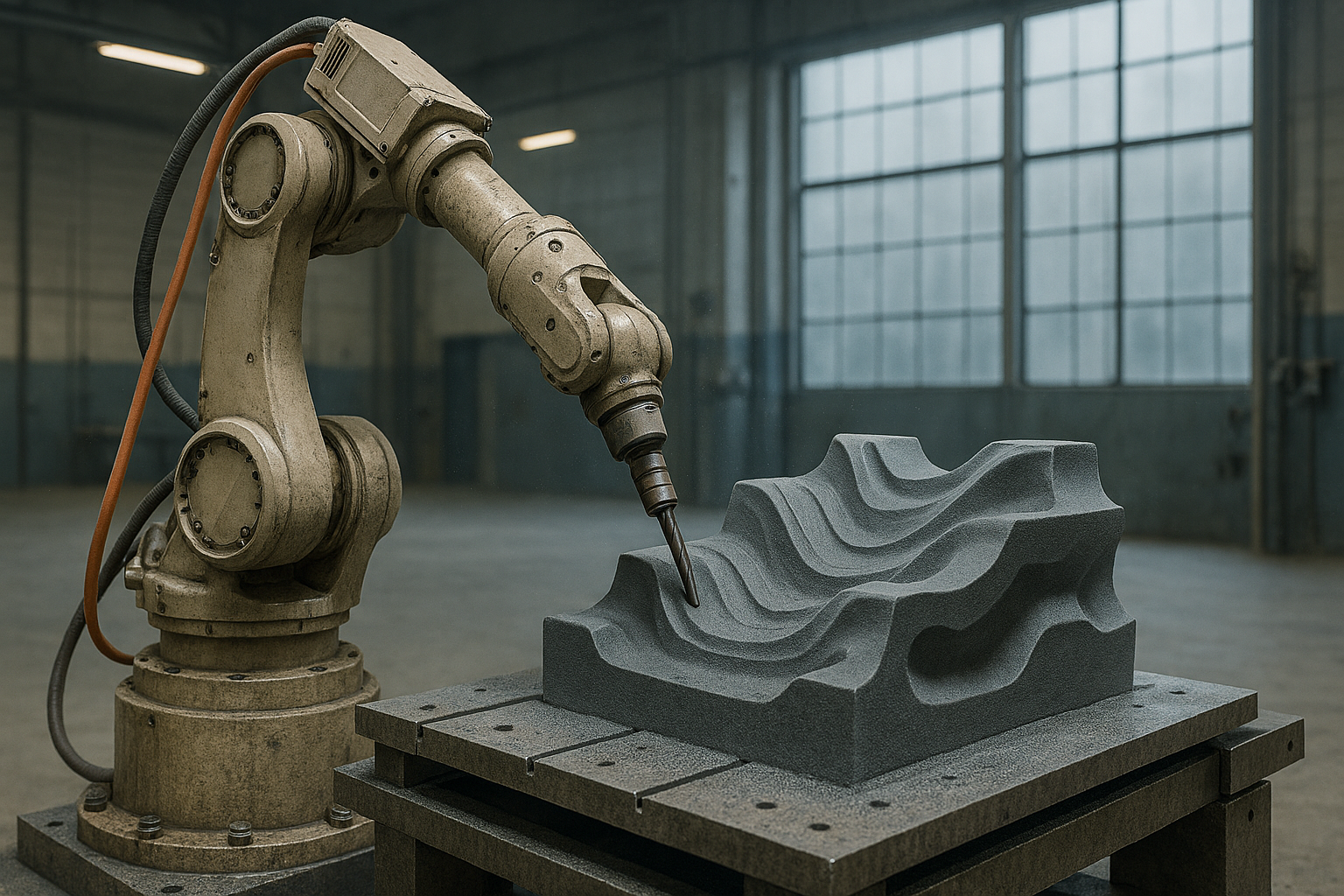
When companies talk about robotic milling, they are often not referring to replacing a heavy, high-rigidity CNC machining center. Instead, robotic milling typically involves an industrial robot equipped with a spindle or cutting tool, executing controlled toolpaths over a fixed or manipulated workpiece.
This approach is especially suitable for:
- trimming operations
- light material removal
- deburring
- finishing
- contour machining on large or complex parts
In these applications, the robot acts as a flexible machining platform, capable of reaching areas that would be difficult or inefficient to process manually.
Manufacturers such as KUKA and ABB have documented robotic cells for milling and trimming of composite materials, plastics, foams, and large-format components. These industrial references show that robotic milling is not experimental—it is a mature solution when applied within its physical and precision limits.
The key distinction lies in understanding what the robot is being asked to do. Trimming composite panels and lightly machining plastics are fundamentally different from heavy steel milling with tight tolerances. Confusing these use cases is one of the most common causes of failed robotic milling projects.
Why Interest in Robotic Milling Is Growing
Interest in robotic milling has grown rapidly in industries that work with:
- composite materials
- technical plastics
- foams
- molds and patterns
- large-format or complex components
In these contexts, the size of the part, changing geometries, or the need to access multiple angles make manual processes difficult to standardize.
Manual milling and trimming often rely heavily on operator skill. While experienced operators can achieve good results, the process typically suffers from:
- variability between operators
- fatigue over long cycles
- ergonomic risks
- difficulty scaling production
Robotic milling addresses these challenges by providing consistent motion, repeatable paths, and the ability to integrate multiple operations into a single automated cell.
When Robotic Milling Can Be Better Than a Manual Process
Manual milling, trimming, and deburring remain common in many industries, especially when volumes are low or automation seems difficult to justify. However, manual processes begin to show clear limitations when certain conditions arise.
Robotic milling can be a better option than manual processing when:
- repeatability is required across multiple parts
- operator exposure to dust, noise, or vibration must be reduced
- surface quality must be consistent
- parts are large, heavy, or awkward to handle
- production must scale without relying on individual skill
For large or ergonomically challenging parts, a robot can maintain stable tool orientation and repeat the same trajectory without fatigue. This reduces variability and improves both quality and operator safety.
Another advantage emerges when companies work with multiple geometries derived from CAD models. Offline programming allows toolpaths to be adapted quickly without redesigning the entire workstation, making robotic milling well suited to high-mix environments.
Typical Applications of Robotic Milling
Robotic milling is most effective in applications where flexibility and reach matter more than extreme stiffness.
Common use cases include:
- trimming composite panels and laminates
- machining plastic and polymer components
- deburring cast or molded parts
- finishing edges and contours
- machining foam patterns and molds
In these applications, the robot’s ability to approach the part from multiple angles often outweighs the lower rigidity compared to a CNC machine tool.
Understanding the Real Limits of Robotic Milling
It is important to be clear: robotic milling is not the best solution for every machining task.
Key limiting factors include:
- overall system rigidity
- vibration behavior
- cutting forces
- spindle quality
- part fixturing
- toolpath strategy
If an application requires very tight tolerances, aggressive material removal, or machining of very hard materials, a conventional machine tool may still be the most appropriate choice.
This is why technical validation is essential before investing. Material type, tool selection, feed rates, depth of cut, and expected surface finish must all be evaluated in real conditions.
A well-chosen robot can perform reliably in light machining and trimming. A poorly matched robot or process can result in vibration, poor surface quality, or uncompetitive cycle times.
In short, the right question is not whether a robot can mill—but whether it can mill this part, with this material, at this tolerance, and with this economic target.
What Makes a Robotic Milling Project Viable
A successful robotic milling project starts with the part, not the robot.
Critical factors to evaluate include:
- part dimensions and weight
- material properties
- cutting force direction
- accessibility
- fixturing and clamping
- required surface quality
Only after these aspects are understood should the robot, spindle, tooling, and cell layout be selected.
The Role of Offline Programming
Offline programming plays a central role in robotic milling. For repetitive trimming and machining operations, programming toolpaths outside the cell:
- reduces commissioning time
- improves path consistency
- simplifies adaptation to new parts
This is particularly valuable in environments where part families share similar geometries but are not identical.
Integrating Additional Operations
When measurement or vision systems are integrated before or after machining, the robotic cell gains additional value. Instead of performing a single operation, the system connects preparation, machining, validation, and finishing within a unified production logic.
Safety and Ergonomic Benefits
One of the most immediate benefits of robotic milling compared to manual processing is reduced operator exposure.
Manual trimming and milling often involve:
- repetitive motion
- vibration
- dust and noise
- awkward postures
Robotic systems remove operators from direct contact with the cutting process, improving ergonomics and safety while maintaining consistent quality.
When It Makes Sense to Invest in Robotic Milling
Evaluating a robotic milling investment makes sense when:
- manual processes generate excessive variability
- skilled labor is heavily consumed by low-value tasks
- ergonomic or safety risks are present
- part size or geometry limits manual stability
- flexibility is a strategic requirement
Another clear trigger is product variety. When a company produces families of similar—but not identical—parts, robotic milling often provides a better balance of reach, adaptability, and cost than rigid, over-dimensioned solutions.
The recommended approach is to test with a real part, define expected quality clearly, and compare total process cost between the manual and robotic solution.
- International Federation of Robotics – https://ifr.org
- ABB Robotics – https://new.abb.com/products/robotics
FAQ
Does robotic milling replace CNC machining centers?
Not always. In many applications, robotic milling complements CNC machines by handling trimming, finishing, and light machining where flexibility is critical.
Which materials are best suited for robotic milling?
Robotic milling is commonly used for composites, technical plastics, foams, and other relatively lightweight materials, especially in trimming and deburring operations.
What is the main technical risk to evaluate first?
System rigidity and dynamic behavior during cutting. Without validating these factors, surface quality and repeatability are difficult to predict.
Is a real-world test necessary before investing?
Yes. Testing with an actual part is the most reliable way to confirm that the robot, tooling, and strategy meet quality and productivity targets.
Can robotic milling improve safety compared to manual processes?
Yes. Removing operators from direct contact with cutting tools significantly reduces ergonomic and safety risks.
Conclusion
Robotic milling is neither a universal replacement for machine tools nor a niche technology. When applied correctly, it provides flexibility, reach, and repeatability that manual processes struggle to achieve.
By understanding its real capabilities and limits, companies can use robotic milling to improve quality, reduce variability, and create safer, more scalable production systems.
If you are evaluating robotic milling for your production environment and want a technical discussion based on your specific parts, materials, and quality requirements, a structured feasibility assessment can clarify whether this approach is suitable.
A data-driven evaluation helps determine if robotic milling can deliver measurable value in terms of productivity, quality, and operational sustainability. Don’t hesitate to call us.