
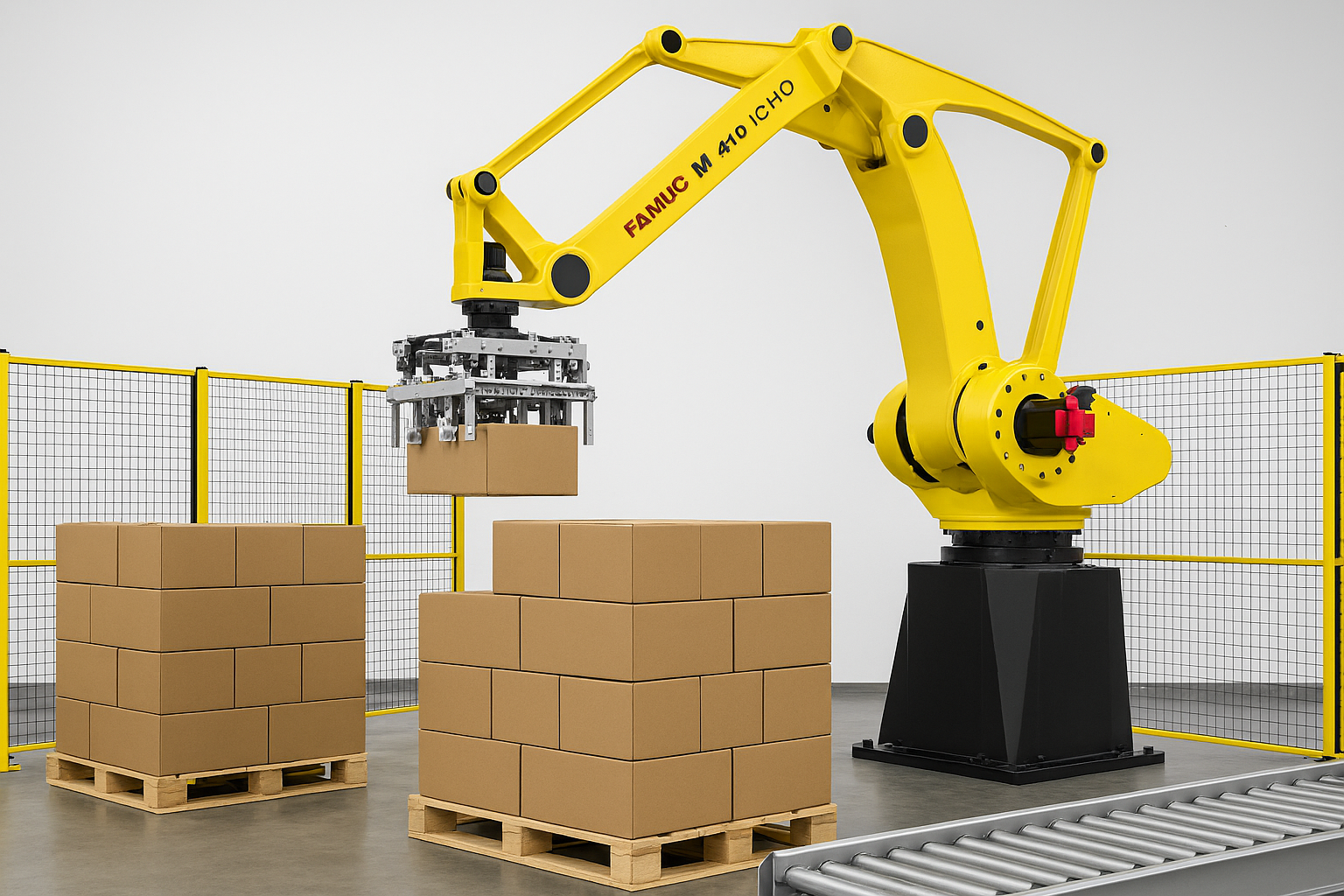
Palletizing is one of the most repetitive, physically demanding, and operationally critical activities within industrial supply chains. Whether in food and beverage, consumer goods, automotive, or logistics hubs, the way products are stacked, stabilized, and prepared for shipment has a direct impact on throughput, safety, and distribution reliability.
In recent years, increasing labor shortages, higher safety standards, and pressure to improve logistics efficiency have accelerated the adoption of robotic palletizing systems. Within this context, the FANUC M‑410iC/110 palletizing robot has emerged as a reference solution for companies looking to automate palletizing without compromising speed, consistency, or flexibility.
This article explains how the FANUC M‑410iC/110 works, why it is designed specifically for palletizing, and how it can improve logistics performance across different industrial environments.
Why Palletizing Is a Strategic Bottleneck in Industrial Logistics
Manual palletizing may appear simple, but it introduces several structural limitations in modern production environments. Repetitive lifting, variable stacking quality, and dependence on operator availability make palletizing one of the most common bottlenecks at the end of the production line.
Typical challenges associated with manual palletizing include:
- inconsistent pallet patterns and load stability
- limited throughput during peak production
- higher risk of workplace injuries due to heavy lifting
- difficulty scaling operations without increasing labor
As production volumes grow and packaging formats diversify, these issues become more pronounced. Robotic palletizing addresses these challenges by delivering repeatable motion, constant cycle times, and predictable quality, regardless of shift patterns or production pressure.
According to the International Federation of Robotics, palletizing remains one of the fastest‑growing industrial robot applications due to increasing labor constraints and safety requirements.
FANUC M‑410iC/110 Palletizing Robot: Purpose‑Built Design
The FANUC M‑410iC/110 is part of FANUC’s dedicated palletizing robot family, designed specifically for high‑speed material handling and load stacking applications. Unlike general‑purpose industrial robots, palletizing robots prioritize reach, payload, and vertical motion efficiency.
Core technical characteristics
- Maximum payload: 110 kg
Suitable for boxes, bags, shrink‑wrapped products, and bulk packaging.
- Reach: 2,400 mm
Enables coverage of wide palletizing areas and multiple pallet positions without additional conveyors.
- Optimized kinematics for palletizing
Vertical wrist motion and smooth trajectories support stable stacking and product protection.
- Compact and robust mechanical design
Simplifies integration into both new and existing palletizing lines.
- FANUC ROBOGUIDE compatibility
Allows offline simulation, cycle time analysis, and layout validation before installation.
These characteristics make the M‑410iC/110 particularly well suited for end‑of‑line automation where reliability and throughput consistency are critical.
Detailed specifications and application examples for palletizing robots are available on the FANUC palletizing robots official website.
Throughput, Cycle Time, and Motion Consistency
One of the main advantages of robotic palletizing is the ability to maintain a constant cycle time. The FANUC M‑410iC/110 is designed to perform repetitive pick‑and‑place motions with high repeatability and minimal variation.
This consistency delivers several operational benefits:
- predictable output per hour
- easier production planning
- reduced buffer requirements between processes
- improved coordination with upstream packaging equipment
Smooth and controlled motion also plays a key role in protecting product integrity. Sudden accelerations or unstable trajectories can cause damage, especially when handling bags or fragile packaging. The M‑410iC/110’s motion profile is optimized to balance speed and stability.
Safety Benefits of Robotic Palletizing
Manual palletizing remains one of the leading causes of musculoskeletal injuries in warehouses and production facilities. Lifting heavy loads, repetitive bending, and awkward postures expose operators to long‑term health risks.
By automating palletizing tasks, companies can:
- reduce direct human exposure to heavy lifting
- reassign operators to higher‑value tasks
- improve compliance with workplace safety regulations
- lower injury‑related downtime and compensation costs
The FANUC M‑410iC/110 contributes to safer working environments by removing the most physically demanding activities from daily operations while maintaining high productivity levels.
Integration with Vision Systems and Flexible Packaging
Modern palletizing operations often require flexibility. Product dimensions, box formats, and pallet patterns may change frequently, especially in food, beverage, and consumer goods industries.
When combined with machine vision systems, the FANUC M‑410iC/110 can:
- identify different box sizes
- adjust pick points dynamically
- adapt pallet patterns without constant reprogramming
- handle mixed SKU palletizing scenarios
This flexibility allows manufacturers to move away from rigid palletizing setups and respond faster to packaging changes without extensive downtime.
Real‑World Example: Palletizing in the Food Industry
In a European food processing facility, the FANUC M‑410iC/110 was implemented to automate palletizing of fresh and packaged products at the end of multiple production lines.
After deployment, the company reported:
- a 25% reduction in pallet preparation time
- improved consistency in pallet quality
- elimination of common manual stacking errors
The integration of vision‑guided handling allowed the robot to accommodate varying box dimensions without frequent program adjustments, a key requirement in a sector characterized by packaging variability and seasonal production changes.
Retrofitting Existing Palletizing Lines
A common concern among manufacturers is whether robotic palletizing requires a complete redesign of existing lines. In many cases, the answer is no.
Thanks to its compact footprint and flexible reach, the FANUC M‑410iC/110 can be integrated into:
- legacy palletizing cells
- mixed manual‑robotic environments
- phased automation projects
Simulation tools such as FANUC ROBOGUIDE allow engineers to test layouts and cycle times virtually, reducing integration risk and improving commissioning efficiency.
Evaluating ROI in Robotic Palletizing Projects
While palletizing robots require upfront investment, their return on investment is typically driven by a combination of factors:
- labor cost reduction
- increased throughput
- lower injury‑related costs
- reduced product damage
- improved process stability
In many industrial contexts, robotic palletizing cells reach payback within a relatively short timeframe, especially in multi‑shift operations or environments with high labor turnover.
When the FANUC M‑410iC/110 Palletizing Robot Is the Right Choice
The FANUC M‑410iC/110 palletizing robot is particularly suitable when:
- payload requirements approach or exceed 100 kg
- high throughput is required at end of line
- multiple pallet positions must be served
- packaging formats vary frequently
- safety and ergonomics are strategic priorities
It is commonly deployed in food and beverage, logistics, consumer goods, and automotive supply chains where palletizing reliability directly impacts delivery performance.
FAQ
What type of products can the FANUC M‑410iC/110 handle?
The robot is designed to handle boxes, bags, and packaged goods up to 110 kg, making it suitable for a wide range of palletizing applications.
Is the FANUC M‑410iC/110 only for new production lines?
No. The robot can be integrated into both new installations and existing palletizing lines, depending on layout and process requirements.
Can the robot adapt to different pallet patterns?
Yes. With proper programming and optional vision systems, the robot can manage multiple pallet configurations and packaging formats.
Does robotic palletizing reduce labor needs completely?
Robotic palletizing reduces manual handling but does not eliminate human involvement. Operators typically shift to supervision, quality control, or logistics coordination roles.
How does robotic palletizing improve consistency?
Robots execute the same motion repeatedly with minimal variation, ensuring uniform pallet quality regardless of shift or production volume.
Final Considerations
The FANUC M‑410iC/110 palletizing robot demonstrates how targeted robotic automation can transform end‑of‑line logistics. By combining high payload capacity, long reach, and reliable motion control, it enables manufacturers to increase throughput, improve safety, and maintain consistent pallet quality.
As supply chains become more demanding and production variability increases, robotic palletizing solutions like the FANUC M‑410iC/110 offer a scalable and future‑proof approach to industrial logistics automation.
If you are evaluating robotic palletizing solutions and want a clear answer based on your specific production requirements, contact URT. Our team will provide a technical assessment tailored to your application.