
The Question Is Not Whether a Robot Can Mill a Part
The question is whether robotic milling creates a better production outcome than the manual process currently being used.
Many manufacturers evaluate robotic milling because they want to reduce labor dependency, improve consistency, or increase throughput. Others are dealing with large parts that are difficult to process manually or are searching for greater flexibility than traditional machining equipment can provide.
However, robotic milling is not automatically superior to manual milling. In some applications, it can reduce variability, improve operator safety, and simplify the handling of large workpieces. In others, the complexity of integration, fixturing requirements, or process instability can outweigh the potential benefits.
The decision should be based on production requirements rather than the appeal of automation itself.
How Robotic Milling Works
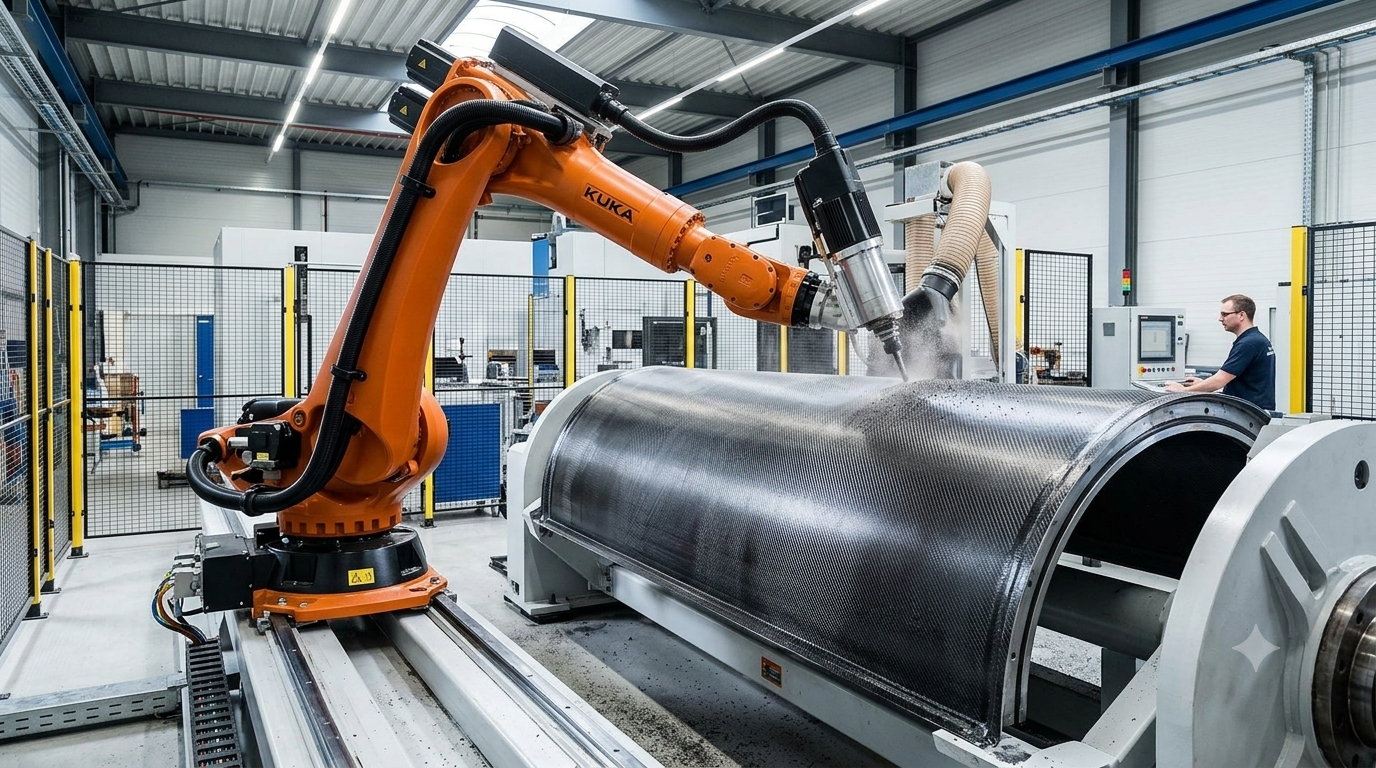
Robotic milling combines an industrial robot with a spindle, tooling package, control system, and workholding solution that allows material to be removed from a workpiece automatically.
The robot follows programmed toolpaths while the spindle performs cutting operations on the part. Depending on the application, the robot may move around a fixed workpiece, manipulate the workpiece itself, or operate as part of a larger automated cell.
Robotic milling is commonly used for:
- Composite trimming.
- Plastic machining.
- Tool and mold finishing.
- Large-format component processing.
- Pattern manufacturing.
- Deburring and edge finishing.
- Prototype production.
- Non-ferrous material machining.
The robot is only one component of the system. Performance depends equally on spindle selection, tooling, programming strategy, fixturing quality, workpiece stability, and process control.
Why Manufacturers Consider Replacing Manual Milling
Manual milling remains an effective solution for many operations, particularly where flexibility, operator judgment, and low production volumes are important.
However, certain production conditions can create challenges for manual processes.
Repetitive trimming, finishing, and material removal tasks often depend heavily on operator skill. Different operators may achieve different results. Fatigue can influence quality. Training requirements can increase as experienced personnel become more difficult to replace.
In these situations, robotic milling may provide greater consistency by executing the same programmed path repeatedly under controlled conditions.
The value comes from repeatability rather than simply replacing labor.
Large Components Are Often Strong Candidates for Robotic Milling
One of the strongest applications for robotic milling involves large workpieces.
Traditional machining approaches can become challenging when parts are physically large, difficult to move, or require access from multiple angles. Aerospace structures, composite molds, marine components, wind energy parts, and large industrial products frequently fall into this category.
Industrial robots provide a large working envelope and flexible access to complex geometries. Instead of moving the component repeatedly between operations, manufacturers can often process multiple areas within a single setup.
This flexibility can simplify production flow and reduce handling requirements.
For organizations evaluating broader automation priorities, understanding which processes should be robotized first can help determine whether milling is an appropriate automation candidate.
When Consistency Matters More Than Operator Skill
Many manual milling operations rely heavily on experienced personnel. While skilled operators often achieve excellent results, maintaining consistency across shifts, facilities, or production teams can be challenging.
Robotic milling systems perform programmed movements repeatedly. Once the process is validated, every part is produced according to the same instructions.
This can reduce variability when:
- Part geometry is consistent.
- Workholding is repeatable.
- Tooling conditions are controlled.
- Material properties remain predictable.
- Production procedures are standardized.
Consistency does not eliminate the need for process monitoring. Tool wear, fixture condition, and material variation still require management. However, robotic execution can reduce operator-driven variation.
Where Robotic Milling May Not Be the Right Choice
Not every milling application benefits from automation.
Processes that depend heavily on real-time operator judgment, highly variable part conditions, or frequent one-off adjustments may be difficult to automate efficiently.
Similarly, low production volumes may struggle to justify programming, integration, and commissioning costs.
Some manufacturers also assume robotic milling can automatically replace CNC machining. In reality, the two technologies solve different production problems.
Robotic milling often excels in flexibility, workspace reach, and large-part accessibility. CNC machines may remain preferable when extremely high rigidity, tight tolerances, or specialized machining requirements are the primary drivers.
Understanding these limitations before investment is critical to avoiding unrealistic expectations.
Process Stability Must Exist Before Automation
A robot can repeat a process very effectively. It cannot stabilize a process that is fundamentally inconsistent.
If manual operators routinely compensate for fixture variation, inconsistent material conditions, dimensional inaccuracies, or undocumented procedures, those problems should be addressed before robotic implementation.
One of the most common automation mistakes is assuming that the robot will solve upstream process issues.
In reality, robotic milling often exposes process instability because the robot performs exactly what it has been programmed to do. Variability that was previously hidden by operator intervention becomes visible.
Before automation begins, manufacturers should verify that:
- Part presentation is repeatable.
- Fixtures are stable.
- Tooling requirements are defined.
- Material conditions are consistent.
- Quality acceptance criteria are documented.
- Production flow is predictable.
Integration Requirements Are Often Underestimated
The milling robot itself is usually not the most difficult part of the project.
Successful robotic milling depends on the integration of multiple systems, including fixturing, spindle technology, tooling management, programming software, safety systems, and quality verification procedures.
Manufacturers often focus on the robot while underestimating the importance of the surrounding process infrastructure.
Programming complexity can also affect project schedules. Facilities evaluating robotic machining cells may benefit from reviewing strategies for reducing robot programming time during industrial automation projects.
The most successful implementations treat robotic milling as a complete production system rather than a standalone robot installation.
How to Evaluate Whether Robotic Milling Is Justified
Before committing to robotic milling, decision-makers should evaluate both operational and business factors.
The following checklist can help structure the assessment:
- Is the process repetitive enough to justify automation?
- Are production volumes sufficient?
- Are workpiece dimensions creating handling challenges?
- Can fixtures maintain repeatability?
- Is labor availability becoming a constraint?
- Can quality improvements be measured?
- Will automation reduce safety exposure?
- Can maintenance teams support the equipment?
- Is programming expertise available internally or externally?
- Can the expected benefits justify implementation costs?
The answers often reveal whether robotic milling is solving a genuine production problem or simply introducing new technology into an already effective process.
Manufacturers comparing machining approaches may also find value in evaluating the real ROI of replacing CNC operations with robotic spindle systems.
Robotic Milling Is Most Valuable When It Solves a Specific Production Constraint
The strongest robotic milling projects are rarely driven by technology alone.
They are driven by a clear operational need: handling large parts, improving consistency, reducing dependence on scarce skills, increasing process flexibility, or improving workplace safety.
When those conditions exist, robotic milling can become a practical production tool that supports long-term manufacturing goals.
When those conditions do not exist, manual processes may remain the more efficient and economical solution.
The objective is not to automate milling because robots are available. The objective is to determine whether robotic milling removes a production constraint that the current process cannot address effectively.
FAQ
What is robotic milling?
Robotic milling is a manufacturing process that uses an industrial robot equipped with a spindle and cutting tools to remove material from a workpiece according to programmed toolpaths.
When is robotic milling better than a manual process?
Robotic milling is often advantageous when parts are large, production is repetitive, consistency is important, or manual operations create labor, safety, or throughput challenges.
Can robotic milling replace CNC machining?
Not always. Robotic milling and CNC machining address different production requirements. The most suitable solution depends on factors such as geometry, flexibility needs, process requirements, and operational objectives.
What industries commonly use robotic milling?
Industries such as aerospace, composites manufacturing, marine production, tooling, mold making, automotive manufacturing, and industrial equipment production commonly evaluate robotic milling applications.
What should be verified before implementing robotic milling?
Manufacturers should verify fixture repeatability, process stability, tooling requirements, material consistency, production volumes, programming requirements, safety considerations, and expected operational benefits before investing.
Talk to URT About Robotic Milling
If you are evaluating robotic milling and want to determine whether it is the right alternative to a manual process, contact URT. We will give you a direct, technical answer based on your actual production requirements.