
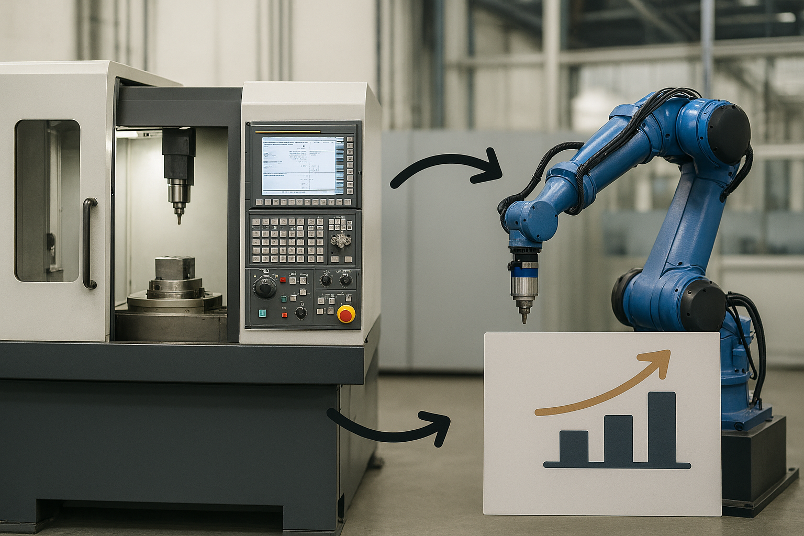
Replacing a CNC machine with a robotic milling cell is not a simple upgrade decision. It is a strategic one. The financial case depends heavily on which specific costs and benefits are included in the calculation — and many standard ROI comparisons leave out the variables that most often determine whether the investment makes sense.
This article explains how to calculate robotic milling ROI correctly when evaluating a robot and spindle system against a conventional CNC machine. It covers the five variables that must be included, a worked illustrative example, and the conditions under which a robotic cell delivers a better return than a fixed machining center.
Why Standard ROI Comparisons Get It Wrong
Most cost comparisons between CNC machines and robotic milling cells focus on acquisition price. That comparison consistently favors the CNC machine — particularly a refurbished or mid-range machining center — because the robot, spindle, tooling, and programming combined often reach a similar total investment.
However, acquisition price is only one variable. It captures the cost at the moment of purchase. It does not capture operating cost over three, five, or ten years. It does not capture the cost of inflexibility when production requirements change. And it does not capture the value of a system that can be reprogrammed for a different task rather than decommissioned.
As a result, a comparison that looks unfavorable for the robotic cell at year one often looks substantially different by year three. The calculation needs to reflect the full operating period.
The Five Variables That Define Robotic Milling ROI
A complete robotic milling ROI calculation must include all five of the following variables. Omitting any one of them produces a misleading result.
1. Acquisition Cost
The total acquisition cost for a robotic milling cell includes the robot, the spindle, end-of-arm tooling, safety equipment, programming, and commissioning. For a refurbished industrial robot — a KUKA KR 210, an ABB IRB 6700, or a FANUC M-20 — fitted with a high-speed machining spindle, the total system cost is typically 40 to 60 percent lower than a comparable new 5-axis CNC machine.
This gap narrows when comparing against a refurbished CNC machine. However, the flexibility advantage of the robotic cell — discussed below — does not narrow with it.
2. Operating Hours and Shift Coverage
A CNC machine in a typical job shop runs one or two attended shifts. It requires an operator for loading, unloading, tool changes, and monitoring. Outside attended hours, it sits idle.
A robotic milling cell can operate unattended for extended periods. Once the program is running and the input stock is loaded, the robot runs through breaks and shift changes without intervention. In two-shift and three-shift environments, that additional output — on the same capital investment — directly improves the return.
The difference compounds over a year. A machine running 16 hours per day versus 8 hours per day on the same annualized capital cost doubles its output per euro invested.
3. Energy Consumption
CNC machining centers — particularly enclosed 5-axis machines with active cooling, high-pressure coolant systems, and continuous spindle operation — are energy-intensive. A 6-axis robot running a machining spindle typically consumes less total energy per operating hour than an equivalent CNC center with the same material removal rate. The exact difference depends on the spindle power, the material, and the cooling requirements of the specific process. However, in operations running extended hours, energy cost is a meaningful line item in the TCO calculation and should be measured for the specific application rather than estimated generically.
4. Maintenance and Spare Parts
CNC machines require precision maintenance of ball screws, linear guides, spindle bearings, and coolant systems. Component replacement on a high-precision machining center is expensive. Lead times for specific spare parts can be significant, particularly on older or discontinued models.
Industrial robots have a different maintenance profile. Scheduled preventive maintenance at 3,000 to 4,000 operating hour intervals covers lubrication, axis checks, and harness inspection. Spare parts for major platforms — KUKA, ABB, FANUC, Yaskawa — are widely available and competitively priced. The spindle itself is a separate maintenance item, but spindle replacement is typically faster and less complex than rebuilding a CNC spindle assembly.
5. Flexibility and Reuse Value
This is the variable most frequently excluded from standard ROI comparisons — and often the most significant over a five to ten year horizon.
A CNC machine is fixed to its purpose. Its axis configuration, work envelope, and control system are designed for a specific class of operations. Repurposing it for a substantially different application requires significant modification or is simply not feasible.
A robotic milling cell is reprogrammable. The same robot that mills aluminum molds today can be reprogrammed to mill composite panels tomorrow. It can be fitted with a different end-effector and switched to a handling application entirely. When a production line changes — and most do within five years — the robot retains residual value and operational relevance. The CNC machine may not.
That flexibility has a real financial value. It reduces the risk that the capital investment becomes obsolete before it is fully depreciated.
An Illustrative ROI Calculation
The following example illustrates how the calculation works for a typical robotic milling project. These are representative figures. Actual numbers vary by application, market, and operating profile.
Scenario: A manufacturer replaces manual mold finishing and a conventional 3-axis CNC with a refurbished 6-axis robot fitted with a high-speed spindle. The robot handles both roughing and semi-finishing on polyurethane and aluminum molds.
Total investment (refurbished robot, spindle, tooling, safety, programming, commissioning): approximately €95,000.
Comparison baseline (equivalent new CNC machine, installed): approximately €160,000 to €200,000.
Annual operating savings:
— One operator position freed across two shifts: approximately €50,000 to €65,000 per year
— Extended operating hours (robot runs through breaks): estimated additional output value of €15,000 to €25,000 per year
— Reduced energy cost per operating hour: €5,000 to €10,000 per year depending on energy tariff
Total annual net benefit: approximately €70,000 to €100,000, depending on shift structure and labor cost.
Resulting payback period: 12 to 18 months at the low end of labor displacement. Longer in markets with lower labor costs or single-shift operations.
This calculation assumes the process is suitable for robotic milling — meaning the tolerance requirements are within the robot’s repeatability specification for the specific material and cut depth. Not all CNC applications are suitable candidates. The section below covers where the limits lie.
According to the International Federation of Robotics, machine tending and robotic machining have been among the fastest-growing industrial robot application categories in recent years, driven specifically by the flexibility and operating cost advantages demonstrated in job shop and mold manufacturing environments.
Where Robotic Milling Is — and Is Not — a Good Fit
Robotic milling delivers strong ROI in specific application types. It is not a universal replacement for CNC machining.
Applications where robotic milling is typically well-suited:
- Roughing and semi-finishing of large molds and patterns in foam, polyurethane, or soft tooling materials
- Trimming and deburring of composite panels, where the large working envelope of a robot covers surface area that a CNC cannot reach in a single setup
- Finishing of wooden furniture components, where the combination of milling and handling in a single cell reduces transfer operations
- Machining of fiber-reinforced plastics and carbon fiber composites, where the robot’s path flexibility allows complex geometries
- Applications where multi-task capability — milling plus handling plus inspection in a single cell — eliminates intermediate steps
Applications where a conventional CNC machine remains the stronger choice:
- High-precision metal machining to tight tolerances (below ±0.05 mm), where CNC rigidity and thermal stability are required
- High-speed hard metal cutting with significant cutting forces, where robot joint stiffness limits surface finish and tool life
- Applications requiring 5-axis simultaneous interpolation with aerospace-grade geometric accuracy
The distinction matters because a robotic milling cell installed in the wrong application will not recover its investment on any reasonable timeline. The process assessment must happen before the financial case is built.
For a broader framework on which processes are suitable automation candidates before selecting the equipment, see our guide on which process delivers the fastest ROI when robotized.
Spindle Selection: A Cost Driver That Is Often Underestimated
The spindle is one of the most important cost variables in a robotic milling cell — and one of the most frequently underestimated at the project planning stage.
Spindle selection drives three things simultaneously: the materials that can be machined, the surface finish achievable, and the maintenance interval of the cell. A spindle undersized for the material removal rate will wear quickly and require early replacement. An oversized spindle adds unnecessary cost and weight to the robot’s end-of-arm payload budget.
The spindle must also be matched to the robot’s payload capacity with sufficient headroom. In milling applications, the cutting forces at the tool tip generate reaction forces at the robot wrist. These forces are not captured in the static payload rating. The robot’s actual effective payload in a milling application is lower than the nominal specification, and the spindle and tooling must be specified accordingly.
For more detail on spindle selection for robotic milling applications, see our article on how to choose the right milling spindle for robotics.
Robot Selection for Milling Applications
Not all industrial robots are suited to milling. The key specification is not payload alone — it is stiffness and dynamic behavior under cutting loads.
High-payload robots in the 100 to 300 kg range — such as the KUKA KR QUANTEC or the ABB IRB 6700 — offer the joint stiffness needed for most roughing applications. Their larger joints tolerate the cyclic cutting forces better than smaller, faster robots designed for handling or assembly.
For milling small components and mold deburring specifically, see our article on which robot type is best suited for milling small components and mold deburring.
For a broader overview of robot milling applications and configurations, see our guide on industrial robots in robotic milling and cutting.
New vs. Refurbished Robots for Milling Cells
Robotic milling is one of the better applications for a refurbished robot. The operating environment is controlled, the working envelope is defined, and the application does not require the latest controller generation. A refurbished KUKA KR 210 or ABB IRB 6700 with a documented rebuild performs adequately for most milling applications at 40 to 60 percent of the cost of a new equivalent. That saving meaningfully improves the ROI calculation. For context on evaluating used robot economics in detail, see our article on understanding TCO for used versus new robots.
FAQ
What is the typical payback period for a robotic milling cell compared to a CNC machine?
In two-shift operations where the robotic cell displaces one operator position and runs extended hours, payback periods of 12 to 18 months are achievable. Single-shift operations or markets with lower labor costs will see longer payback periods. The calculation depends on the specific operating profile — shift structure, labor cost, energy cost, and the degree of flexibility benefit — not on industry averages.
Can a robot achieve the same precision as a CNC machine in milling?
For most roughing and semi-finishing applications in soft materials — foam, polyurethane, soft aluminum — yes. For high-precision hard metal machining to tight tolerances below ±0.05 mm, no. Robot joint stiffness and thermal behavior do not match a precision machining center under high cutting forces. The application determines whether robotic milling is technically viable before the financial case is relevant.
What robot payload is recommended for milling applications?
High-payload robots in the 100 to 300 kg range are most commonly used for milling. The larger joints of these platforms provide better stiffness under cutting loads than lighter, faster robots. The spindle and tooling weight must be included in the payload calculation, and a safety margin above the calculated load is standard practice to account for dynamic cutting forces.
How much does the spindle affect the total cost of a robotic milling cell?
The spindle typically accounts for 10 to 20 percent of total cell cost, depending on specification. However, an incorrectly specified spindle — undersized for the material removal rate or poorly matched to the robot’s payload budget — generates maintenance costs and downtime that far exceed the initial saving from choosing a cheaper unit. Spindle selection deserves the same attention as robot selection.
Is robotic milling suitable for all CNC machining applications?
No. Robotic milling is well-suited to roughing, trimming, deburring, and finishing of large or complex workpieces in soft to medium materials. It is not suitable for high-precision hard metal cutting that requires the rigidity and thermal stability of a dedicated machining center. Evaluating technical suitability before building the financial case avoids investing in a system that cannot meet the process requirements.
Talk to URT About Robotic Milling and CNC Replacement Projects
At URT, we supply industrial robots — new and refurbished — for robotic milling and machining applications. We work with manufacturers evaluating whether a robotic cell is the right replacement for an existing CNC, which robot and spindle combination fits their process, and what a realistic ROI looks like for their specific operation.
If you are evaluating a robotic milling project, contact URT. We will give you a direct, technical answer based on your actual production requirements.