
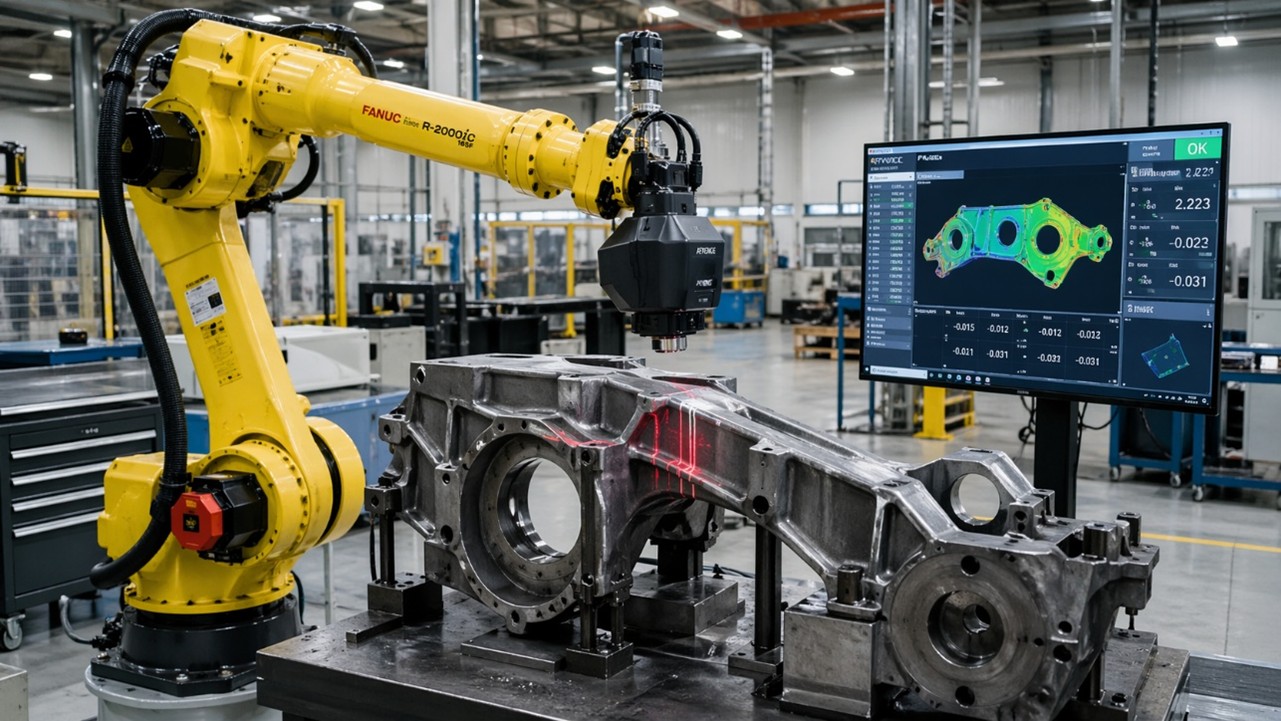
Why Measurement Automation Is Often Evaluated for the Wrong Reason
The question is not whether a robot can move a measurement device around a part. The real question is whether the production environment can support reliable measurement results without introducing new sources of variation. Many manufacturers evaluate robotic inspection because labor is difficult to find or because manual inspection creates a bottleneck. Those factors matter, but they are not usually the main reason a robotic inspection project succeeds.
The strongest business case for robotic dimensional inspection often comes from consistency, traceability, and the ability to inspect more parts without disrupting production flow. At the same time, adding a robot to a measurement process does not automatically improve measurement quality. If the part presentation, fixturing, environmental conditions, or measurement strategy are unstable, automation may simply repeat the same measurement problem more efficiently.
For this reason, manufacturers should evaluate robotic dimensional inspection as a production-system decision rather than a robot purchase. The robot is only one component in a process that includes sensors, measurement equipment, fixtures, software, quality procedures, and data management.
When Robotic Dimensional Inspection Is a Good Candidate for Automation
Not every inspection process benefits from robotic automation. The best candidates typically combine repetitive measurement requirements with production volumes that make manual inspection difficult to sustain consistently.
High Inspection Frequency
When a large number of parts require dimensional verification every shift, manual inspection can become a throughput constraint. Operators may need to move repeatedly between production and inspection activities, creating delays and inconsistent measurement timing.
In these situations, a robotic inspection cell can perform predefined measurement routines repeatedly while maintaining a predictable inspection process.
Complex Part Geometries
Some parts require measurements from multiple angles or positions that are difficult to access manually. A robot can move sensors, probes, scanners, or cameras through repeatable paths around the component, reducing dependence on operator positioning.
This advantage becomes particularly relevant when multiple measurement points must be collected from every part and when the inspection sequence itself is highly repetitive.
Traceability Requirements
Manufacturers increasingly need inspection data linked to specific production lots, machines, operators, or customers. Automated inspection systems can simplify data collection and reporting by integrating measurement results directly into production records.
The value is not merely collecting more data. The value comes from creating data that can be analyzed consistently over time to identify process drift, recurring defects, or equipment-related variation.
The Process Conditions That Matter Before Adding a Robot
One of the most common mistakes in inspection automation projects is assuming the robot will compensate for process instability. In reality, robotic measurement systems generally perform best when the inspection environment is already controlled.
Part Presentation Must Be Repeatable
If parts arrive in inconsistent positions, orientations, or fixture conditions, measurement repeatability becomes more difficult to achieve. The robot may require additional sensing systems, vision guidance, or fixture redesign to compensate for that variation.
Before automation, manufacturers should evaluate whether parts are presented consistently enough for repeatable inspection routines.
Environmental Stability Matters
Measurement systems can be affected by vibration, temperature variation, dust, lighting conditions, and machine movement. A robot may repeat a programmed path precisely, but environmental instability can still influence measurement accuracy.
This is why inspection automation projects often require evaluation of the broader production environment rather than focusing only on robot selection.
Inspection Criteria Must Be Clearly Defined
A robotic system requires explicit instructions. If operators currently make subjective decisions about what constitutes an acceptable part, those decisions must be translated into measurable criteria before automation begins.
Unclear quality standards frequently create more implementation challenges than the robot itself.
Technical Requirements for a Stable Inspection Cell
The robot arm is rarely the most critical component in a dimensional inspection application. The overall inspection architecture usually determines whether the project delivers useful results.
Measurement Technology Selection
Different applications may use contact probes, laser scanners, structured-light systems, vision technologies, or other measurement devices. The correct choice depends on part geometry, material characteristics, tolerance requirements, production speed, and inspection objectives.
The robot’s role is generally to position the measurement device consistently. The measurement technology itself remains responsible for generating usable inspection data.
Fixture Design
Measurement repeatability depends heavily on stable fixturing. A highly capable robot cannot compensate for a component that shifts during inspection.
For many projects, fixture design becomes as important as robot programming because it establishes the reference conditions for every measurement cycle.
Data Integration
Inspection data is most valuable when it can be connected to production decisions. Manufacturers should evaluate how measurement results will interact with quality systems, production databases, process monitoring tools, and corrective-action workflows.
Without a clear plan for using inspection data, automation may create large volumes of information without improving production outcomes.
Where ROI Usually Comes From
Companies often justify inspection automation primarily through labor reduction. While labor savings can contribute to ROI, they are rarely the only value driver.
Earlier Detection of Process Drift
Automated inspection can increase inspection frequency without increasing labor requirements. This may allow quality issues to be identified earlier, reducing scrap, rework, and downstream production losses.
Consistent Inspection Execution
Manual inspection methods can vary between operators, shifts, and production periods. Automated routines help standardize the inspection process, making results easier to compare over time.
Production Flow Improvements
When inspection becomes a bottleneck, production scheduling can become more difficult. Automated inspection can help synchronize quality verification with production flow, reducing waiting time between manufacturing and acceptance decisions.
Manufacturers evaluating broader automation initiatives may also benefit from understanding how to integrate inspection without creating production bottlenecks and how inspection fits into overall automation priorities.
Common Mistakes When Automating Measurement Processes
A frequent assumption is that robotic inspection automatically increases measurement accuracy. Accuracy depends on the measurement system, calibration procedures, environmental conditions, fixturing, and process control—not solely on robot motion.
Another common mistake is treating inspection as an isolated project. Inspection data becomes significantly more valuable when it supports production improvement decisions rather than simply generating reports.
Some manufacturers also underestimate programming, validation, and integration requirements. Like any automation project, inspection systems must be validated against production conditions rather than laboratory assumptions.
The same principle discussed in industrial robots for metrology in production applies strongly to measurement applications. Automation cannot eliminate variation that originates elsewhere in the manufacturing process.
When Robotic Dimensional Inspection Should Not Be Automated Yet
There are situations where delaying automation may be the better decision.
If part presentation varies significantly, inspection criteria are not documented, fixtures are unstable, or quality requirements are still changing frequently, a robotic inspection project may add complexity without delivering reliable results.
Similarly, if production volumes are low and manual inspection already provides adequate throughput and traceability, the business case for automation may be weak.
The goal should not be to automate inspection because robotic technology is available. The goal should be to automate inspection when the process conditions support repeatable, actionable measurement results.
What to Check Before Investing
Before evaluating robotic dimensional inspection, manufacturers should review the entire measurement process rather than focusing only on the robot.
- Are inspection criteria fully documented and measurable?
- Are parts presented consistently for inspection?
- Can fixtures maintain repeatable positioning?
- Have environmental influences been evaluated?
- Is inspection currently limiting production throughput?
- How will measurement data be used operationally?
- Can production systems receive and use inspection results?
- Are quality requirements stable enough to justify automation?
Companies considering broader implementation planning may also find value in reviewing how to reduce robot programming time in industrial automation because inspection projects often require significant validation and programming effort.
FAQ
Can industrial robots replace coordinate measuring machines (CMMs)?
Not necessarily. Industrial robots and CMMs serve different purposes. The suitability depends on tolerance requirements, inspection speed, production environment, measurement technology, and quality objectives.
What industries commonly use robotic dimensional inspection?
Automotive, aerospace, metal fabrication, plastics manufacturing, and other industries that require repeatable inspection of large production volumes frequently evaluate robotic inspection systems.
Does robotic inspection automatically improve measurement accuracy?
No. Measurement accuracy depends on the complete inspection system, including sensors, fixtures, calibration methods, environmental conditions, and measurement procedures.
What creates the strongest ROI for robotic inspection?
ROI often comes from earlier defect detection, improved inspection consistency, reduced bottlenecks, better traceability, and more effective use of quality data rather than labor reduction alone.
When should a company postpone robotic inspection automation?
Automation should generally be postponed when process variation remains uncontrolled, inspection criteria are unclear, fixturing is unstable, or production requirements are still changing significantly.
Talk to URT About Robotic Dimensional Inspection
If you are evaluating robotic dimensional inspection, contact URT. We will give you a direct, technical answer based on your actual production requirements.