
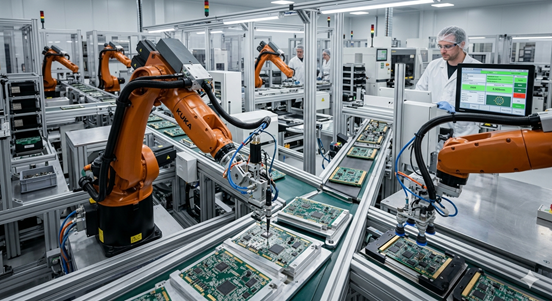
Why Small Parts Are Not Automatically Good Candidates for Automation
The decision to automate electronic assembly is often driven by a simple assumption: if a task is repetitive and involves small components, a robot should perform it better than a human operator. In practice, the situation is more complex. Small part size alone does not justify automation. The real question is whether the process is stable enough for a robot to repeat consistently without introducing excessive integration complexity.
Electronic assembly frequently combines high precision, delicate handling, product variation, and demanding quality requirements. A robotic system can create significant value when those variables are controlled. However, if components arrive inconsistently, assembly procedures change frequently, or product volumes are too low, automation may increase costs without delivering meaningful operational benefits.
The most successful electronic assembly projects are typically those where the robot is solving a specific production constraint rather than simply replacing manual labor.
When Electronic Assembly Is a Good Candidate for Automation
Not every assembly operation benefits equally from robotics. The strongest candidates generally combine repetitive motion, predictable part presentation, and stable production volumes.
High-Volume Production
When the same assembly sequence is repeated thousands of times per shift, robotic automation can help maintain consistency across production runs. The value often comes from repeatability and cycle stability rather than raw speed alone.
In high-volume environments, even small variations in assembly quality can create significant scrap, rework, or testing costs. A properly integrated robotic system can help reduce those variations.
Repeatable Component Positioning
Robots perform best when components arrive in known locations and orientations. Feed systems, trays, fixtures, or conveyors must present parts consistently enough for the robot to execute the same assembly sequence repeatedly.
If operators currently spend significant time correcting part orientation or compensating for inconsistent presentation, those issues should be addressed before automation is considered.
Quality-Critical Operations
Electronic products often contain assembly steps where consistency directly affects downstream performance. Tasks such as connector insertion, adhesive dispensing, fastening, component handling, and product loading may benefit from robotic repeatability when process conditions are stable.
In these cases, automation can contribute to quality consistency by reducing variation between shifts and operators.
The Process Conditions That Matter Before Adding a Robot
One of the most common mistakes in electronic assembly automation is assuming that a robot will compensate for process variation. In reality, robots generally amplify process stability rather than create it.
Part Presentation Must Be Controlled
Small electronic components can be particularly sensitive to presentation issues. Misaligned trays, inconsistent feeders, damaged packaging, or variable component orientation can create handling challenges that increase integration complexity.
The more predictable the incoming components, the easier it becomes to achieve reliable robotic assembly.
Tolerances Must Be Understood
Many electronic assemblies operate within tight dimensional tolerances. The assembly strategy must account for how components fit together, how force is applied, and how positional variation is managed throughout the process.
Successful automation projects evaluate these conditions before robot selection rather than after commissioning begins.
Product Variants Must Be Managed
Frequent product changes can reduce the economic advantage of automation. While modern robotic systems can manage multiple recipes, excessive variation may require additional programming, tooling changes, vision systems, or validation effort.
Manufacturers should assess whether production stability supports automation over the expected life of the system.
Technical Requirements for a Stable Electronic Assembly Cell
The robot arm itself is only one element within an electronic assembly system. Cell performance depends on the interaction between tooling, part presentation, quality controls, and process design.
End-of-Arm Tooling Selection
Delicate components often require specialized gripping solutions capable of handling parts without causing mechanical damage, contamination, deformation, or electrostatic concerns.
The choice of tooling frequently has a greater impact on project success than the robot model itself.
Vision and Verification Systems
Electronic assembly applications commonly rely on cameras, sensors, or verification systems to confirm part presence, orientation, placement, or assembly completion.
These technologies can help manage variation, but they also introduce additional integration and validation requirements that should be considered during project planning.
Traceability and Data Collection
Many electronics manufacturers require production traceability for quality assurance and regulatory reasons. Automated assembly systems can simplify data collection when integrated correctly with production and quality systems.
The operational value comes from using that information to identify trends, investigate failures, and improve process control.
Where ROI Usually Comes From
Labor reduction is often the most visible benefit discussed during automation projects, but it is rarely the only factor driving return on investment.
Consistency and Reduced Rework
Assembly errors can create expensive downstream consequences, especially when defects are discovered during testing, final assembly, or customer use. Consistent robotic execution can help reduce variation when the process itself is stable.
Predictable Production Throughput
Automated assembly cells can provide more predictable cycle times, helping production planners manage output requirements more effectively.
This does not necessarily mean maximum speed. In many cases, stable throughput creates more operational value than occasional peak performance.
Scalability
As product demand increases, manual assembly operations may become difficult to expand without additional training, supervision, and quality management requirements. Automation can provide a more scalable production model when demand justifies the investment.
Companies evaluating automation priorities may benefit from reviewing how to automate quality control with machine vision and robots without slowing production before committing to an electronic assembly project.
Common Mistakes When Automating Small Electronic Components
A frequent mistake is focusing exclusively on robot precision while overlooking process variation. Even highly repeatable robots depend on stable fixturing, consistent component presentation, and well-defined assembly conditions.
Another mistake is underestimating the complexity of handling delicate parts. Gripping force, electrostatic discharge protection, component orientation, and verification requirements can significantly influence project cost and complexity.
Some manufacturers also expect automation to solve quality problems that originate elsewhere in the production process. If incoming parts vary significantly or assembly requirements are not fully documented, robotic automation may simply reproduce those issues more consistently.
The same principle discussed in machine vision inspection without bottlenecks applies strongly to electronic assembly environments.
When Electronic Assembly Should Not Be Automated Yet
Automation may not be justified when production volumes are low, product designs change frequently, or assembly procedures remain under development.
Likewise, if operators regularly compensate for undocumented process variation, unstable component supply, or inconsistent fixturing, the process may require stabilization before robotics can deliver reliable results.
In some situations, improving work instructions, tooling, fixtures, or quality controls may provide greater value than adding robotic automation immediately.
The objective should not be to automate because the components are small. The objective should be to automate when production conditions allow the robot to execute a stable, repeatable assembly process that supports measurable business goals.
What to Check Before Investing
Before evaluating robotic electronic assembly, manufacturers should assess the complete production process.
- Are production volumes sufficient to justify automation?
- Are components presented consistently?
- Are assembly tolerances clearly documented?
- How frequently do product variants change?
- Can delicate components be handled reliably with available tooling?
- Is traceability required?
- Are quality requirements stable and measurable?
- Will automation address a genuine production constraint?
Manufacturers should also consider how programming and validation requirements influence automation projects, particularly when multiple product variants are involved, as discussed in robot programming methods and limitations in industrial robotics.
FAQ
Can industrial robots handle very small electronic components?
Yes, but successful handling depends on component presentation, tooling design, process stability, and verification systems. The robot alone does not guarantee reliable assembly.
What electronic assembly tasks are commonly automated?
Connector insertion, adhesive dispensing, fastening, component handling, product loading, packaging preparation, and other repetitive assembly operations are common automation candidates.
Does robotic assembly automatically improve product quality?
No. Robotic assembly can improve consistency when the process is stable, but it cannot eliminate variation that originates from components, fixtures, or process design.
What creates the strongest ROI in electronic assembly automation?
ROI typically comes from consistent quality, reduced rework, stable throughput, scalability, and improved process control rather than labor reduction alone.
When should a manufacturer delay automation?
Automation should generally be delayed when production volumes are low, product designs change frequently, process variation remains uncontrolled, or assembly requirements are not yet fully defined.
Talk to URT About Robotic Electronic Assembly
If you are evaluating robotic electronic assembly, contact URT. We will give you a direct, technical answer based on your actual production requirements.