
Why Robot Integration Is About More Than Installing a Robot
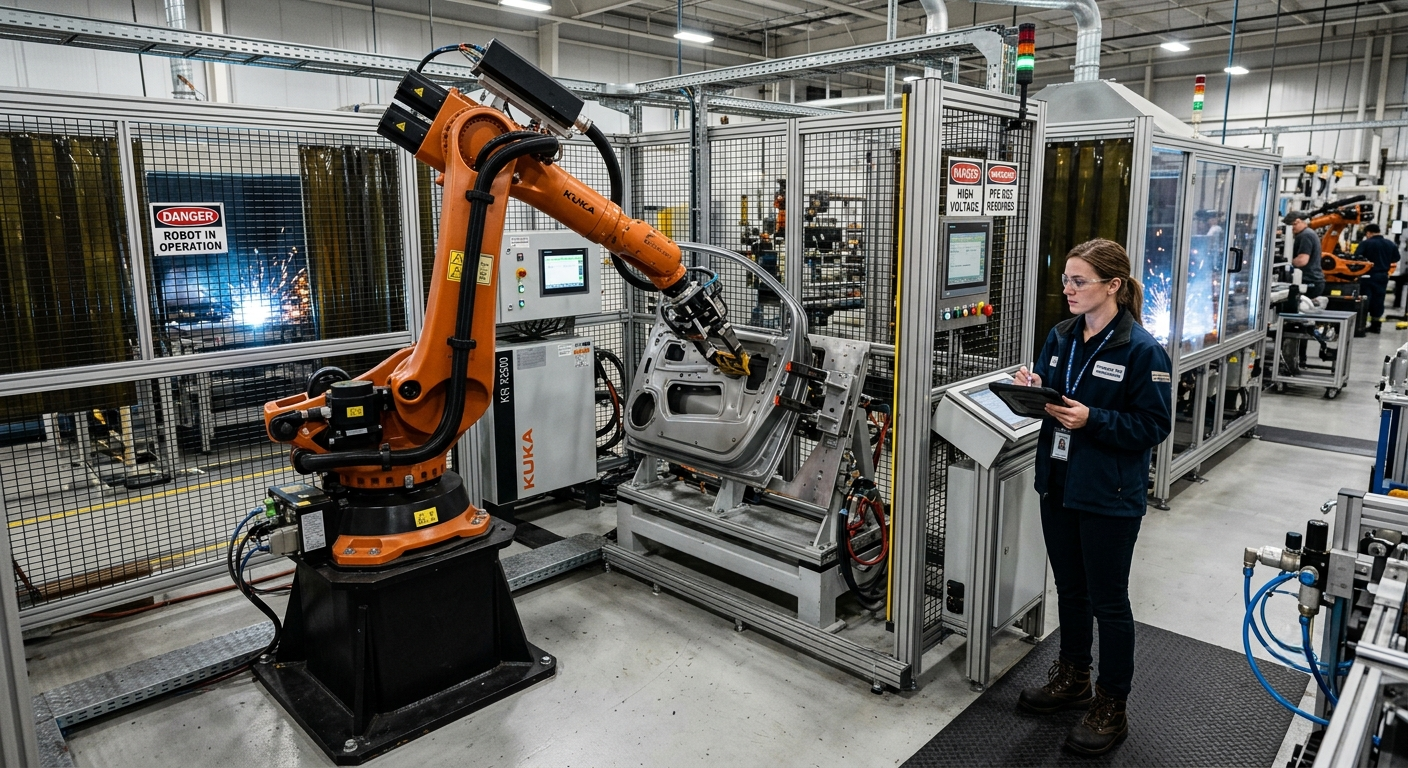
One of the biggest misconceptions about industrial automation is that buying the right robot is enough to guarantee success. In reality, many first-time projects struggle because the production environment was never prepared to support robotic operation. Robot integration is about bringing together the robot, surrounding equipment, safety systems, software, and production processes so they function as a single, reliable system.
It’s easy to focus on payload, reach, or brand when selecting a robot. However, those are only part of the equation. How parts arrive at the cell, how finished products move to the next operation, how the robot exchanges information with other equipment, and how operators interact with the system all have a direct impact on day-to-day performance.
Understanding these fundamentals before investing helps manufacturers avoid costly redesigns, reduce implementation risk, and build a stronger foundation for future automation projects.
What Robot Integration Actually Includes
Robot integration goes well beyond programming robot movements. A successful robotic cell depends on several systems working together reliably throughout every production cycle.
The industrial robot
The robot provides the motion and repeatability required for the application, but it cannot deliver consistent results on its own. Its performance depends on how well it is integrated with the rest of the production cell.
End-of-arm tooling (EOAT)
Whether the application uses a gripper, welding torch, vacuum system, or custom end effector, the tooling must match the product and process requirements. Even a highly capable robot will struggle if the tooling cannot handle parts consistently.
Peripheral equipment
Fixtures, conveyors, machine tools, positioners, sensors, and vision systems all play a role in keeping production flowing smoothly. If one component creates delays or inconsistencies, the entire cell can be affected.
Control and communication
Industrial robots constantly exchange information with PLCs, CNC machines, conveyors, and other equipment. Reliable communication ensures each operation happens in the correct sequence and helps prevent unnecessary downtime.
Safety systems
Safety measures such as fencing, light curtains, interlocks, and emergency stops should be considered part of the overall cell design from the beginning. They protect personnel while allowing production to operate efficiently and safely.
The Process Conditions That Matter Before Adding a Robot
Before selecting a robot, it’s worth evaluating whether the production process itself is ready for automation. Stable processes are usually much easier to integrate successfully than those that rely heavily on operator adjustments.
Stable part presentation
Robots repeat the same programmed path with excellent consistency. If parts arrive in different positions or orientations every cycle, additional vision systems, sensors, or improved fixturing may be required to achieve reliable operation.
Repeatable fixtures
Fixtures should locate every component accurately and consistently. Otherwise, the robot will repeat the same positioning error every cycle, leading to quality issues rather than solving them.
Predictable production flow
A robotic cell performs best when upstream and downstream equipment operate at a stable pace. Frequent machine stoppages or inconsistent material supply often become the real constraint, regardless of the robot’s capabilities.
Defined quality standards
Clear quality criteria and measurable production targets should already be in place before automation begins. They provide the baseline needed to evaluate whether the integration project delivers the expected improvements.
Technical Requirements for a Reliable Robotic Cell
Every application has its own technical challenges, but several requirements are common across most integration projects.
- Select a robot that fits the application and available workspace.
- Choose end-of-arm tooling designed for the product being handled.
- Ensure reliable communication between controllers and production equipment.
- Provide sufficient space for maintenance and operator access.
- Confirm that electrical and pneumatic services meet the cell’s requirements.
- Design safety systems as part of the overall project, not as an afterthought.
- Develop robot programs that account for normal production conditions.
- Create operator interfaces that are straightforward to use during daily production.
Looking at these factors together is essential. A well-specified robot cannot compensate for poor communication, inadequate tooling, or an unstable production flow.
Where ROI Usually Comes From
For most manufacturers, the value of robot integration extends beyond reducing manual labor.
Many projects generate stronger returns through more consistent cycle times, lower scrap rates, reduced rework, better machine utilization, improved ergonomics, and fewer production interruptions. These improvements often have a greater long-term impact than labor savings alone.
That’s why successful projects establish measurable KPIs before implementation. Comparing production performance before and after commissioning makes it much easier to evaluate whether the investment achieved its objectives.
If you’re exploring automation strategy in more detail, the URT blog offers additional resources covering industrial robotics, integration planning, and application-specific guidance across different manufacturing environments.
Common Mistakes When Integrating a Robot
Many first-time automation projects run into similar issues, and most of them have little to do with the robot itself.
A common mistake is expecting automation to fix an unstable process. If parts vary significantly, fixtures lack consistency, or quality problems already exist, the robot is likely to repeat those issues more efficiently rather than eliminate them.
Another frequent oversight is concentrating almost entirely on the robot while giving less attention to tooling, communication, maintenance planning, or operator training. These areas often determine how smoothly the cell performs once production begins.
Successful integration also requires clear ownership. Production, engineering, maintenance, and quality teams all need defined responsibilities throughout the project lifecycle.
When Robot Integration Should Wait
Automation is not always the right next step.
If production methods change constantly, part dimensions are inconsistent, fixtures are still being redesigned, or product quality depends largely on operator judgment, it may be better to stabilize the process first.
Addressing these issues before introducing a robot usually leads to a simpler integration project, fewer commissioning challenges, and more predictable long-term performance.
What to Check Before Investing
Before moving forward with a robot integration project, review the following points to assess whether your production environment is ready.
- Is the manufacturing process standardized and well-documented?
- Are parts presented consistently to the robot?
- Can fixtures locate every component accurately?
- Are production KPIs already being monitored?
- Have communication requirements between all equipment been defined?
- Is there enough space for maintenance and servicing?
- Have safety requirements been considered from the beginning of the project?
- Has a clear internal project owner been assigned?
FAQ
What is robot integration?
Robot integration is the process of connecting an industrial robot with machinery, tooling, control systems, safety equipment, and production workflows so the entire manufacturing cell operates as one coordinated system.
Is buying the robot the largest part of an automation project?
Not necessarily. The robot is only one component of the overall solution. Tooling, communication, programming, safety, and process stability all play a significant role in determining the project’s success.
Can every manufacturing process be automated?
No. Processes with high variation, inconsistent part presentation, or unstable production conditions often require improvements before automation becomes practical.
How should a company prepare for its first robot integration project?
Start by documenting current production performance, defining measurable objectives, standardizing the process where possible, and involving engineering, maintenance, production, and quality teams early in the planning stage.
Does robot integration automatically guarantee ROI?
No. A positive return depends on measurable improvements such as reduced scrap, more consistent cycle times, better equipment utilization, lower downtime, and improved production stability.
Talk to URT About Robot Integration
If you are evaluating robot integration for your manufacturing operation, contact URT. We will give you a direct, technical answer based on your actual production requirements.