
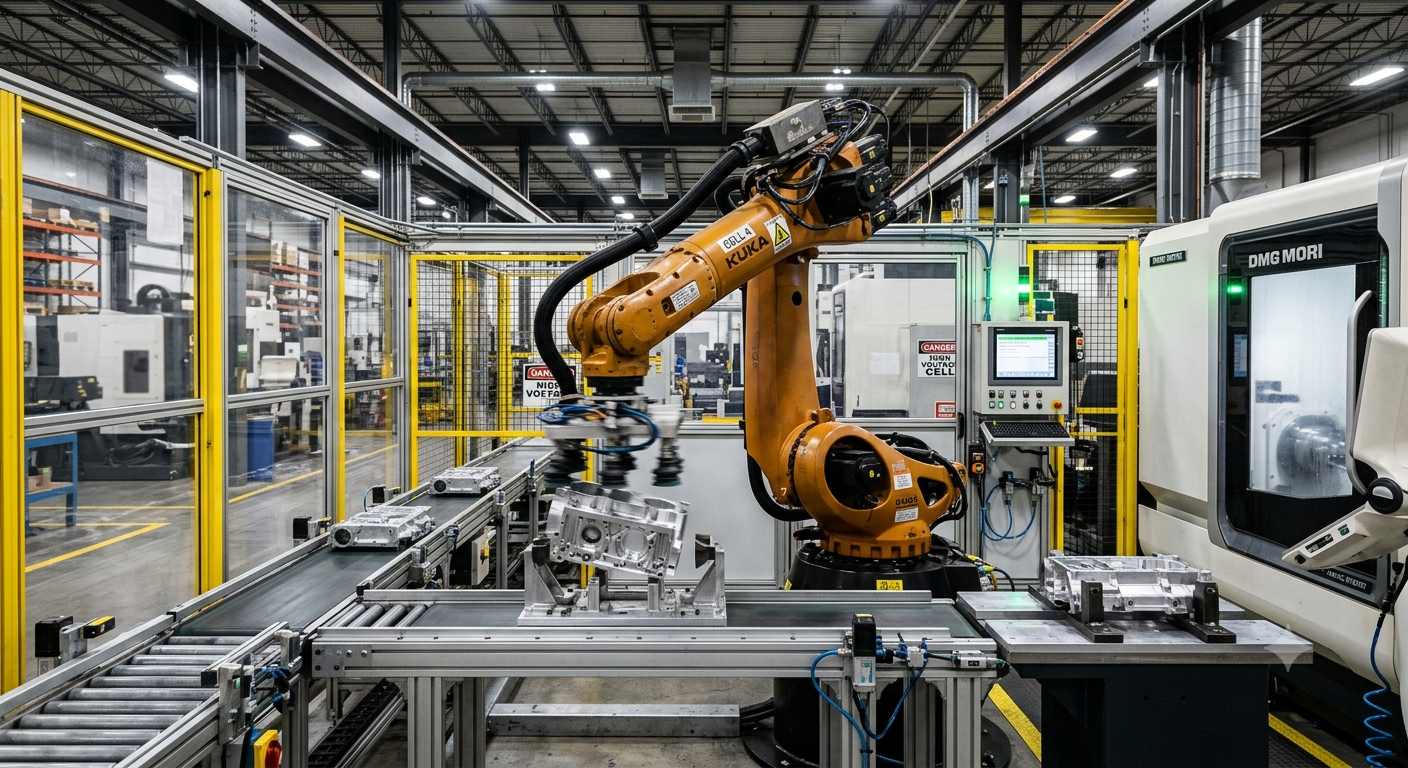
A robot can complete its programmed motion quickly and still fail to improve production output. That is why robot cycle time should not serve as a simple measure of how fast the arm moves. The real question is whether the complete robotic cell can repeat the required sequence at a stable rate without waiting for parts, machines, operators, sensors, safety conditions, or downstream equipment.
This distinction matters because project teams often set a cycle-time target before defining what the cycle actually includes. One supplier may measure robot motion only. Another may include gripping, process time, machine communication, and part release. Both may report a valid number, but those numbers do not describe the same production reality.
For plant managers, automation engineers, and technical buyers, cycle time becomes useful only when everyone understands the measurement boundary. Faster robot movement has limited value if part presentation, machine processing, tooling response, quality checks, pallet exchange, or downstream handling still constrain the cell.
What Robot Cycle Time Should Mean in a Real Production Cell
Robot cycle time is the elapsed time required for a defined robotic sequence to start, complete its required actions, and return to the agreed condition for the next cycle. The important phrase is defined robotic sequence. Without a clear start point, end point, and operating condition, teams can interpret the number differently.
In a simple handling application, the cycle might begin when a sensor confirms part availability and end when the robot places that part and becomes ready to accept the next one. In a machine-tending cell, the relevant cycle may include machine access, part removal, finished-part placement, new-part loading, confirmation signals, and clearance from the machine area.
Welding, palletizing, packaging, assembly, and other applications create different sequences. A welding cycle may depend more on process time than on free robot movement. Palletizing performance may depend on case arrival, gripper action, pallet pattern logic, and pallet exchange. In packaging, upstream product flow can leave a fast robot waiting with unused motion capacity.
Cycle-time discussions should therefore begin with the sequence boundary, not with a speed claim. The plant and integrator need to agree on the event that starts the clock, the event that stops it, the production conditions that apply, and the normal auxiliary actions included in the measurement.
Why Robot Cycle Time Matters Beyond Throughput
Cycle time is crucial because it links robot performance to the overall production system’s economics. While throughput is the most direct impact, cycle time also influences machine utilization, work-in-process inventory, operator workload, changeover efficiency, buffer sizing, and the reliability of the automation business case.
It determines whether the robot supports the required production rate
If a line requires a specific production rhythm, the robotic cell must support that rhythm under normal operating conditions. A theoretical sequence that works only with perfectly presented parts and no interruptions is not enough. Operations teams need to know whether the cell can sustain the required rate with the variation that actually exists in production.
This question becomes especially important when selecting which process to robotize first. A repetitive task may appear attractive, but unstable inputs or unresolved upstream delays can weaken the project case.
It affects utilization of expensive production equipment
In machine tending, robot handling can determine how long a CNC machine, molding machine, press, or other asset waits between process cycles. If unloading and reloading take longer than expected, the machine may remain idle even though its own processing capability has not changed.
The opposite situation also occurs. A robot may complete its handling sequence quickly but spend most of the cycle waiting for the machine process to finish. Reducing robot motion time further may then produce almost no additional output.
For this reason, project teams should evaluate machine tending as a flow problem rather than a robot-speed problem. URT’s guide to robotizing CNC machine loading and unloading without creating bottlenecks develops that decision in more detail.
It influences the credibility of ROI calculations
Cycle-time assumptions often feed directly into projected annual output, labor requirements, machine utilization, and payback calculations. When an assumed cycle excludes realistic waiting time, changeovers, planned operator interventions, or auxiliary equipment behavior, the financial model can overstate the production effect.
A defensible ROI case separates theoretical cycle capability from sustained production performance. The objective is not to make the robot look faster on paper. It is to identify which part of the current production loss automation can actually remove.
The Difference Between Robot Motion Time and Full Cell Cycle Time
One common automation mistake is treating robot motion time as the complete cell cycle. Motion time represents only one component. During a normal sequence, the robot may also wait for confirmation signals, gripper actions, process completion, machine doors, fixtures, sensors, safety conditions, product arrival, or downstream clearance.
Consider a pick-and-place sequence. Before the arm travels to the pickup position, the cell needs an available and correctly presented part. The end effector then engages the part and confirms a secure grip. Next, the robot moves to the destination, releases the part, receives the required confirmation, and continues to the following state.
Late part arrival forces the robot to wait. Slow gripper response adds another delay. An occupied destination blocks the sequence again. Increasing programmed arm speed does not automatically remove any of those constraints.
Different delays require different remedies. A motion-path problem may need programming optimization. Unstable infeed may require better part presentation. Machine handshake delays may point to control-system work, while downstream blockage may require changes outside the robot cell.
When programming effort itself creates a significant project constraint, teams should evaluate reducing robot programming time in industrial automation as a separate issue rather than confusing engineering time with production cycle time.
What Usually Controls Robot Cycle Time
A useful cycle-time review breaks the sequence into components instead of treating the final number as a single robot characteristic. This method helps teams identify where elapsed time originates and which delays they can realistically remove.
Robot path and motion profile
Travel distance, path geometry, orientation changes, approach positions, clearance requirements, and programmed motion behavior all affect elapsed time. An unnecessarily long path can add time without adding production value. However, shortening that path without checking collision clearance, process requirements, cable routing, tooling behavior, and safe operation can create a different risk.
The fastest path is therefore not automatically the best path. Production needs a stable sequence with sufficient clearance and repeatability, not an isolated motion demonstration.
End-of-arm tooling response
Grippers, vacuum systems, welding torches, dispensing equipment, and other tooling introduce their own operating conditions. A robot may reach a position quickly but still wait for grip confirmation, vacuum state, clamp action, release confirmation, or another process signal.
Tooling selection can therefore influence cycle performance as much as robot motion. It also affects payload margin, access, part control, maintenance burden, and the consequences of a failed pickup.
Part presentation
A robot cannot maintain a stable cycle when parts arrive unpredictably. Variation in position, orientation, spacing, stack condition, or timing can create waiting, search behavior, rejected picks, or additional sensing requirements.
Here, teams must separate repeatability from process readiness. A task can look repetitive to an operator while incoming parts remain highly variable. Successful automation may require fixtures, feeders, conveyors, vision, orientation control, or upstream process changes before the cell can maintain a reliable cycle.
Machine and controller communication
Robotic cells depend on handshakes between the robot controller, PLC, machines, safety system, sensors, and auxiliary equipment. The robot may wait for permission to enter, confirmation that a door has opened, a fixture state, process completion, or clearance to release a part.
Not every wait represents waste. Some interlocks support correct sequencing and safe operation. Engineers need to distinguish necessary conditions from avoidable delays caused by poor logic, slow equipment response, or an unnecessarily sequential process.
Upstream and downstream flow
A robotic cell depends on the material flow around it. When upstream equipment cannot provide parts consistently, the robot starves. When downstream equipment cannot remove finished parts or pallets quickly enough, the robot becomes blocked.
End-of-line systems make this issue especially visible. Before focusing on robot speed, the plant should examine whether case arrival, accumulation, pallet supply, pallet discharge, labeling, wrapping, or another surrounding process creates the real constraint. The broader decision framework appears in URT’s article on when end-of-line automation makes operational sense.
Why the Fastest Possible Cycle Is Often the Wrong Target
Driving every movement toward the shortest possible time can create the wrong optimization objective. Production systems need sustained performance, not one exceptional cycle. A small theoretical saving has limited value if it increases nuisance stops, part instability, tooling wear, recovery difficulty, or sensitivity to normal variation.
Aggressive motion, for example, may expose weaknesses in part control. A component that remains stable during moderate acceleration may shift in the gripper under a more demanding motion profile. The result can include failed placements, interruptions, or additional recovery work rather than useful production gains.
Similar problems arise when teams remove timing margins from equipment handshakes without understanding their purpose. Engineers should optimize unnecessary delays. However, some waiting periods reflect real mechanical response, process completion, signal validation, or safety conditions.
A better target is the shortest stable and supportable cycle that meets production requirements. The target should account for normal product variation, realistic equipment behavior, maintainability, and the ability of operators and technicians to recover the cell after a fault.
How to Measure Cycle Time Before Changing the Robot Program
Before optimizing the cell, define the measurement method. Use the following checklist to separate robot motion from the other conditions that influence elapsed production time.
- Define the exact event that starts the cycle measurement.
- Define the exact event that ends the cycle measurement.
- Record whether the measurement includes process time.
- Separate robot motion from waiting time.
- Identify waits caused by upstream part availability.
- Identify waits caused by downstream blockage.
- Record tooling actions and confirmation delays.
- Record machine, PLC, and safety-system handshakes.
- Check whether the sequence represents normal production or an ideal demonstration.
- Compare repeated cycles instead of relying on one best result.
- Document product format, recipe, tooling, and operating conditions.
- Identify the actual production constraint before changing robot speed.
This approach prevents a common error: optimizing the most visible movement instead of the largest source of lost time. If the robot spends substantial time waiting for a machine or material, reducing one travel segment may have little effect on total output.
Measurement should also connect to broader production indicators. Cycle time alone does not show whether the cell delivers acceptable quality, stable uptime, manageable recovery, or useful machine utilization. A wider KPI framework often becomes necessary after commissioning. URT’s guide to KPIs for measuring robotic automation success provides a related framework.
When Cycle-Time Optimization Should Not Be the First Priority
Delay cycle-time reduction when the process itself remains unstable. If parts arrive outside the expected position, fixtures repeat inconsistently, product quality varies, or operators regularly intervene to correct upstream problems, a faster robot may simply encounter those problems sooner.
Reliability issues should also take priority over speed optimization. Frequent faults, inconsistent gripping, communication interruptions, difficult recovery, or uncertain machine handshakes can have a larger production impact than a modest reduction in nominal cycle time.
Another case occurs when the robot is not the bottleneck. An upstream machine may control output, downstream handling may already run at capacity, or process time may exceed the robot handling sequence. Under those conditions, additional robot speed may not change line throughput.
Sometimes the current cycle already meets demand with sufficient margin. Engineering resources may then create more value by improving uptime, changeover performance, maintenance access, quality stability, or recovery procedures. Faster motion matters only when speed addresses the real constraint.
This is why automation should not compensate for uncontrolled production conditions. The question explored in whether automation improves quality or repeats the same mistake faster applies directly to cycle-time projects: optimization cannot substitute for process control.
What to Verify Before Setting a Cycle-Time Requirement
A cycle-time requirement works best when it describes the production outcome the cell must support rather than an arbitrary robot-speed target. Before adding the requirement to a project specification, the plant should verify the measurement boundary and surrounding constraints.
Use the following checks to make the target technically meaningful and easier to validate during commissioning.
- Confirm the required production rate and the basis for that requirement.
- Define whether the target applies to robot motion, a complete cell sequence, or finished production output.
- Specify the product variant and recipe used for measurement.
- Confirm how the measurement treats part arrival and downstream availability.
- Define whether machine process time sits inside or outside the cycle boundary.
- Identify normal tooling and sensor confirmation steps.
- Clarify how changeovers and format variation affect the target.
- Define realistic acceptance conditions instead of using an unloaded demonstration.
- Check whether quality requirements remain stable at the proposed operating rate.
- Verify that the target addresses the actual production bottleneck.
A clear requirement protects both the buyer and the integrator. It makes acceptance testing more objective and reduces the risk of disputes over a number that nobody defined consistently.
Clear boundaries also improve investment decisions. When cycle time reflects real production conditions, the plant can evaluate whether the project changes throughput, machine utilization, labor allocation, scrap, rework, or another measurable source of value.
FAQ
What is robot cycle time?
Robot cycle time is the total time taken to complete a specific robotic sequence and return to the set condition ready for the next cycle. This definition is meaningful only when the start and end events, included actions, product condition, and operating assumptions are clearly specified.
Is robot cycle time the same as production cycle time?
No. Robot cycle time may refer only to a defined robot sequence, while production cycle time can include machine processing, part arrival, operator actions, inspection, downstream handling, and other events. Teams should not use the terms interchangeably unless both measurements share the same boundary.
Does a faster robot always increase production output?
No. Output increases only when robot speed affects the real system constraint. If the robot waits for an upstream machine, product arrival, process completion, or downstream clearance, faster motion may have little effect on total throughput.
What factors can increase robot cycle time?
Many factors can affect robot cycle time, including robot path length, orientation changes, tooling response, part presentation, sensing, machine handshakes, process time, safety conditions, upstream starvation, and downstream blockage. Which factors matter most depends on the specific application and the defined cycle boundaries.
Should cycle time be measured from one robot movement?
Usually not when the goal is to understand production performance. One movement may help with programming analysis, but a production decision normally requires a defined repeatable sequence. Repeated measurements under representative operating conditions provide more useful information than one best-case movement.
When should a company optimize robot cycle time?
Optimization makes sense when measurement shows that the robotic sequence creates a meaningful production constraint and the process remains stable enough to support changes. If reliability, part presentation, machine communication, or downstream flow causes the real problem, address those conditions first.
Can cycle-time optimization reduce ROI instead of improving it?
Yes. Optimization can reduce value if it creates instability, increases interruptions, complicates recovery, or consumes engineering resources without changing actual output. ROI depends on measurable production effects, so a shorter nominal cycle has limited value when it does not improve sustained performance.
Talk to URT About Robot Cycle Time
If you are evaluating robot cycle time, contact URT. We will give you a direct, technical answer based on your actual production requirements.