
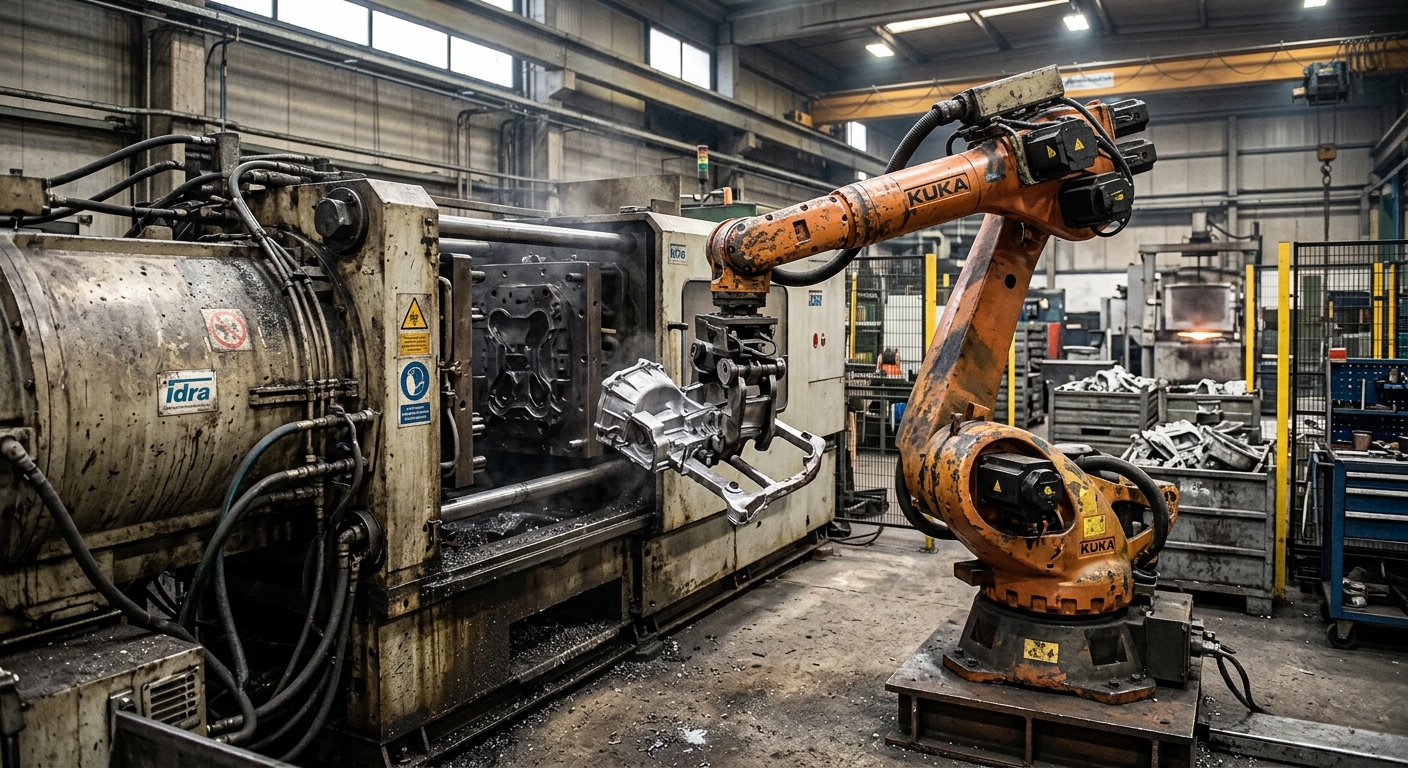
A robot can move smoothly during a test and still create problems once it returns to a die-casting cell. Buyers evaluating used die-casting robots need to look beyond basic motion. Mechanical wear, heat exposure, controller condition, tooling, and integration requirements all affect whether reuse makes sense.
Die casting can expose equipment to heat, contamination, lubricants, repeated cycles, and demanding handling conditions. Those factors can affect joints, cables, connectors, tooling, sensors, and other cell components. A successful reuse project starts with the condition of the actual robot, not with assumptions based on its model or purchase price.
The real decision is simple: can this specific robot support the new process without creating unacceptable integration or downtime risk? That question requires a structured inspection before the plant designs the cell around the equipment.
Previous Application History Changes What You Need to Inspect
Start by finding out where the robot worked before. Previous service does not determine whether the robot is good or bad, but it helps identify likely areas of wear.
A robot that worked beside a die-casting machine may have faced heat, contamination, and repeated high-cycle movement. A robot from a cleaner handling process may show a very different wear pattern. Neither background proves suitability for the next application.
Maintenance records can reduce uncertainty. Review available service history, repairs, controller information, backups, and tooling details. These records can reveal whether technicians addressed recurring problems or whether major questions remain unanswered.
Visual appearance tells only part of the story. A clean robot can still contain worn components. A robot with cosmetic marks may still have strong mechanical condition after proper maintenance.
URT’s guide on what to consider when buying refurbished robots explains why buyers need to assess the complete equipment history rather than focus only on price or appearance.
Mechanical Condition Comes Before Application Fit
Do not begin with the question, “Can this model handle the part?” Begin with the condition of the actual unit.
Inspect the robot for abnormal motion, leakage, damaged covers, deteriorated cables, worn dress components, and signs of previous repair. Listen for unusual mechanical behavior during controlled movement. Review any available maintenance information that may explain what you find.
A basic movement test only confirms that the axes can move. It does not prove that the robot can support another production cycle under the intended load and motion profile.
Evaluate the full wrist load
The robot will not carry the casting alone. It also carries the gripper, adapters, sensors, brackets, heat protection, and other wrist-mounted equipment.
Tooling geometry matters as much as total weight. A long gripper can move mass farther from the flange and increase mechanical demand on the wrist. Heat shields and extended fingers may create the same effect.
Engineers need to evaluate the complete tooling arrangement against official documentation for the exact robot model and variant. Do not assume that a nominal payload rating proves that every tooling configuration will work.
Inspect cables, connectors, and dress components
External cabling often receives less attention than the arm, yet it can create early downtime after installation. Repeated movement, heat, contamination, and poor routing can damage cables and connectors.
Check the condition of the dress package and plan the new routing before commissioning. The new cell may require a different path than the robot followed in its previous application.
Good cable routing reduces unnecessary bending, abrasion, interference, and exposure to hot areas. Poor routing can turn an otherwise sound robot into a maintenance problem.
Heat Exposure Can Decide Whether Reuse Makes Sense
Die-casting applications require more than a general check for high temperature. Engineers need to understand where the heat comes from and how long the robot remains exposed.
A hot casting can transfer heat through the gripper. Radiant heat from the process can affect the wrist and nearby components without direct contact. Hot air and contamination around the machine can also increase environmental stress.
Cycle conditions matter too. A robot may spend only a short time near the die during normal production. An abnormal stop can leave the arm or tooling near a hot area for much longer.
Do not assume every industrial robot offers the same protection
Robot configurations differ. Some versions target demanding foundry or casting environments, while standard industrial robots may require a different layout or additional protection.
Confirm the exact model and configuration before making environmental assumptions. Review official manufacturer information for the unit whenever possible.
If you cannot confirm environmental limits or protective features, treat that uncertainty as an engineering issue. Do not replace missing information with specifications from a similar robot or another variant.
Use cell design to reduce unnecessary exposure
Layout can sometimes reduce heat exposure more effectively than adding protection to the arm. Keep major robot components away from hot areas when the process allows it.
Tooling can create distance between the wrist and the casting, but that approach creates a trade-off. Longer tooling can increase inertia and reduce clearance around the machine.
The cell designer therefore needs to consider thermal protection, reach, tooling stiffness, mechanical loading, and access together. Solving one problem should not create another.
Controller Compatibility Can Turn a Good Robot Into a Poor Purchase
A mechanically healthy robot can still create a difficult project when its controller does not fit the new cell. Check controller generation, communication options, available software, I/O requirements, backups, and support before committing to the equipment.
The robot may need to communicate with the die-casting machine, conveyors, inspection systems, cooling equipment, tooling, and safety devices. Define those interfaces early.
An older controller may still fit the project. The key question is whether the plant can integrate and support it without excessive cost or downtime risk.
This issue becomes especially important when replacing an existing robot. Similar arms do not guarantee plug-and-play replacement. Controllers, software, mounting details, safety architecture, and tooling interfaces can differ.
URT’s guide to refurbished robot compatibility with existing systems explains why buyers need to resolve these questions before the robot becomes part of the final cell design.
Check support before production depends on the robot
Ask who will troubleshoot the system after commissioning. Check spare parts access, internal controller knowledge, backups, documentation, and external technical support.
A platform already used in the plant may simplify maintenance and training. An unfamiliar controller may increase dependence on outside support.
Neither situation automatically makes the project right or wrong. The important point is to include support capability in the purchasing decision rather than discovering the gap after a production stop.
The Gripper Needs a Separate Engineering Review
Reusing the robot does not mean the old gripper belongs in the new cell. The new casting may differ in geometry, temperature, weight distribution, surface condition, or presentation.
The gripper needs to hold the part securely throughout the entire path. Engineers need to consider finger geometry, contact points, actuator behavior, sensors, adapters, and the consequences of losing air or electrical power.
Heat also affects tooling decisions. A longer gripper may keep the wrist farther from the casting, but it can increase mechanical loading. Insulating components or heat shields may help, but the design needs to match the actual process.
Part location matters just as much. If the casting does not arrive in a repeatable position, the robot may miss the correct grip point even when the arm performs perfectly.
In that situation, the plant may need better mechanical location, sensors, vision, or changes to the upstream process. The robot cannot compensate reliably for every source of uncontrolled variation.
Process Stability Matters More Than Robot Repeatability
A repeatable robot cannot fix an unstable die-casting process by itself. The cell needs consistent part presentation, known cycle conditions, predictable machine signals, and reliable tooling.
For example, variation in part location can force the gripper to approach an inconsistent pickup point. Excess material or changing part geometry can interfere with gripping. Irregular machine timing can leave the robot waiting or create recovery problems.
These issues can reduce output even when the robot works exactly as programmed. They can also make operators blame the robot for problems that begin elsewhere in the process.
Before reuse, document the conditions the robot will receive from the die-casting machine. Define normal cycles, common interruptions, part orientation, required cooling or transfer steps, and the expected response after a fault.
If the process varies too much, stabilize it before adding or reusing the robot. Automation can repeat a controlled process very well. It can also repeat an uncontrolled problem very consistently.
A New Cell Requires a New Safety Review
The previous installation does not prove that the robot will operate safely in the new one. The new cell changes the layout, machine interfaces, tooling, access points, and intervention tasks.
Die casting adds hazards beyond robot motion. The cell may include hot parts, hot surfaces, machine movement, stored energy, dropped components, and maintenance access near process equipment.
Engineers need to evaluate the complete system rather than treat the robot as an isolated machine. OSHA’s industrial robotics guidance provides useful general context for considering the robot together with controls, end effectors, sensors, power sources, and related equipment.
The plant also needs clear recovery procedures for jams, dropped parts, abnormal machine cycles, and maintenance work. These situations often require people to interact with the cell under conditions that differ from normal automatic operation.
Reusing equipment does not reduce the need for a proper safety assessment. In some cases, it increases the amount of verification because the buyer must understand both the condition of the used equipment and the design of the new installation.
Total Reuse Cost Matters More Than Purchase Price
A used robot may lower the initial equipment cost, but that does not automatically make the project cheaper. The real comparison includes everything required to put the robot into stable production.
Include inspection, refurbishment, tooling, protective equipment, controller work, programming, integration, safety equipment, commissioning, training, spare parts, and support. Also consider the financial effect of downtime if the cell cannot recover quickly from a failure.
URT’s analysis of used robot total cost of ownership compared with new equipment provides a broader framework for this decision.
A low purchase price can disappear quickly when the project needs extensive adaptation. A higher-priced used robot in better condition may create less overall risk than a cheaper unit with unknown history or difficult controller support.
When a new robot may make more sense
Do not force a used robot into the project just because the purchase price looks attractive. New equipment may make more sense when the available used robot lacks the required environmental configuration or creates unacceptable support risk.
New equipment may also offer a clearer path when the plant cannot verify the used robot’s condition or history. Production criticality matters here. A plant with very high downtime costs may accept less uncertainty than one with flexible capacity.
The right comparison depends on the whole project. URT’s guide to choosing between new and refurbished robots looks at that decision through compatibility, support, integration effort, and production risk.
What to Check Before Reusing a Robot for Die Casting
Use this checklist after you define the application requirements. Treat each item as something to verify, not something to assume from the robot’s age, appearance, or previous use.
- Robot identity: Confirm the exact model, variant, controller, configuration, and available documentation.
- Previous application: Identify the process and environment where the robot worked before.
- Mechanical condition: Inspect joints, wrist components, covers, seals, cables, connectors, and dress equipment.
- Service history: Review available maintenance records, repairs, backups, and known faults.
- Heat exposure: Define radiant heat, part temperature, exposure duration, and abnormal-stop conditions.
- Environmental protection: Confirm whether the exact robot configuration suits the planned cell environment.
- Wrist load: Include the casting, gripper, adapters, sensors, shields, and other tooling.
- Tooling geometry: Check centre of gravity, inertia, clearance, gripping stability, and heat transfer.
- Robot path: Review pickup, release, machine access, joint movement, obstacles, and recovery positions.
- Controller fit: Check communication, I/O, software, backups, and safety interfaces.
- Support capability: Confirm spare parts access, internal skills, documentation, and technical support.
- Cell safety: Assess hot parts, machine movement, maintenance access, intervention, and fault recovery.
- Total project cost: Add inspection, refurbishment, tooling, integration, commissioning, training, and downtime risk.
If several items remain unknown, do not treat them as minor paperwork gaps. Each unknown can become an integration problem, a maintenance problem, or a production stop later.
FAQ
Can any used industrial robot work in die casting?
No. The robot must match the application, environment, tooling, controller requirements, and cell design. Mechanical condition also matters. A robot that performs well in a clean handling application may not suit a demanding casting environment.
Is a robot from a previous die-casting application a safer choice?
Not automatically. Previous casting service may mean the robot had suitable protection for that environment. It may also mean the unit experienced years of heat, contamination, and heavy cycling. Inspect the actual condition before making a decision.
How important is the robot’s maintenance history?
Maintenance history can reduce uncertainty. It may show previous repairs, recurring problems, or regular service. When records do not exist, the buyer needs a stronger physical and technical inspection before relying on the robot in production.
Can the old gripper stay on the robot?
Only when it fits the new part and process. Check geometry, gripping force, sensors, temperature exposure, mechanical loading, and behavior during faults. A gripper that worked in the previous cell may not fit the next one.
Why does controller compatibility matter so much?
The controller connects the robot to the rest of the cell. Communication, I/O, software, backups, safety interfaces, diagnostics, and support all affect integration. A sound robot arm can still create a poor project when the controller does not fit the plant.
When should a plant buy new instead?
A new robot may make more sense when the plant cannot verify the used unit’s condition, environmental suitability, controller support, or integration fit. New equipment may also reduce risk when production cannot tolerate extended downtime or uncertain spare-parts support.
Talk to URT About Used Robots for Die Casting
If you are evaluating used robots for die casting, contact URT. We will give you a direct, technical answer based on your actual production requirements.