
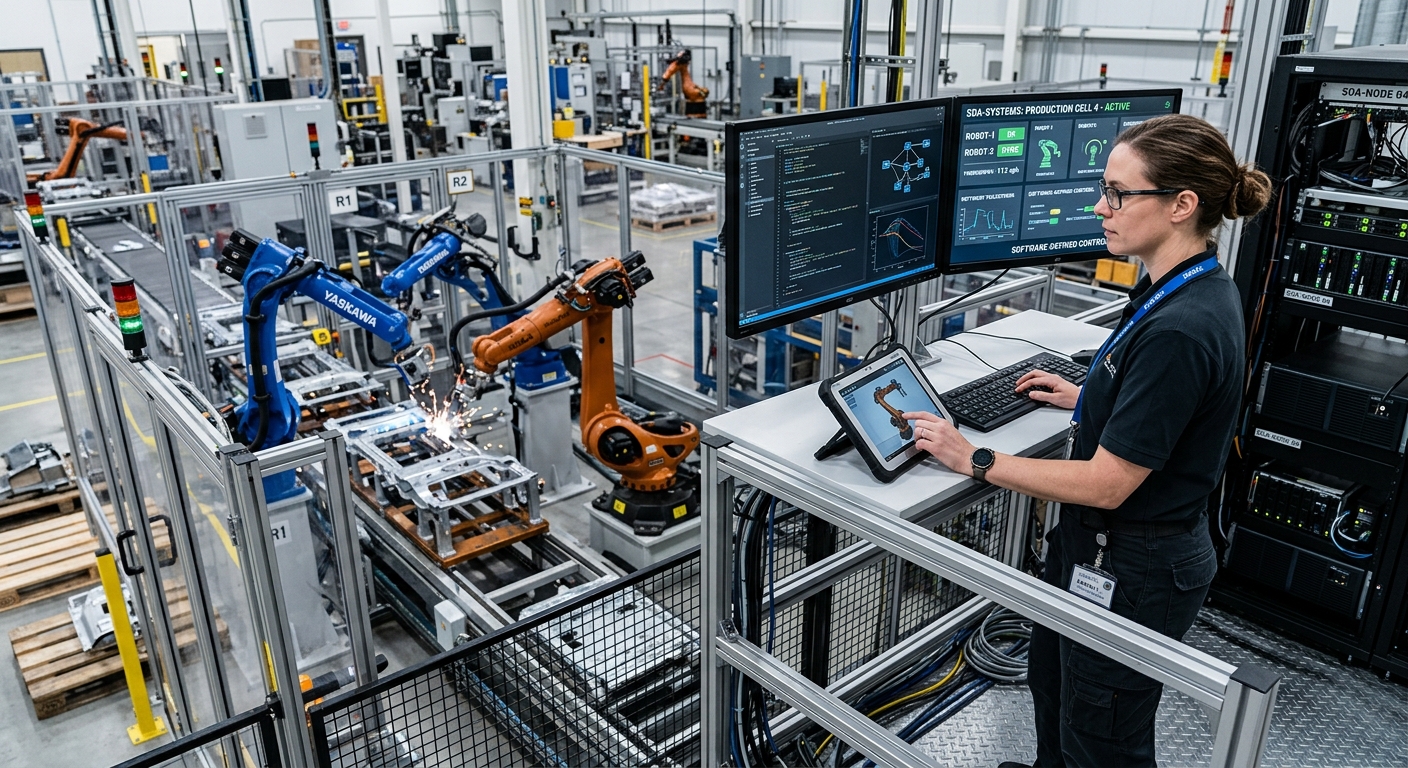
Software flexibility does not remove the physical constraints of a robot cell
Software-defined automation can change how manufacturers configure, program, connect, and adapt industrial robots. However, it does not make the physical production process programmable by default. A plant may gain more flexibility at the software layer while tooling, fixtures, part presentation, robot reach, safety architecture, and upstream equipment still constrain production.
That distinction matters because the business case for software-defined automation involves more than moving functions into software. Manufacturers need to determine whether software makes the automation system easier to modify, integrate, diagnose, and reuse. They also need to ensure that new software dependencies do not increase production risk.
For an industrial buyer, this shifts part of the robot decision away from the mechanical arm alone. Buyers increasingly need to consider controller architecture, interfaces, software tools, data access, integration capability, version management, and support. These factors can influence how a robotic cell performs throughout its operating life.
What is actually becoming more software-defined?
Industrial robots have depended on software for decades. Robot programs already control motion sequences, process instructions, communication with peripheral equipment, recipes, error handling, and many other cell functions. Software-defined automation therefore does not represent the arrival of software in robotics.
The more meaningful change involves separating more automation functionality from rigid, hardware-specific engineering. Instead of permanently tying every machine function to one physical configuration, a software-oriented architecture can make certain behaviors easier to configure, reuse, simulate, connect, or modify.
This approach can affect several layers of a robotic system. These include robot programming, PLC communication, production recipes, equipment interfaces, simulation, data collection, diagnostic functions, and connections to higher-level production systems. Platforms differ considerably in their architecture, so manufacturers should not treat the term itself as a technical specification.
That last point matters when evaluating suppliers. Two systems described as software-defined may provide very different levels of openness, portability, hardware independence, data access, or integration flexibility. Buyers need to examine what they can actually change through software. They should also identify which functions still depend on proprietary hardware, controllers, licenses, or engineering tools.
Robot programming can become less isolated
A traditional robotic cell can accumulate several separate engineering environments. Engineers may use one for the robot, another for the PLC, and others for vision, safety, process equipment, and production monitoring. Every interface adds another element that teams must commission and maintain.
Software-oriented architectures can reduce some of this fragmentation when programming, simulation, configuration, and data exchange work together. The operational benefit goes beyond using fewer programming environments. A better architecture can reduce the engineering effort required when the production system changes.
This connects directly with the broader challenge of reducing robot programming time in industrial automation. Programming speed matters most when it reduces real commissioning, changeover, recovery, or modification time. A more convenient development interface alone does not guarantee that result.
Production data can become part of the control strategy
A connected robot can provide information about operating states, alarms, cycle execution, and other available controller data. When production systems receive that information, software can provide more useful context about what is happening inside the cell.
Manufacturers must distinguish between collecting data and creating operational value. A plant does not improve uptime merely because it stores more variables. Data becomes useful when the organization knows which conditions matter, how to identify abnormal behavior, and what action to take.
This is particularly relevant to predictive maintenance using robot sensors and production data. In this context, the quality of the maintenance decision matters more than the volume of information collected.
Where software-defined automation can create practical value
The strongest case appears in production environments where change itself creates a measurable cost. Products, recipes, sequences, equipment combinations, or production volumes may change regularly. In these environments, the ability to modify the automation system efficiently can have operational value.
A plant running the same product on a dedicated line for many years has different requirements from a manufacturer handling shorter production runs or multiple variants. Frequent product introductions and equipment repurposing also change the requirements. Software flexibility matters more in these environments because engineering changes occur more often.
Faster production changes
Production changes may require engineering teams to modify robot programs, PLC logic, recipes, tooling parameters, vision configurations, and equipment interfaces. A better software architecture can simplify those changes when engineers design the cell for variation from the beginning.
However, software cannot compensate for physical incompatibility. A new product may still require different grippers, fixtures, sensors, conveyors, guarding, or robot capacity. A configurable program cannot make an end effector grip a part that it was never designed to handle.
This is the same production principle seen in flexible packaging automation. A robotic system can switch recipes quickly, but the physical cell must still support the required formats. URT’s guide to choosing robots for multiple packaging formats examines the difference between programmable flexibility and actual cell flexibility.
More repeatable engineering across cells
Software reuse can also create value when a manufacturer operates several similar cells. Teams can standardize program structures, interfaces, naming conventions, diagnostic logic, and equipment communication. This standardization can reduce the amount of custom engineering required for each installation.
The advantage depends on standardization beyond the software itself. Software reuse becomes more difficult when every cell uses different peripheral equipment, controller generations, field communication, safety architectures, and operating conventions.
For multi-cell plants, the relevant question is not simply whether engineers can copy code. They need to determine whether the automation architecture has enough standardization to make reused software behave predictably in another machine.
Better visibility for maintenance and production teams
Software-defined and connected architectures can also make diagnostics more accessible. Instead of treating each robot as an isolated machine, the plant can combine robot states with information from PLCs, process equipment, sensors, and production systems.
This approach can shorten fault investigation when the available information identifies where the production sequence actually stopped. For example, a robot alarm may represent the visible symptom rather than the initiating condition. Part presentation, a peripheral machine, a sensor, or an upstream process may have caused the original problem.
Better diagnostics still require people who understand the system. Software can expose the state of the cell. It cannot automatically give maintenance teams the skills to identify the root cause or recover production safely.
Where the software-defined automation argument becomes overstated
The risk with any new automation concept comes from assuming that architectural flexibility automatically produces operational flexibility. Industrial production is less forgiving. The robot still has to move a physical tool through a physical workspace while coordinating with real parts, machines, people, and process constraints.
A software change cannot increase the mechanical capacity of an undersized robot. It cannot correct inadequate torch access in a welding fixture. It also cannot stabilize randomly presented parts without the required sensing or fixturing, or make an unsuitable gripper handle a new product reliably.
The same principle applies to process quality. If inputs vary outside controlled conditions, a more sophisticated software layer may simply control an unstable process in a more sophisticated way. Manufacturers should establish whether the underlying operation is genuinely ready for automation before investing in additional software capability. The distinction is similar to the question of whether automation improves quality or repeats the same process problem faster.
Hardware independence has limits
Software abstraction can make systems easier to integrate, but industrial robot platforms are not interchangeable computing devices. Controllers, motion systems, safety functions, communication options, programming environments, process packages, and peripheral interfaces can differ substantially.
This becomes especially important when a plant operates equipment from different generations. A software architecture designed around newer connectivity capabilities may not transfer directly to a legacy controller. Manufacturers must include gateways, software licenses, interface development, controller upgrades, and additional hardware in the project evaluation when the architecture requires them.
Simulation is not production validation
Software-oriented automation can make offline engineering and simulation more useful. This becomes particularly valuable when teams want to prepare changes before interrupting production. However, a successful virtual test does not eliminate the need to commission the physical cell.
Real production introduces variables that engineers must represent accurately in the model. These include fixture tolerances, cable routing, tooling behavior, sensor response, actual part presentation, equipment timing, communication delays, and operator interaction. Simulation can reduce uncertainty, but teams still need acceptance testing to demonstrate reliable physical performance.
Adoption depends on the existing automation architecture
Manufacturers can evaluate software-defined automation more easily in a new cell than in a plant with years of accumulated automation equipment. Existing factories may contain several robot brands, controller generations, PLC platforms, communication protocols, process machines, custom programs, and undocumented interfaces.
In that environment, the first question concerns architecture: what can realistically communicate with the proposed software layer? The second question concerns operations: what happens to production if that layer becomes unavailable?
Manufacturers should therefore evaluate compatibility before software functionality. Engineering teams need to identify which robot controllers and peripheral devices expose the required interfaces. They must also determine which systems need additional integration and which legacy equipment should remain independent.
Ownership must remain clear
As automation becomes more software-dependent, responsibility can become less obvious. A cell failure may involve robot code, PLC logic, networking, an application service, a database, or another connected system.
Plants need to assign clear ownership to those layers. Maintenance personnel may understand the robot but lack the knowledge to diagnose the communication architecture. In that situation, recovery may depend on an external software specialist. Likewise, an IT team that does not understand production consequences could introduce unexpected operational effects during a routine infrastructure change.
The technical architecture therefore needs a corresponding support architecture. Plants should define who maintains each layer, who controls changes, who can restore a known configuration, and who responds when production stops.
Cybersecurity becomes an operational requirement
Greater connectivity creates another condition that manufacturers cannot treat as an afterthought. When robot controllers and automation systems exchange more data across networks, plants need to manage access control, software updates, configuration, network architecture, and recovery planning. These elements become part of production reliability.
This does not mean every robotic cell needs a connection to higher-level systems. Manufacturers should add connectivity when it supports a defined operational requirement. Connections without a clear production purpose increase system complexity without necessarily improving output.
The cost question is about lifecycle engineering, not software price
The financial case for software-defined automation involves more than licenses or development tools. Its value is more likely to appear across the lifecycle of the automation system.
Relevant cost drivers include engineering hours for new cells, commissioning time, production interruptions during modifications, program reuse, troubleshooting time, and training requirements. Manufacturers should also account for software support, controller compatibility, licenses, network infrastructure, and the cost of maintaining multiple versions.
That means plants that make frequent engineering changes may have the strongest business case. If a cell rarely changes after commissioning, additional software flexibility may provide limited value. A simpler architecture may already perform the required work reliably.
The plant should define measurable objectives before implementation. Useful measurements can include engineering hours per product change, commissioning time, changeover losses, and recovery time after selected faults. Plants can also measure the effort required to deploy a validated change across similar cells. URT’s framework for measuring robotic automation with production KPIs provides a useful basis for separating technical capability from demonstrated production value.
How to evaluate software-defined automation before investing
The evaluation should start with the production problem rather than the software platform. Use the following checks to determine whether additional software flexibility addresses a measurable constraint or simply adds another technology layer to the cell.
- Define the production change: Identify what currently requires excessive engineering time, downtime, manual configuration, or specialist intervention.
- Map the hardware dependencies: Document the robot controllers, PLCs, safety systems, sensors, vision equipment, process machines, and networks that the software must interact with.
- Check controller compatibility: Confirm which existing robot generations can support the required interfaces. Do not assume that all robots from one manufacturer behave identically.
- Separate software flexibility from physical flexibility: Verify that tooling, fixtures, workspace, part presentation, and peripheral equipment can support the intended production changes.
- Define ownership: Establish who controls software changes, backups, versions, access permissions, diagnostics, and recovery.
- Plan for failure: Determine how the cell behaves if a network connection, software service, interface, or higher-level system becomes unavailable.
- Measure the baseline: Record current engineering effort, changeover losses, commissioning time, or recovery time before claiming that a new architecture improves them.
- Evaluate lifecycle support: Consider licenses, updates, training, integration knowledge, documentation, and long-term compatibility alongside the initial implementation cost.
A software-defined approach becomes easier to justify when these checks expose a real production constraint that software can remove. If unstable parts, inadequate tooling, poor fixturing, insufficient robot capacity, or an uncontrolled process cause the problem, manufacturers should address those issues first.
FAQ
What does software-defined automation mean for industrial robots?
It generally means moving more configuration, coordination, programming, data handling, and system behavior into software layers. Engineers can then modify some functions more independently from the physical automation hardware. The practical meaning depends on the platform, so buyers should verify which functions they can configure through software and which still depend on specific controllers or equipment.
Does software-defined automation make industrial robot hardware interchangeable?
No. Robot controllers, safety functions, motion systems, programming environments, communication interfaces, process packages, and tooling requirements can differ. Software can abstract some differences, but engineers still need to address physical and controller-level compatibility.
Can software-defined automation reduce robot programming time?
It can reduce programming time when the architecture supports reusable programs, standardized interfaces, simulation, structured configuration, and easier deployment across similar systems. Manufacturers should measure the reduction in real engineering, commissioning, or changeover effort rather than the number of software tools used.
Is software-defined automation useful for older industrial robots?
Potentially, but manufacturers must check compatibility controller by controller. Older systems may have limited communication interfaces, software dependencies, or integration options. Additional gateways or controller changes can alter the economics of the project.
Does a more connected robotic cell create more cybersecurity risk?
Greater connectivity increases the number of interfaces that teams need to manage. Plants therefore need to consider access control, network architecture, software changes, backups, version management, and recovery as part of production reliability. The appropriate architecture depends on which connections the plant actually needs.
When is software-defined automation not worth the added complexity?
It may offer limited value in a stable cell that performs one process for long periods, requires few engineering changes, and already has reliable diagnostics and support. Manufacturers should also avoid using additional software complexity as a substitute for correcting unstable processes, unsuitable tooling, inconsistent part presentation, or other physical production problems.
Talk to URT about software-defined robot automation
If you are evaluating software-defined robot automation, contact URT. We will give you a direct, technical answer based on your actual production requirements.