
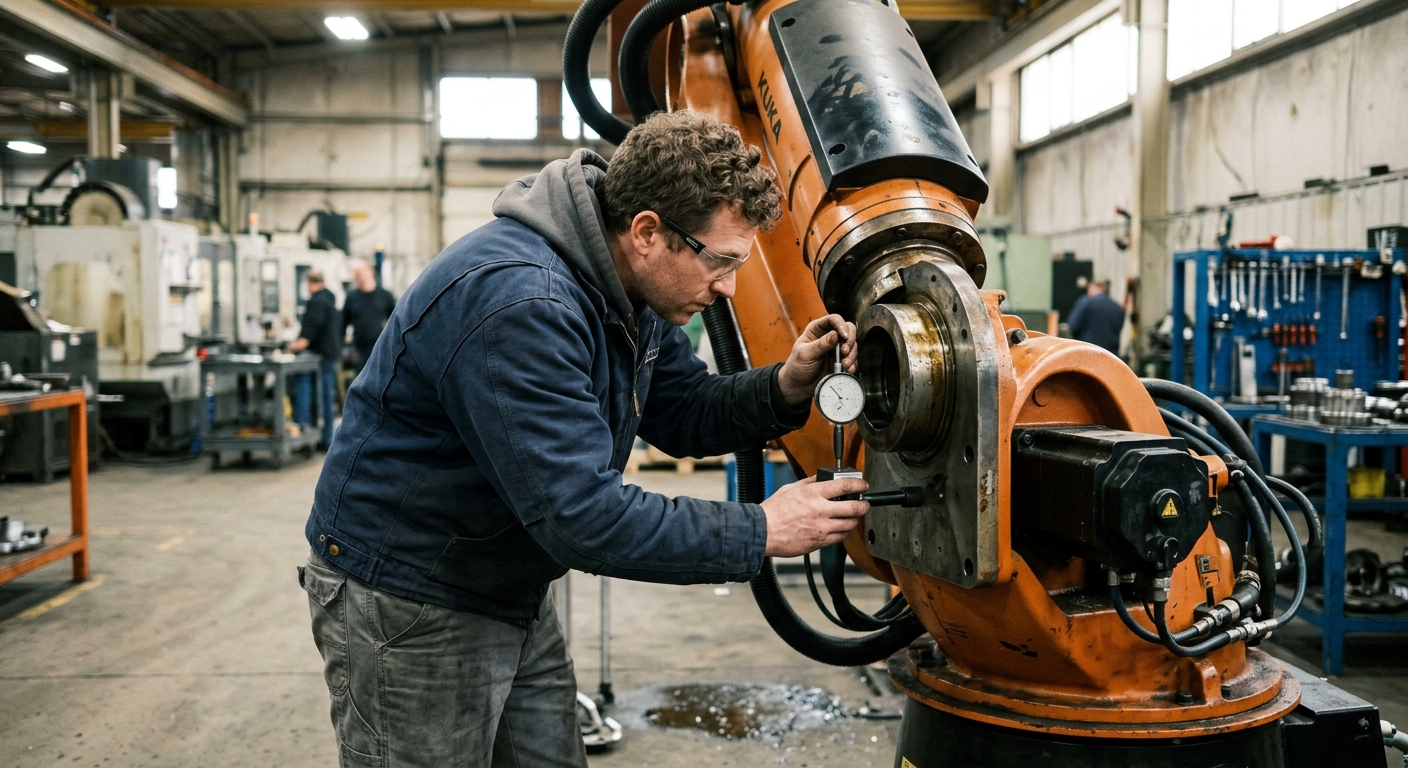
Backlash Should Be Diagnosed Before It Becomes a Repeatability Problem
Industrial robot backlash can first appear as a small positioning inconsistency that operators compensate for rather than report. A taught point needs adjustment, a tool approaches a fixture differently depending on its direction of travel, or a process that was previously stable begins requiring corrections. The operational risk is assuming that every positioning problem is a programming problem.
Backlash is mechanical lost motion between the drive system and the robot joint. Some clearance is inherent in transmission systems. However, a noticeable increase can indicate wear, damage, looseness, or another condition that requires investigation. The important maintenance question is therefore not whether any clearance exists, but whether the robot’s mechanical condition has changed enough to affect production.
That distinction matters because changing programs or process offsets can hide a mechanical problem temporarily. If the underlying condition continues to deteriorate, the plant may eventually face quality losses, additional maintenance work, or unplanned downtime.
What Excessive Backlash Usually Indicates
When backlash becomes excessive, maintenance teams need to isolate the cause rather than assume it. An industrial robot contains several mechanical interfaces. These include the motor, reduction mechanism, joint structure, tooling, and process load. Movement observed at the tool does not automatically identify which component is responsible.
A maintenance team should also distinguish backlash from other sources of apparent positioning error. Loose tooling, fixture movement, calibration problems, damaged mounting interfaces, process variation, or an unstable workpiece can produce symptoms that resemble mechanical play in the robot.
This is why diagnosis should begin with the symptom and its operating conditions. Does the error appear on one axis or throughout the robot? Does it become visible only when the direction of travel reverses? Does it change with robot posture or load? Did it appear gradually or immediately after a collision or abnormal event?
Those observations provide more useful diagnostic information than repeatedly modifying taught positions.
Common Mechanical Causes of Excessive Robot Backlash
Wear in the Joint Reduction Mechanism
The reduction mechanism transfers motor motion to the robot joint while providing the mechanical ratio required for controlled movement. Wear inside that transmission can increase lost motion between commanded motor movement and actual joint movement.
The rate and pattern of wear depend on the robot, application, operating history, loading, maintenance condition, and previous mechanical events. For that reason, maintenance teams should not assign a universal service life or backlash limit without manufacturer documentation for the specific robot.
If a joint shows progressively increasing play, especially when movement reverses direction, the reduction mechanism is one area that qualified maintenance personnel may need to evaluate.
Abnormal Loads and Repeated Mechanical Stress
A robot can operate successfully only when the complete mechanical load is appropriate for its configuration and application. That load includes more than the workpiece. The end-of-arm tooling, adapters, cables, process equipment, and the way the mass is distributed all influence the mechanical demands placed on the axes.
Repeated operation under unsuitable loading conditions can increase stress on drivetrain components. Dynamic motion matters as well. Aggressive acceleration, frequent reversals, demanding postures, and high-duty operation can increase mechanical demands. A slower process may behave differently with the same nominal load.
This is one reason buyers should never treat payload as the only mechanical selection criterion. The robot, tooling, load distribution, motion profile, and application have to be evaluated together.
Collisions and Abnormal Process Events
A collision does not have to stop a robot permanently to justify mechanical inspection. Contact with a fixture, machine, workpiece, pallet, positioner, or other cell equipment can transmit abnormal forces through the robot structure.
After a significant collision, simply reteaching the affected points may restore the process without establishing whether the mechanical condition has changed. If positioning symptoms appeared immediately after the event, maintenance teams should record that timing as valuable diagnostic information.
Maintenance teams should follow the robot manufacturer’s inspection and recovery procedures rather than assuming that successful movement means the drivetrain is undamaged.
Loose Mechanical Interfaces
Not every apparent backlash problem originates inside a gearbox or reducer. Mechanical looseness at the robot base, wrist interface, tooling adapter, end effector, fixture, or another structural connection can create movement that appears at the tool center point.
This distinction can materially change the repair decision. Replacing or rebuilding an internal joint component will not solve movement caused by a loose external interface.
The diagnostic process therefore needs to isolate where movement begins. Maintenance personnel should follow the applicable manufacturer procedures and plant safety practices rather than dismantling components based on the symptom alone.
Lubrication or Maintenance-Related Deterioration
Robot drivetrain components depend on the maintenance requirements specified by their manufacturer. Incorrect lubricant, contamination, leakage, inadequate maintenance, or maintenance performed outside the applicable procedure can contribute to mechanical deterioration.
There is no responsible universal lubrication interval for all industrial robots. The correct lubricant, quantity, method, inspection criteria, and maintenance schedule depend on the exact robot and axis. Manufacturer documentation should control these decisions.
A useful maintenance strategy is to preserve records so that maintenance teams can compare changes with the robot’s service history. URT’s guidance on predictive maintenance and robot reliability explains the broader value of detecting deterioration before it becomes an unplanned production stop.
Why Backlash Can Affect More Than Robot Positioning
The production consequence depends heavily on the application. A small mechanical change may have little visible effect in a tolerant transfer operation. The same change can matter much more when the tool must follow a controlled path.
In welding, dispensing, machining, assembly, or machine tending, unexpected movement can affect process consistency, approach positions, tool alignment, or clearance from fixtures. The robot arm may still run its program without generating a controller fault while the process itself becomes less stable.
This is why maintenance teams should not evaluate backlash only by asking whether the robot still moves. The relevant question is whether the mechanical condition still supports the production tolerance and process stability required by the cell.
Repeated reteaching can also create a secondary problem. If maintenance personnel compensate for changing mechanics by continually changing programmed points, the original baseline becomes harder to recover. The plant may know that the cell is drifting without having a clean record of when the drift began or how quickly it developed.
Plants concerned about the wider downtime consequences can also review strategies for minimizing downtime in robotic automation. The objective is to connect mechanical condition with production risk before a failure forces the decision.
How to Approach a Backlash Inspection Without Guessing
A backlash investigation should be structured around evidence. The objective is not to disassemble the robot until a worn component is found. First, determine whether the symptom is mechanical and identify where the movement originates. Then decide whether specialist inspection is justified.
Before making a repair decision, maintenance teams can use the following checklist to organize the information that a qualified technician or service provider will need:
- Record when operators first observed the positioning problem and whether it is becoming progressively worse.
- Identify whether the symptom appears on a particular axis, robot posture, direction change, load condition, or section of the program.
- Check whether tooling, fixtures, mounting interfaces, and other external components could be contributing to the observed movement.
- Review recent collisions, overload events, maintenance work, component replacements, or process changes.
- Compare the current behavior with previous maintenance, calibration, and production records where available.
- Confirm the exact robot model, controller, application configuration, tooling, and process load before ordering parts or planning major mechanical work.
- Consult the manufacturer’s service documentation for the applicable inspection criteria and procedures.
The goal is to narrow the diagnosis before committing production time and parts to a repair. Plants that rely heavily on external technicians should also consider whether internal staff can recognize early mechanical symptoms, preserve useful diagnostic information, and recover the cell safely after service. The article on training staff to operate and maintain industrial robots addresses that capability question in more detail.
When Backlash Requires Specialist Support
Internal maintenance teams can often document symptoms and review the robot’s history. They can also inspect accessible external interfaces within their approved procedures. Internal joint diagnosis and drivetrain repair are different matters. They can require manufacturer-specific procedures, measurement methods, tooling, calibration work, and technical knowledge that should not be improvised.
Specialist support becomes particularly important when maintenance teams cannot isolate the source of movement. The same applies after a collision, when teams suspect internal drivetrain wear, or when mechanical work could affect calibration and production accuracy.
The same applies when a robot is critical to production and an incorrect diagnosis would extend downtime. Replacing parts without confirming the source of the movement can consume both maintenance budget and production time without solving the actual problem.
Spare-parts planning also matters once the defective component has been identified. Component availability, correct part identification, controller generation, robot age, and the scope of the repair can influence how quickly the cell returns to service. URT’s overview of spare parts in robotic maintenance covers this broader support issue.
Backlash Matters When Evaluating a Used Industrial Robot
Mechanical play deserves particular attention when evaluating used equipment because the buyer may not have complete knowledge of the robot’s previous operating conditions. Application history, loading, collisions, maintenance records, and previous repairs can all affect how much confidence can be placed in a visual inspection alone.
This does not mean that measurable play automatically makes a used robot unsuitable. It means buyers must evaluate the mechanical condition against the intended application and the manufacturer’s criteria before integrating the robot into a production cell.
A handling application with broad process tolerance and a precision process do not impose identical demands. Likewise, a robot that requires mechanical work may still be commercially viable if the condition is understood before purchase and the repair is included in the project cost.
The risk is buying on price and basic motion alone. A robot that powers up and completes a movement test has not necessarily demonstrated the mechanical condition required for the buyer’s application.
FAQ
What is backlash in an industrial robot?
Backlash is lost mechanical motion within a transmission or mechanical interface. In practical terms, commanded movement can occur before the output side of the mechanism fully responds, particularly when the direction of motion changes. The acceptable condition depends on the robot design and manufacturer criteria.
Does backlash always mean the robot gearbox is damaged?
No. Apparent backlash at the tool can have several sources, including internal transmission wear, loose tooling, mounting interfaces, fixtures, or other mechanical components. The source should be isolated before a gearbox or reducer is blamed.
Can excessive backlash cause positioning problems?
Yes. Increased mechanical play can contribute to positioning inconsistency, especially when an axis reverses direction or the process depends on controlled tool positioning. However, positioning problems can also result from calibration, tooling, fixturing, or process conditions, so the symptom alone does not prove excessive backlash.
Can robot programming compensate for mechanical backlash?
Changing taught points may temporarily compensate for a visible positioning error, but it does not repair mechanical wear or looseness. If the mechanical condition continues to change, repeated programming corrections can hide the trend and make diagnosis more difficult.
Should a robot be dismantled to check for backlash?
Not as an initial response. Maintenance teams should first document the symptom, isolate external sources of movement, review the robot’s history, and follow the manufacturer’s diagnostic procedures. Personnel with the appropriate robot-specific knowledge should handle internal drivetrain inspection or repair.
Should backlash be checked before buying a used robot?
Mechanical condition should be part of a used robot evaluation. The inspection should consider the intended application, available maintenance history, signs of abnormal wear or previous damage, and the manufacturer’s criteria for the specific robot rather than relying only on whether the robot can move under power.
Talk to URT About Industrial Robot Backlash
If you are evaluating industrial robot backlash, contact URT. We will give you a direct, technical answer based on your actual production requirements.