
The Real Question Is How Much of the Failure You Need to Cover
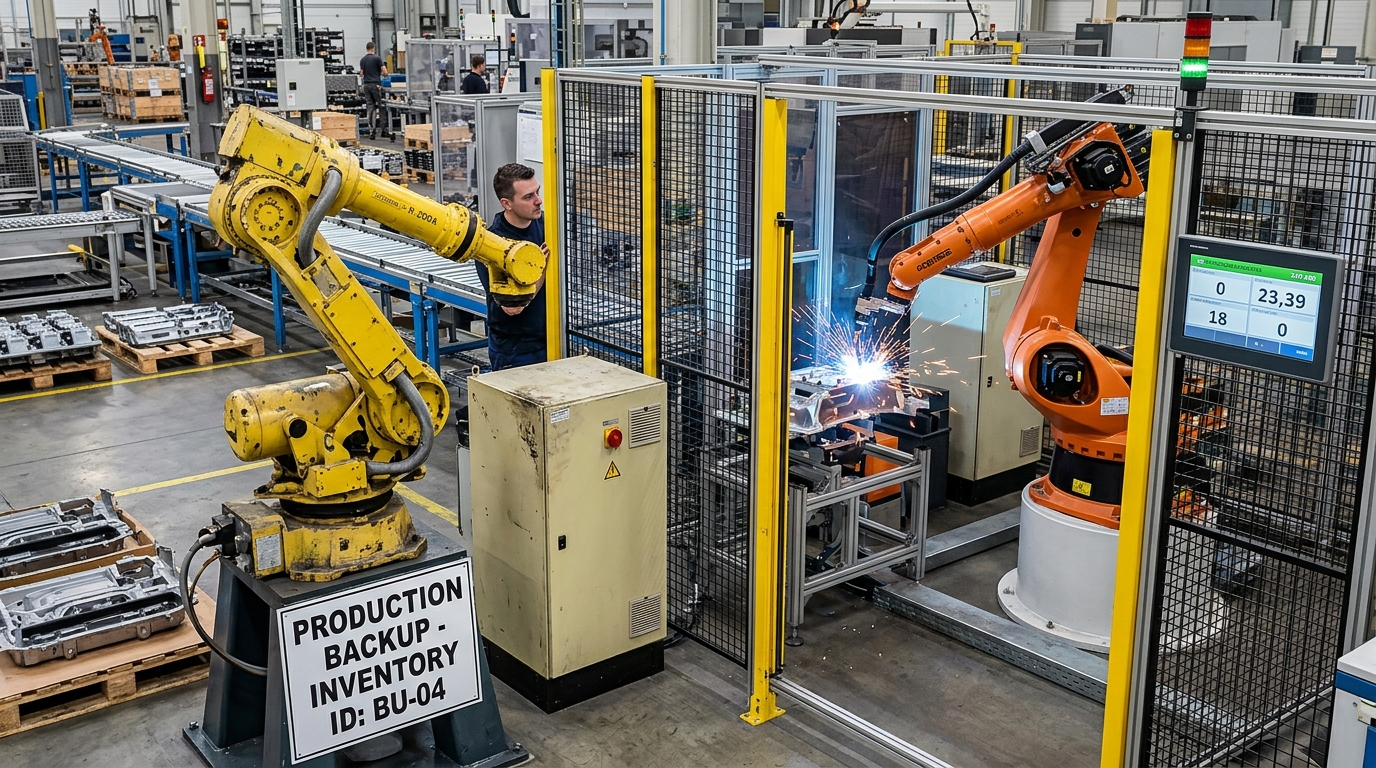
A used robot backup can make more operational sense than a shelf of spare parts. This is especially true when a robot failure could stop a critical process, and the plant cannot predict which component will fail. Keeping a compatible robot can give the maintenance team access to a broader range of mechanical and control components. It can also provide a replacement platform when the plant has prepared the recovery plan correctly
That does not mean every plant running older robots should buy another machine and park it in storage. A spare robot creates its own requirements: capital, storage, preservation, compatibility verification, software management, safe handling, and a documented recovery procedure. If those requirements are ignored, the backup robot may be little more than expensive inventory.
The decision therefore starts with downtime exposure rather than purchase price. The plant needs to determine which failures can realistically be covered with stocked components, which failures could create a long recovery, and whether a complete compatible robot would materially change that recovery risk.
Spare Parts Work Best When the Failure Modes Are Known
A conventional spare-parts strategy works best when the maintenance team understands the installed equipment. The team can then identify the components most likely to create production problems. The plant may already have years of maintenance history, established supplier relationships, internal repair capability, and a clear list of components that justify local inventory.
Under those conditions, buying a complete robot solely as insurance may add little value. Targeted inventory is easier to manage when critical components remain readily available. This approach also works when technicians can diagnose and replace them efficiently.
The weakness appears when the spare-parts list becomes an attempt to predict every possible failure. An industrial robot is not only a mechanical arm. Its production availability can depend on the controller, drives, motors, cabling, feedback components, teach pendant, communication hardware, software configuration, safety interfaces, tooling connections, and other cell-level equipment.
A plant can therefore have a well-stocked maintenance room and still encounter a failure it did not anticipate. The question is not whether spare parts are useful. They remain essential. The question is whether the parts strategy provides enough coverage for the production consequence of an extended outage.
This distinction becomes more important as equipment ages. Availability, controller support, internal expertise, and the condition of the installed robot can change over time. Plants evaluating older equipment should consider these factors as part of the broader total cost of ownership of a used robot, rather than treating the original equipment price as the complete cost.
A Backup Robot Becomes More Relevant When Downtime Is Concentrated
Not every robot deserves the same redundancy strategy. A robot in a non-critical process may have manual fallback capacity. That creates a different business risk from a robot whose failure stops several upstream or downstream operations.
The stronger case for a complete backup usually appears when downtime is concentrated around one robot or one standardized robot platform. If the cell has no practical bypass and the plant cannot shift production elsewhere, recovery time becomes much more important than the cost of the failed component.
This is particularly relevant when several cells use the same robot family or closely standardized configurations. One correctly selected backup may support a wider maintenance strategy than maintaining unrelated inventories for multiple machines. However, apparent similarity between robots is not enough. The maintenance team still needs to check the exact configuration and compatibility.
Plants should also distinguish between a backup robot used as a donor and one expected to replace a failed production robot. Those are different strategies. A donor machine provides access to compatible components. A replacement machine requires a much more complete plan covering mechanical installation, tooling, controller configuration, programs, interfaces, safety validation, and restart procedures.
The greater the production consequence of an outage, the more valuable it becomes to define that distinction before the failure occurs.
Compatibility Determines Whether the Backup Has Real Value
The biggest mistake in a backup-robot strategy is assuming that two robots with similar model names are interchangeable. Several factors determine whether components or complete systems can actually be exchanged. These include model variants, controller generations, software options, communication hardware, mechanical configurations, and application packages.
The plant should therefore evaluate a spare robot against the installed production asset before purchasing it. The plant needs to define the backup robot’s intended role. It may serve as a source of compatible components, a replacement candidate, or simply another robot from the same family.
Controller and software compatibility
Controller generation matters because a mechanical match does not guarantee a controls match. Several control-system variables can affect recovery. These include software options, field communication, safety configuration, application packages, program formats, and interfaces with other equipment.
The plant should also know what backups exist for the production robot. The maintenance team should manage the information required to restore production. This includes programs, configuration data, tooling data, communication settings, and relevant calibration information. A spare controller without the correct production configuration does not automatically restore the cell.
Mechanical configuration
A backup arm must be evaluated beyond the brand and broad model family. Several mechanical details determine how much preparation the backup requires. These include the exact variant, mounting arrangement, dress package, tooling interface, application configuration, and physical condition.
This is one reason URT’s guidance on refurbished robot compatibility with existing systems is relevant to redundancy planning. The plant should establish compatibility before it needs the spare machine, not during an active production outage.
Cell interfaces
Even a compatible robot is only one part of the cell. The production system may depend on much more than the robot. Critical elements can include tooling, fixtures, sensors, process equipment, safety hardware, PLC communication, and surrounding machinery.
A backup strategy that covers the robot but ignores these dependencies can create false confidence. A second robot does not help if another component creates the main downtime risk. That component could be a specialized gripper, welding power source, external axis, safety device, or cell controller.
Using a Spare Robot as a Donor Is Different From Keeping It Production-Ready
A donor robot can be valuable because it expands the range of components physically available to the maintenance organization. But that value depends on verified compatibility and the condition of those components. The maintenance team should not assume that a complete used machine contains serviceable parts.
Evaluating used equipment requires more than checking the robot model. Review its mechanical condition, controller version, software, licensing, spare-parts availability, support capability, and available service history. These are also central considerations when buying a refurbished robot.
A production-ready spare requires more preparation. The organization needs a clear procedure for returning the machine to service. That procedure should cover handling, installation, connections, configuration, and technical checks. The necessary tooling and cell interfaces need to be understood before an outage.
Safety is part of that preparation. Robot replacement can involve hazardous energy, mechanical handling, electrical work, safety-system intervention, and recommissioning. Qualified personnel should therefore develop and execute the recovery procedure before a breakdown occurs.
Compare Costs Through Recovery Risk
Comparing the price of one used robot with the price of a small spare-parts inventory misses the purpose of redundancy. Instead, compare each strategy against the failures it can cover and the production losses it could reduce.
A parts strategy can make economic sense when failures are predictable and replacement components remain accessible. It also depends on the maintenance team’s ability to diagnose and repair the system quickly. A backup robot becomes more relevant when component availability is uncertain or the installed platform is aging. The case also becomes stronger when several compatible robots operate in the plant, or an extended outage would severely affect production.
The plant should also include the cost of maintaining the backup strategy itself. The maintenance team also needs to control software and configuration information. The maintenance team also needs to control software and configuration information.
The financial question is therefore not simply whether a used robot costs less than a collection of replacement components. It is whether the additional coverage changes the expected operational consequence of a serious failure enough to justify the investment and preparation.
| Decision factor | Spare-parts strategy | Used backup robot |
|---|---|---|
| Known recurring component failures | Usually strong coverage when the correct parts are stocked | May provide more equipment than the plant actually needs |
| Uncertain failure location | Coverage depends on what was predicted and stocked | Can broaden available component coverage if compatibility is verified |
| Controller or configuration differences | Individual components can be selected for the exact installed system | Requires careful controller, software, and option verification |
| Multiple standardized robots | Inventory can support several cells if components are common | One compatible machine may support several assets as a donor or replacement candidate |
| Complete robot replacement | Does not provide a replacement arm by itself | Possible only when mechanical, control, software, tooling, and cell compatibility are planned |
| Storage and preservation | Usually simpler for individual components | Requires suitable space, condition management, and handling planning |
When Keeping Spare Parts Is the Better Strategy
A backup robot should not be treated as the default solution for downtime. Targeted spare parts may provide better coverage when the robot platform still has reliable support. This strategy also makes sense when maintenance requirements are predictable and replacement components remain accessible.
The same applies when the robot itself is not the dominant downtime risk. If failures are more likely to occur in tooling, process equipment, fixtures, conveyors, sensors, safety systems, or upstream machinery, investing in another robot may protect the wrong asset.
A spare robot is also weak insurance when the plant has no realistic method for using it. Physical availability does not guarantee fast recovery. Technicians still need the correct programs, system backups, configuration knowledge, and a practical method for exchanging the machine.
In some cases, modernization or replacement with newer equipment may be more defensible than continuing to build redundancy around an aging platform. The trade-off between extending an installed platform and replacing it should be evaluated through supportability, integration cost, expected production life, and downtime exposure. URT’s comparison of new versus refurbished robots provides a broader framework for that decision.
What to Verify Before Buying a Robot as a Backup
Use this checklist to test whether the proposed backup actually reduces recovery risk. The objective is not simply to confirm that another robot is available but to establish what role it can perform during a real outage.
- Confirm the exact robot model and variant against the installed production equipment.
- Verify whether the intended role is complete replacement, component donor, or both.
- Check controller generation and relevant hardware compatibility.
- Identify software, application options, communication requirements, and licensing dependencies.
- Confirm the mechanical condition of the used robot rather than assuming stored equipment is serviceable.
- Review service history and operating information when available.
- Identify which components are realistically interchangeable with the installed machine.
- Maintain current production programs, configuration information, and required system backups.
- Check tooling, cabling, dress packages, external axes, process equipment, PLC communication, and safety interfaces.
- Define who has the technical capability to execute the recovery plan.
- Estimate downtime exposure for failures covered by parts versus failures covered by the complete backup.
- Confirm that storage, preservation, handling, and access arrangements keep the backup usable.
The final test is practical: the plant should be able to explain what happens after a production robot fails. If the answer depends on diagnosing the problem first and then discovering whether the necessary equipment is compatible, the redundancy plan is incomplete.
FAQ
Is buying a used robot always better than stocking expensive spare parts?
No. A used robot makes more sense when it provides useful additional failure coverage, and the machine or its components are verified as compatible. When likely failures are understood and individual parts are readily available, targeted spare inventory can be simpler and more appropriate.
Can any robot from the same model family be used as a backup?
No. Model family alone is not enough to establish interchangeability. The exact variant, controller generation, mechanical configuration, software options, application equipment, and cell interfaces should be checked before treating another robot as a backup.
Can the maintenance team simply swap a backup robot into the cell after a failure?
Not automatically. Physical installation is only one part of recovery. Programs, configuration, tooling, interfaces, safety systems, calibration requirements, communication with other equipment, and recommissioning may all need to be addressed before production can restart.
Does a donor robot eliminate the need to stock spare parts?
No. A donor robot and a targeted spare-parts inventory can serve different purposes. Frequently needed or known critical components may still justify dedicated stock, while the donor machine can provide broader coverage for less predictable failures when its components are compatible and serviceable.
What is the biggest risk when buying a used robot specifically as a backup?
The biggest practical risk is assuming compatibility without verifying it. A low-cost machine provides little protection if its controller, software, mechanical configuration, or critical components cannot support the installed production system.
When should a plant consider replacing the platform instead of buying another backup robot?
Replacement deserves consideration when the existing platform creates increasing support, compatibility, or downtime risk. The plant should also consider whether the remaining production life justifies expanding its legacy inventory. The decision should include integration cost and production risk rather than equipment age alone.
Talk to URT About Used Robot Backup Planning
If you are evaluating used robot backup planning, contact URT. We will give you a direct, technical answer based on your actual production requirements.