
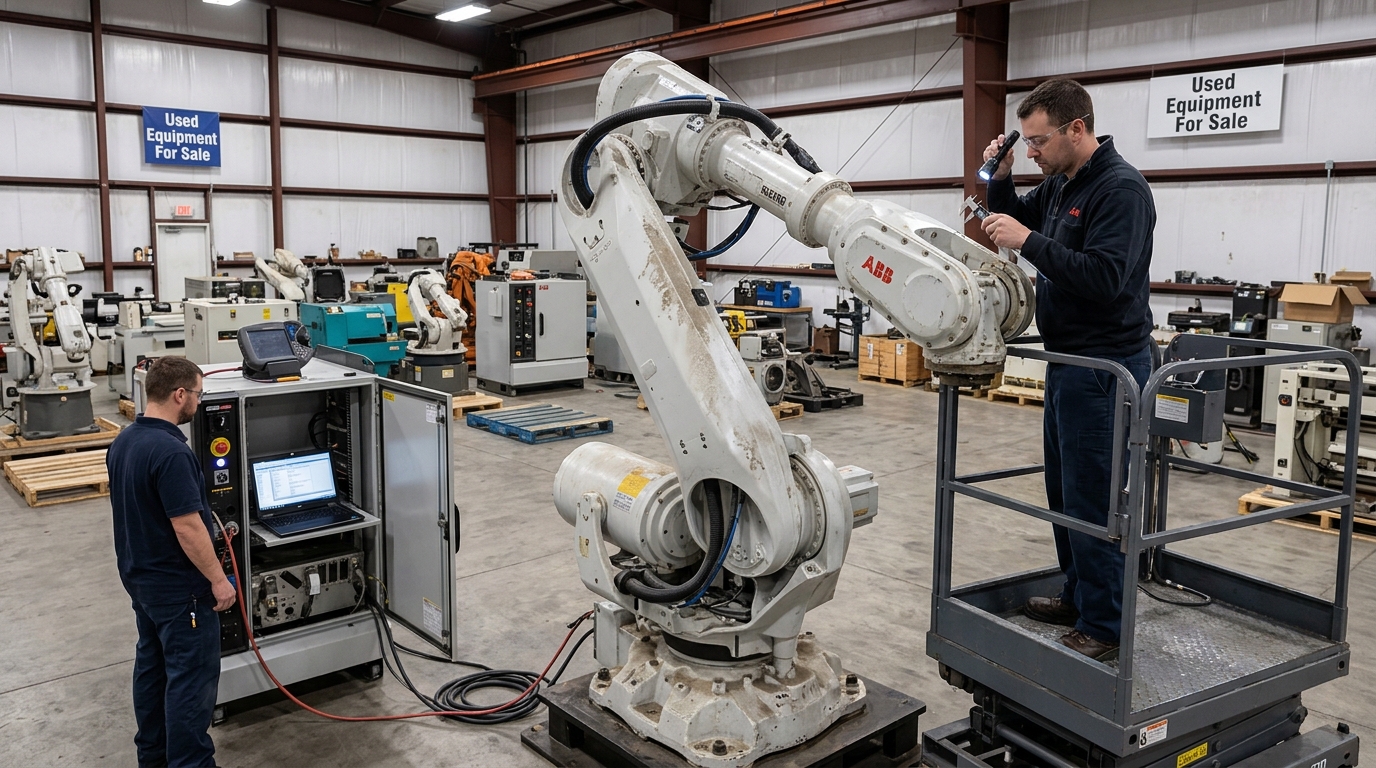
Why buying a used ABB IRB 6700 requires more than checking price
A used ABB IRB 6700 can be a sensible investment for manufacturers looking to expand automation capacity without committing to the purchase cost of a new robot. However, the purchase only makes financial sense when the robot’s mechanical condition, exact model variant, controller configuration, and integration requirements match the intended production cell. A lower acquisition price does not compensate for unexpected repairs, incompatible equipment, or prolonged commissioning delays.
The main buying risk is treating the IRB 6700 designation as sufficient technical information. The series includes different configurations, and two robots carrying the same family name may not be interchangeable for a specific application. Buyers must establish which variant the seller offers and whether its configuration supports the required tooling, working envelope, and production sequence.
The evaluation should therefore begin with the application rather than the available robot. A production manager replacing an existing robot has different requirements from an integrator designing a new material handling cell. In both situations, the objective is to determine whether the complete robotic system can operate reliably, not simply whether the robot offers an attractive purchase price.
Verify the exact ABB IRB 6700 model before evaluating suitability
The ABB IRB 6700 is a family of industrial articulated robots associated with demanding handling and manufacturing applications. However, the family designation alone does not establish the capabilities of an individual unit. Buyers should request the complete model identification before making assumptions about payload, reach, mounting configuration, or controller compatibility.
Why the exact model variant matters
Different IRB 6700 variants serve different operating requirements. A configuration intended for handling large components may not offer the same working envelope or load characteristics as another variant within the series. These differences affect the feasibility of the entire robotic cell.
For example, a robot may appear suitable for machine tending because its nominal payload meets the initial requirement. However, the selected end effector, component orientation, wrist loading, and required approach movements may make the actual application unsuitable. Engineers must evaluate payload together with the complete load configuration and the manufacturer’s applicable limits.
Reach also requires more than checking the maximum distance shown in a product description. The robot must access all required positions while maintaining appropriate tooling orientation, avoiding obstacles, and respecting joint and operating limits.
When comparing available units, buyers should distinguish between the robot family, exact mechanical variant, controller configuration, and any application-specific equipment included in the sale.
Specification verification before cell design
Engineers must verify final payload, reach, repeatability, mounting, controller, and tooling limits against the exact robot identification plate and official manufacturer documentation. They should never take numerical specifications from another IRB 6700 variant or assume that every model in the family shares identical capabilities.
The official ABB Robotics product information provides a manufacturer starting point for identifying robot families and technical documentation. For used equipment, buyers should also obtain the documentation corresponding to the actual robot configuration and controller generation.
Before approving a purchase, the engineering team should confirm that the offered unit matches the application requirements established during cell design. The team should resolve any uncertainty about the exact variant before selecting tooling or committing to the cell layout.
Mechanical condition determines whether the purchase price is meaningful
A used industrial robot may have a satisfactory external appearance while containing mechanical wear that affects production reliability. Repainting, cleaning, or basic movement demonstrations do not establish the condition of the complete mechanical system.
The inspection must focus on whether the robot can perform the intended application consistently and whether the inspection team has identified foreseeable mechanical problems before installation.
Check joints, reducers, and mechanical movement
Joint condition is a central part of evaluating a used ABB IRB 6700. The inspection team should look for abnormal mechanical noise, excessive play, unexpected resistance, and signs of deterioration during controlled movement.
Operating conditions, maintenance history, and previous loading can affect reducers, bearings, brakes, and related mechanical components. Buyers should not automatically reject a robot because it previously operated in a demanding application, but they should verify its actual condition.
A qualified technician should evaluate movement across the relevant operating range using suitable diagnostic procedures. A brief demonstration of the robot moving between two positions cannot establish the condition of every axis or confirm performance under the intended production load.
Inspect lubrication and evidence of leakage
Lubrication condition can provide useful information about maintenance practices and potential mechanical problems. Buyers should look for visible leakage, contamination, damaged seals, and evidence of neglected maintenance.
Maintenance requirements depend on the specific robot configuration and the manufacturer’s instructions. Buyers should not assume that all units within the IRB 6700 family have identical maintenance requirements.
Any unexplained leakage or mechanical abnormality requires investigation before purchase. The relevant question is whether the condition represents normal service wear, a maintenance requirement, or a potentially expensive repair.
Evaluate structural condition and previous damage
Visible damage to covers, mounting surfaces, cable routing, or structural components may indicate previous incidents or unsuitable operating conditions. Cosmetic marks do not necessarily indicate a serious problem, but inspectors should distinguish them from damage affecting mechanical integrity.
Buyers should ask whether the robot has experienced collisions, overload events, or significant repairs. Where records are unavailable, the buyer should account for that uncertainty when defining the inspection scope and making the purchasing decision.
Mechanical evaluation becomes particularly important when the robot will operate in a production environment where unexpected downtime could interrupt several connected operations.
Controller compatibility can create greater risk than mechanical wear
The robot arm is only one component of the investment. The controller, drives, communication interfaces, software configuration, and associated electrical equipment determine how the robot will operate within the production system.
A mechanically sound ABB IRB 6700 may still be unsuitable if its controller cannot support the intended integration without substantial additional work.
Confirm the controller supplied with the robot
Buyers should establish exactly which controller comes with the robot and whether it has the correct configuration for the offered unit. They should document the controller identification, software version, installed options, and electrical condition.
Buyers must also determine whether the sale includes the teach pendant, required cables, controller cabinet, and other essential components. Missing equipment can create additional procurement costs and delay commissioning.
Buyers should never assume compatibility solely because the equipment carries the ABB brand. They must verify the specific controller and robot configuration together.
Check communication with existing equipment
Integration requirements vary depending on the production application. A robot operating in a standalone handling cell may require a different communication architecture from one connected to CNC machines, conveyors, sensors, or plant-level control systems.
The engineering team should confirm whether the controller supports the required communication interfaces and whether the system includes the necessary hardware and software options. PLC integration, input/output configuration, safety communication, and production data exchange may all affect project scope.
If the robot will replace an existing unit, the engineering team must evaluate compatibility with current programs, tooling, electrical connections, and surrounding equipment individually.
URT’s guide to refurbished robot compatibility with existing systems examines the broader integration questions that buyers should resolve before committing to used equipment.
Verify software, backups, and licensing
A controller that powers on successfully does not necessarily contain everything the application requires for production. Buyers should confirm the availability of system backups, relevant software options, application programs, and configuration documentation.
Software dependencies become especially important when the cell requires specialized functions or integration with equipment already installed at the plant.
When purchasing the robot as a replacement, buyers should verify whether the existing programs can transfer to the new system or require adaptation. Differences in controller configuration, software versions, or installed options may require engineering work even when the mechanical robot appears comparable.
Service history and refurbishment quality should be documented
Used and refurbished robots are not necessarily equivalent purchasing categories. A seller may offer a used robot in its existing operating condition, while a refurbished unit may have undergone inspection, repair, component replacement, testing, or other preparation.
However, the term refurbished does not establish a universal technical standard. Buyers should request a clear description of the work the supplier actually performed.
What service records can reveal
Maintenance documentation can help establish whether the robot has received appropriate attention throughout its operating life. Useful information includes previous maintenance activities, major component replacements, recorded faults, repairs, and relevant controller interventions.
Operating hours can contribute to the assessment when reliable records are available. However, hours alone cannot establish mechanical condition because the operating load, application, environment, and maintenance practices also affect wear.
A robot that previously performed repetitive handling under controlled conditions may have a different wear profile from a unit exposed to frequent collisions, contamination, or demanding loading cycles. Inspectors should assess the actual equipment before drawing conclusions about either operating history.
What a refurbishment report should explain
A meaningful refurbishment report should identify the condition the supplier assessed, the work completed, the components replaced, and the tests performed. General statements about inspection or reconditioning offer less value than documented evidence.
Buyers should also establish whether the refurbishment covered only the mechanical arm or included the controller, electrical equipment, cabling, and other supplied components.
The difference matters because a robot with serviced mechanical components may still require significant controller or integration work.
For a broader comparison of purchasing approaches, see URT’s article on when new or refurbished industrial robots are appropriate.
Integration requirements determine whether the ABB IRB 6700 fits the application
Even a well-maintained robot with the correct controller can become an expensive purchase if the engineering team has not evaluated the application properly. Integration suitability depends on the complete production cell, including tooling, fixtures, safety systems, material flow, and maintenance access.
Material handling and machine tending
For material handling, the robot must support the combined load of the workpiece and end-of-arm tooling throughout the required movements. The engineering team must also consider part orientation, gripping forces, acceleration requirements, and the location of pickup and placement positions.
In machine tending, access to the machine can become a more significant constraint than nominal robot reach. Door openings, fixtures, machine structures, and the required approach direction may restrict usable movement.
The engineering team should evaluate the robot against a complete movement sequence rather than isolated target positions. Simulation or a suitable engineering assessment can help identify potential reach limitations, collisions, and cycle constraints before installation.
URT’s guide to robotizing CNC loading and unloading without creating bottlenecks explains why machine access and production flow must be considered together.
Cycle time and production capacity
The ability to complete a movement does not establish that the robot can meet the required production rate. Cycle performance depends on movement distances, tooling, load conditions, acceleration limits, equipment synchronization, and waiting time.
A robot may complete its programmed movements quickly but remain idle while waiting for upstream equipment. Conversely, an unsuitable cell layout may require unnecessarily long movements that reduce throughput.
Before purchase, the integrator should evaluate the complete production sequence and identify the operations that determine the achievable cycle time.
Safety and cell layout
The installation team must conduct an appropriate safety assessment covering the robot, tooling, workpieces, surrounding equipment, and expected operator interactions. The assessment should consider safeguarding, access control, hazardous energy, maintenance intervention, and recovery procedures.
An emergency stop function alone does not satisfy all safety requirements. The engineering team must design and validate the complete cell for the intended application and applicable requirements.
For general industrial robotic system safety considerations, OSHA’s robotics guidance provides useful context on hazards associated with robotic installations.
Buyers should account for safety engineering and validation within the project budget rather than treating them as secondary tasks after the robot arrives.
The real cost of a used ABB IRB 6700 extends beyond acquisition
The purchase price is only the starting point for evaluating the investment. The relevant financial comparison is the total cost required to bring the robot into stable production and maintain it over the planned operating period.
A lower-priced unit may become more expensive if it requires major repairs, unavailable components, extensive programming, or prolonged commissioning.
Costs that should be included in the evaluation
To compare available robots fairly, buyers should estimate the complete project cost using the same assumptions for each option. The following items provide a practical framework for developing that estimate.
- Robot acquisition: Purchase price and the exact equipment included in the sale.
- Transport and handling: Shipping, unloading, storage, and installation preparation.
- Mechanical preparation: Required inspection, servicing, repairs, or component replacement.
- Controller preparation: Electrical checks, software configuration, backups, and required communication options.
- Tooling and fixtures: End effectors, adapters, workholding equipment, and application-specific components.
- Integration: Programming, PLC communication, cell coordination, and commissioning.
- Safety: Risk assessment, safeguarding, validation, and operator access provisions.
- Training and support: Operator preparation, maintenance capability, and specialist assistance.
- Production interruption: Potential downtime during installation, troubleshooting, or unexpected repairs.
Buyers should evaluate these costs against the expected production benefit. A used robot may offer a lower initial investment, but the financial analysis must also consider the cost of achieving the required production performance.
Spare parts and future maintenance exposure
Buyers should check spare parts availability before purchase, especially for controller components, drives, motors, and other items that could cause extended downtime.
The buyer should determine whether suppliers can provide suitable replacement components and qualified technical support for the exact configuration. The continued existence of the robot family does not guarantee parts availability for every variant or controller.
Where the plant lacks experience maintaining ABB robotic systems, external service arrangements may form an important part of the ownership cost.
When buying new may be the safer decision
A used ABB IRB 6700 is not automatically the best choice for every project. New equipment may be more appropriate when the application requires capabilities unavailable in the offered configuration, when controller compatibility remains uncertain, or when the production schedule leaves little tolerance for uncertain equipment condition.
New equipment may also be preferable when the project requires a specific support arrangement or when the cost of adapting the used robot approaches the cost of a more suitable alternative.
The purchasing team should base its decision on total project risk and expected operating requirements rather than purchase price alone.
Practical inspection checklist before purchasing a used ABB IRB 6700
The final evaluation should combine technical inspection, documentation review, and application verification. Purchasing managers, maintenance teams, and integrators can use this checklist to identify unresolved issues before approving the transaction.
- Exact model: Confirm the complete IRB 6700 variant and identification details.
- Manufacturer documentation: Verify the specifications against the exact configuration.
- Mechanical condition: Inspect joints, reducers, brakes, seals, and structural components.
- Movement testing: Request appropriate functional tests and investigate abnormal behavior.
- Controller: Confirm the controller identity, electrical condition, and compatibility with the robot.
- Software: Check installed options, available backups, and required application functions.
- Included equipment: Confirm the teach pendant, cables, cabinet, and other supplied components.
- Service history: Request available maintenance, repair, and fault records.
- Refurbishment: Identify exactly what the supplier inspected, repaired, replaced, and tested.
- Application suitability: Validate the load, working envelope, tooling, and movement sequence.
- Integration: Verify PLC communication, safety interfaces, and compatibility with surrounding equipment.
- Spare parts: Assess availability of critical components and qualified support.
- Commercial conditions: Confirm inspection rights, delivery scope, warranty terms if offered, and responsibility for missing or defective components.
- Total project cost: Compare acquisition, preparation, integration, commissioning, and operating risks.
The purchasing team should document unresolved findings rather than treat them as minor details. A missing controller option, uncertain mechanical condition, or incompatible robot variant can change the economic justification of the project.
The strongest purchasing decision is one where the buyer understands both the equipment and the engineering work necessary to make it productive.
FAQ
Is the ABB IRB 6700 a good robot to buy used?
A used ABB IRB 6700 can be a suitable purchase when its exact variant, mechanical condition, controller configuration, and application requirements are compatible. Buyers should base the decision on inspection results and total project cost rather than the model reputation or acquisition price alone.
What is the most important inspection before buying a used ABB IRB 6700?
No single inspection establishes the suitability of the complete robot. Buyers must verify mechanical condition, controller compatibility, model identification, and application requirements. A serious problem in any one of these areas can make the purchase unsuitable.
Can a used ABB IRB 6700 be integrated into an existing production line?
Yes, provided the robot and controller support the required application and integration interfaces. The engineering team must confirm compatibility with existing PLCs, safety systems, tooling, software, and production equipment before purchase. The project may require additional engineering work.
How can buyers verify the operating condition of a used ABB IRB 6700?
Buyers should request available service documentation and arrange an appropriate inspection by qualified personnel. Functional movement testing, mechanical evaluation, controller diagnostics, and review of recorded faults can provide evidence of condition. A short movement demonstration is not sufficient on its own.
Does a refurbished ABB IRB 6700 always offer better reliability than a used unit?
Not necessarily. Reliability depends on the original condition of the robot, the refurbishment work completed, the quality of replacement components, and the testing performed. Buyers should evaluate documented work rather than rely on the refurbished label.
Can different ABB IRB 6700 variants replace one another?
Not automatically. Variants may differ in their mechanical configuration and operating capabilities. The engineering team must verify replacement suitability against the existing application, tooling, controller, working envelope, and installation requirements.
When should a manufacturer avoid purchasing a used ABB IRB 6700?
A manufacturer should reconsider the purchase when technicians cannot adequately assess mechanical condition, suppliers cannot provide essential components, controller compatibility remains uncertain, or the offered variant does not meet the application requirements. A new robot or a different used configuration may provide a more defensible investment.
Talk to URT About Buying a Used ABB IRB 6700
If you are evaluating a used ABB IRB 6700 for your production application, contact URT. We will give you a direct, technical answer based on your actual production requirements.