
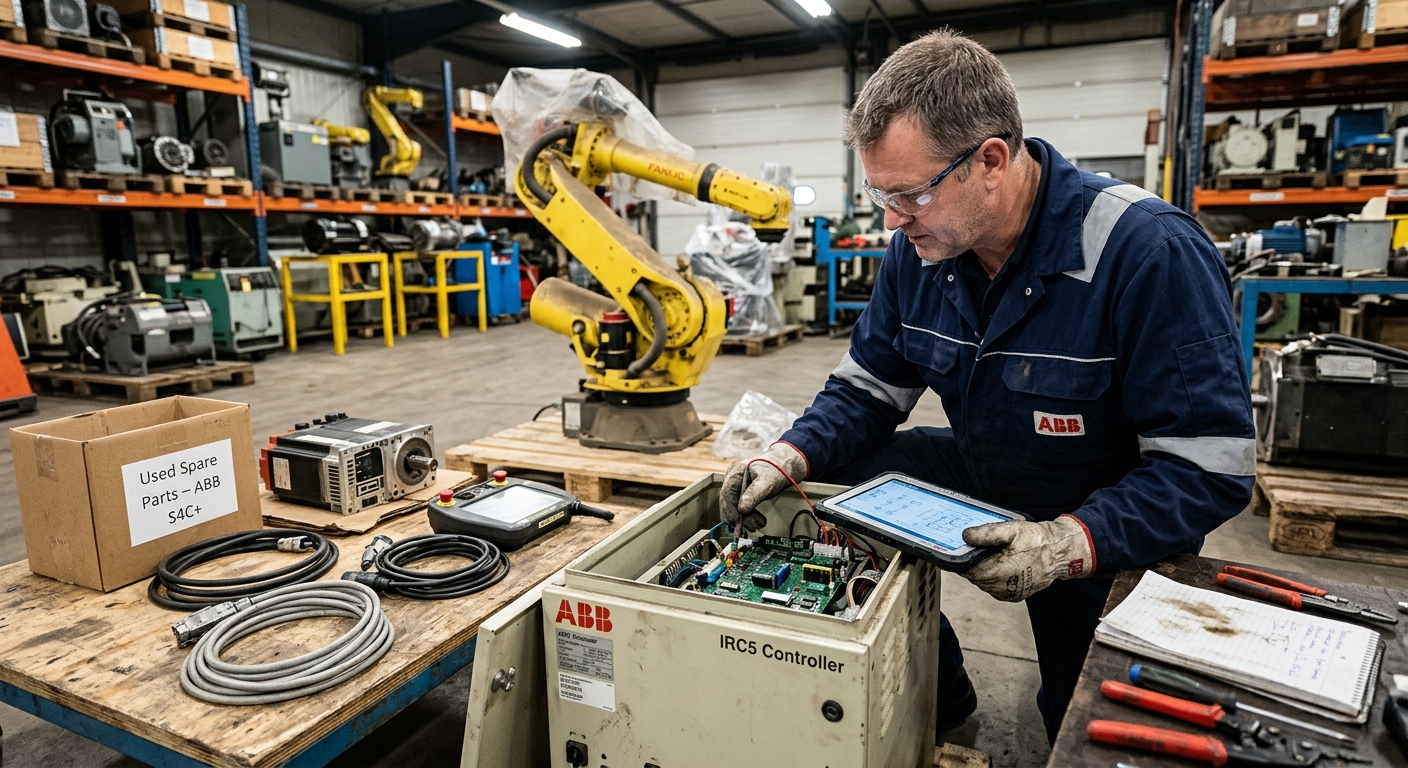
A used industrial robot may be ready for immediate purchase, but the buyer still needs to confirm whether maintenance teams can keep it running. When evaluating used robot spare parts, purchasing managers must distinguish between equipment availability and long-term serviceability. A robot may pass an operational test while relying on a controller board, motor, drive, or mechanical assembly that suppliers struggle to provide.
The purchasing decision therefore involves two separate questions. Can the company acquire a robot that meets its production requirements? Can the maintenance team obtain the components and technical support needed to restore operation after a failure? A positive answer to the first question does not guarantee a positive answer to the second.
For production managers, maintenance engineers, and technical buyers, spare-part availability belongs in the purchasing assessment from the beginning. The objective is not to eliminate every possible equipment failure. It is to understand the consequences of those failures, identify realistic recovery options, and determine whether the production operation can tolerate the remaining risk.
Why robot availability does not guarantee spare-part availability
Robot availability describes whether a supplier can provide a particular robot or configuration. Spare-part availability describes whether the plant can obtain the exact components required to maintain and repair that equipment. These conditions may differ considerably, especially when buyers evaluate older robot and controller generations.
A used robot may remain mechanically suitable long after its manufacturer introduces newer models. Its structure and motion capabilities may still meet the requirements of welding, handling, palletizing, or machine tending. However, the availability of complete used robots does not establish a dependable supply of individual replacement components.
A complete robot does not guarantee a sustainable parts supply
A supplier may offer several complete robots from the same product family. That inventory gives buyers additional equipment options, but it does not necessarily provide reliable replacement parts. Individual units may contain different controller generations, electronic assemblies, wiring configurations, or application packages.
Even robots with similar model names can require different replacement components. A part that appears mechanically interchangeable may contain electrical or software differences that prevent direct substitution.
Buyers must therefore verify the exact configuration of the equipment they intend to purchase. The presence of other robots from the same series provides useful sourcing possibilities, but it does not confirm component compatibility.
Commercial availability does not establish technical compatibility
A supplier may advertise a replacement component without confirming that it matches the installed robot. Compatibility can depend on part numbers, hardware revisions, controller software, electrical connections, and configuration parameters.
This issue becomes particularly relevant when suppliers recover components from dismantled robots. A component may have worked correctly in its previous installation but still require inspection, testing, configuration, or specialist intervention before another robot can use it.
Purchasing teams should ask whether a supplier can identify, verify, and deliver the correct component. They should also establish whether their maintenance personnel can install it and restore the system to production.
Which robot components create the greatest availability risk?
Not every robot component presents the same sourcing challenge. Maintenance teams can obtain some replacement items through established industrial supply channels. Other components depend on a particular manufacturer, controller generation, or mechanical configuration.
The buyer should prioritize components that can stop the entire cell, require specialized repair procedures, or create extended downtime when replacement stock is unavailable.
Controllers, electronic boards, and drives
Controller-related components can create significant sourcing challenges in older robotic systems. Processor boards, drive modules, power supplies, communication interfaces, and operator panels may depend on particular hardware and software generations.
Replacing an electronic component may require more than installing another board. The maintenance team may need compatible firmware, configuration data, software options, or parameter restoration procedures.
Before purchasing a used robot, buyers should identify the exact controller version and its critical electronic assemblies. They should also confirm access to backups, technical documentation, and qualified personnel who can restore the controller after a failure.
Motors, encoders, and feedback components
Robot motors and position-feedback systems require particular attention because their compatibility directly affects motion control. A replacement motor must satisfy the mechanical, electrical, and control requirements of the installed system.
Similar external dimensions do not establish interchangeability. Motor connections, feedback devices, braking arrangements, and drive requirements may differ between configurations.
Some replacements also require mastering, calibration, or other manufacturer-defined procedures. Buyers must determine whether qualified personnel have the necessary service tools and technical information before assuming that a replacement component will solve the problem.
Mechanical assemblies and wear components
Mechanical condition remains central to used robot evaluation. Gearboxes, bearings, brakes, seals, and other motion-related components influence reliability and positioning performance.
Maintenance teams may find some wear components relatively easily, while specialized mechanical assemblies can require manufacturer-specific sourcing or suitable donor equipment. Buyers should verify these requirements for the exact robot rather than relying on the manufacturer’s general market presence.
A mechanical inspection should also identify existing deterioration that could accelerate replacement requirements. Purchasing equipment with known mechanical problems without confirming repair options can transfer a significant maintenance burden into the integration project.
Application-specific equipment
The robot arm represents only one part of the production system. Welding equipment, grippers, sensors, positioners, tool changers, and communication hardware can introduce additional spare-part dependencies.
A robot may remain fully operational while another component prevents the cell from producing. For example, a welding cell can stop because of a torch package, wire-feeding component, or peripheral control failure even when the robot controller reports no mechanical fault.
Buyers should extend the spare-parts assessment to the complete robotic cell. Components that create single points of failure deserve particular attention, especially when the production process has limited alternative capacity.
How controller generations affect long-term maintenance support
Controller age can significantly influence the support requirements of a used robot. An older controller does not automatically make the equipment unsuitable, but buyers must understand its hardware, software, communication interfaces, and recovery procedures.
The controller determines more than robot movement. It also supports application functions, equipment communication, diagnostic processes, and system recovery. These dependencies affect the plant’s ability to maintain the robot throughout its next production assignment.
Hardware and software support must work together
Finding a replacement electronic board may solve only one part of a controller problem. The installed software version, licensed functions, configuration files, and hardware revisions can determine whether the replacement will operate correctly.
A maintenance team might obtain compatible hardware but lack the tools or documentation needed to restore the system. In that situation, physical spare-part availability does not provide a complete recovery solution.
Buyers should confirm the controller’s software version, installed options, backup procedures, and restoration requirements. These details help establish whether the plant can recover from a significant electronic failure without unexpected integration work.
Communication compatibility can restrict replacement options
Robotic cells frequently exchange signals with PLCs, production machines, safety equipment, and application controllers. These connections may depend on particular communication modules, interfaces, or software functions.
A replacement controller component with a different hardware revision may affect those connections. A seemingly minor change can create additional engineering work across the cell.
Purchasing teams should therefore review refurbished robot compatibility with existing production systems before choosing equipment. This evaluation helps identify controller dependencies while the company can still compare alternative configurations.
Technical expertise is part of the support strategy
A spare component has limited practical value when the plant lacks the expertise to install and configure it. Older controller generations may require specialist knowledge that the internal maintenance team does not possess.
Buyers should confirm whether qualified service providers support the exact controller. They should also determine whether diagnostic tools, programming access, and recovery documentation remain obtainable.
A manufacturer’s reputation does not guarantee convenient support for every historical configuration. The purchasing decision must reflect the actual technical resources available for the equipment under consideration.
How spare-part availability changes the total cost of a used robot
Purchase price represents only the initial cost of a used robot investment. The complete economic result also depends on integration, maintenance, spare parts, downtime exposure, and the useful production life that the equipment can realistically provide.
A lower acquisition cost can remain attractive when the plant has credible sourcing options and suitable maintenance expertise. However, that advantage becomes less meaningful when one component failure could interrupt production for an unacceptable period.
Downtime can cost more than the replacement component
When a critical component fails, the replacement price represents only one expense. The plant may also lose output while technicians identify the fault, confirm compatibility, obtain the component, perform repairs, and validate the cell before restarting production.
The financial impact depends on the application. A robot serving a production bottleneck, a continuous manufacturing line, or an operation without backup capacity can create greater downtime exposure than equipment that operates intermittently.
Buyers should estimate these consequences using their own production data. Relevant variables include lost contribution from interrupted output, recovery labor, external service expenses, expedited sourcing costs, and downstream production disruption.
A lower purchase price may conceal higher support costs
An inexpensive used robot may require additional investment in spare parts, controller support, or preventive repairs. This does not automatically make the purchase unattractive. It means the buyer must compare acquisition cost with the condition and supportability of the complete system.
Consider two robots that satisfy the same handling application. One may have a lower purchase price but depend on difficult-to-source electronic components. The other may cost more initially but offer clearer maintenance and replacement options.
The purchasing team should compare the total cost of maintaining both alternatives. URT’s analysis of the total cost of ownership of used robots compared with new equipment provides a broader framework for this decision.
Critical spare-parts inventory requires financial justification
Keeping replacement components on site can reduce dependence on external delivery times. However, inventory also ties up capital, requires appropriate storage conditions, and may lose practical value when the plant modifies or replaces equipment.
The appropriate inventory strategy depends on failure consequences, component availability, sourcing lead time, and the number of compatible robots operating within the facility.
Instead of purchasing every possible replacement component, maintenance and purchasing teams should identify the parts that justify local stock. The cost of holding those parts should remain proportionate to the downtime risk they help control.
What buyers should verify before purchasing a used robot
A reliable purchasing process connects equipment identity, technical condition, and spare-parts support in one assessment. Inspecting the robot without examining its serviceability leaves an important investment risk unresolved.
Purchasing and maintenance teams can use the following checklist during supplier discussions and technical due diligence. Wherever possible, they should support each answer with equipment identification, documentation, inspection findings, or confirmed sourcing information.
- Exact robot identification: Confirm the manufacturer, complete model designation, serial number, and relevant configuration details.
- Controller identification: Record the controller model, hardware generation, software version, and installed options.
- Mechanical condition: Review inspection findings, known faults, available repair history, and the condition of critical motion components.
- Critical components: Identify the electronic, mechanical, and application-specific parts that could cause extended downtime.
- Part-number verification: Match replacement components to the exact installed configuration rather than relying on model-family descriptions.
- Supplier availability: Confirm whether suppliers can provide the required components and whether their condition meets the application’s requirements.
- Lead times: Request realistic sourcing estimates for critical components that the plant will not stock internally.
- Software and backups: Verify access to controller backups, configuration data, software tools, and recovery documentation.
- Service capability: Establish who can diagnose failures, install components, and validate the system after repair.
- Production exposure: Estimate the operational consequences if a critical replacement component becomes difficult to obtain.
Buyers do not necessarily need a positive answer to every question. However, they should understand unresolved risks and explicitly accept them before purchase. An unconfirmed sourcing option should remain an open technical issue rather than an assumed solution.
What evidence should buyers request from suppliers?
Useful documentation includes identification-plate photographs, controller details, available service records, inspection reports, and information about installed components. Buyers should also request confirmation of known faults and any limitations that testing has identified.
Suppliers should distinguish between components they currently hold in stock, parts they can obtain through established channels, and items that may require repair or alternative sourcing.
These situations provide different levels of purchasing certainty. A possible future sourcing arrangement does not offer the same assurance as a confirmed replacement component with verified compatibility.
Why a functional test cannot replace parts verification
A robot that powers on and completes a movement test provides useful evidence of its current operating condition. However, the test does not establish future availability of controller boards, drives, motors, feedback devices, or mechanical assemblies.
Functional testing helps identify present equipment problems. Spare-parts verification addresses the plant’s ability to recover from future failures. Buyers need both assessments to understand the equipment’s practical production risk.
URT’s guide to the factors to consider when buying refurbished robots provides additional guidance on equipment condition and purchasing decisions.
When spare-part risk should change the purchasing decision
Limited spare-part availability does not automatically disqualify every used robot. Some production environments can tolerate longer recovery periods. Other plants already have compatible equipment, replacement inventory, or specialist maintenance capabilities that reduce their exposure.
The important distinction is whether the buyer understands and controls the risk. A low purchase price should not justify accepting uncertain support without evaluating the operational consequences.
When a used robot remains a sensible option
A used robot can make sense when its technical condition meets the application requirements and the plant has credible sourcing or recovery options for critical components. Existing maintenance expertise and compatible equipment can strengthen the investment case.
For example, a plant that already operates the same robot and controller configuration may have established diagnostic procedures, replacement inventory, and maintenance knowledge. Adding another compatible unit could simplify support compared with introducing an unfamiliar controller generation.
However, common branding or similar model names do not prove component interchangeability. Buyers must still compare exact configurations before assuming that robots can share spare parts or service procedures.
When refurbishment or modernization deserves consideration
A mechanically suitable robot may still depend on an aging controller or difficult-to-source electronic components. In that situation, the plant can evaluate modernization as an alternative to replacing the entire system.
Depending on the equipment and available engineering support, modernization might involve selected component replacements or broader control-system modifications. These changes can introduce electrical engineering, software development, safety assessment, commissioning, and validation requirements.
Modernization does not automatically offer the lowest total cost. Buyers should compare the complete project against purchasing a different used robot or a new system, including future support requirements and production risk.
When a newer robot may be the safer investment
A newer robot may provide a more defensible solution when suppliers cannot reliably source critical components, the controller lacks practical technical support, or the production process cannot tolerate extended downtime.
This situation can also arise when the application requires communication functions, software capabilities, or maintenance arrangements that an older system cannot support without extensive modification.
Robot age alone should not determine the decision. URT’s comparison of when new or refurbished robots are appropriate explains how production requirements, integration conditions, and lifecycle costs influence the choice.
Building a spare-parts strategy before production starts
Spare-parts planning should continue after equipment selection. Before commissioning, the maintenance team needs a documented approach to diagnosing faults, obtaining replacement components, and restoring production.
This preparation becomes particularly important when a plant introduces a robot generation that its technicians have not maintained previously. General industrial maintenance experience does not necessarily provide the controller-specific knowledge required for robotic fault recovery.
Classify components according to production criticality
A practical inventory strategy prioritizes operational consequences rather than component purchase price alone. A relatively inexpensive electronic module can cause serious downtime when the robot cannot operate without it and suppliers cannot provide a quick replacement.
Maintenance teams should identify single points of failure, assess available backup capacity, and establish realistic sourcing lead times. These factors help determine which components deserve local inventory.
The team should also review component criticality when production requirements change. A robot that initially provides backup capacity may become essential if the plant later assigns it to a primary manufacturing process.
Maintain accurate configuration and recovery records
Reliable documentation helps maintenance personnel respond to failures without unnecessary uncertainty. The plant should maintain equipment identification records, installed part numbers, approved replacement information, software details, and controller backups according to manufacturer requirements.
Recovery documentation should identify the personnel who have authorization and qualifications to perform diagnostic, repair, and restart activities. Replacement work involving drives, motors, brakes, or safety-related equipment may require specialized procedures and validation.
For broader safety context, OSHA’s guidance on hazardous energy control provides useful information for planning safe servicing and maintenance. Personnel must follow applicable requirements and manufacturer procedures during actual interventions.
Assign support responsibilities before commissioning
Different organizations may handle equipment supply, integration, and maintenance. A supplier might provide the robot while an integrator manages installation and another service company handles repairs.
Without clear responsibilities, a technical failure can also create delays in diagnosis, purchasing approval, and service coordination. The plant should identify who will diagnose faults, approve replacement parts, maintain backups, coordinate external support, and authorize production restart.
Maintenance managers should evaluate these arrangements against realistic failure scenarios. A support plan that depends on an unidentified specialist or an unconfirmed parts source does not yet provide a dependable recovery strategy.
FAQ
Does the availability of a used industrial robot mean spare parts are available?
No. Complete robots and individual replacement components have different supply conditions. Buyers must verify critical spare parts for the exact robot and controller configuration rather than assuming that equipment availability guarantees long-term serviceability.
Which spare parts should buyers check first when purchasing a used robot?
Buyers should prioritize components that could stop production and create lengthy recovery periods. These may include controller boards, drives, motors, feedback devices, mechanical assemblies, and application-specific equipment. The final priority depends on the installed configuration and the consequences of failure.
Can maintenance teams use spare parts from another robot of the same brand?
Sometimes, but the brand or model family alone does not establish compatibility. Maintenance teams must verify part numbers, hardware revisions, electrical requirements, software dependencies, and mechanical configurations before using a replacement component.
Are older industrial robots automatically more difficult to maintain?
No. Maintenance difficulty depends on equipment condition, controller support, spare-parts availability, documentation, and available technical expertise. A plant may find an older robot with established support arrangements easier to maintain than a newer but unfamiliar system.
Should buyers purchase spare parts together with a used robot?
Purchasing critical spare parts can make sense when uncertain lead times and high downtime costs justify local inventory. However, buyers should verify compatibility, production criticality, storage requirements, and maintenance needs before committing additional capital.
Can a refurbished robot still offer good value when some parts are difficult to source?
Yes, provided the buyer understands the sourcing risk and the application can tolerate it. The decision depends on recovery options, downtime consequences, maintenance expertise, and total ownership cost. Another robot configuration may be more appropriate when critical components have no credible replacement pathway.
How can buyers confirm spare-part availability before purchasing?
Buyers should identify the exact robot and controller configuration, determine critical replacement part numbers, and request sourcing confirmation from credible suppliers. They should also assess component condition, lead times, technical compatibility, and the expertise required to complete repairs.
Talk to URT about used robot spare-parts availability
If you are evaluating used robot spare-parts availability, contact URT. We will give you a direct, technical answer based on your actual production requirements.