
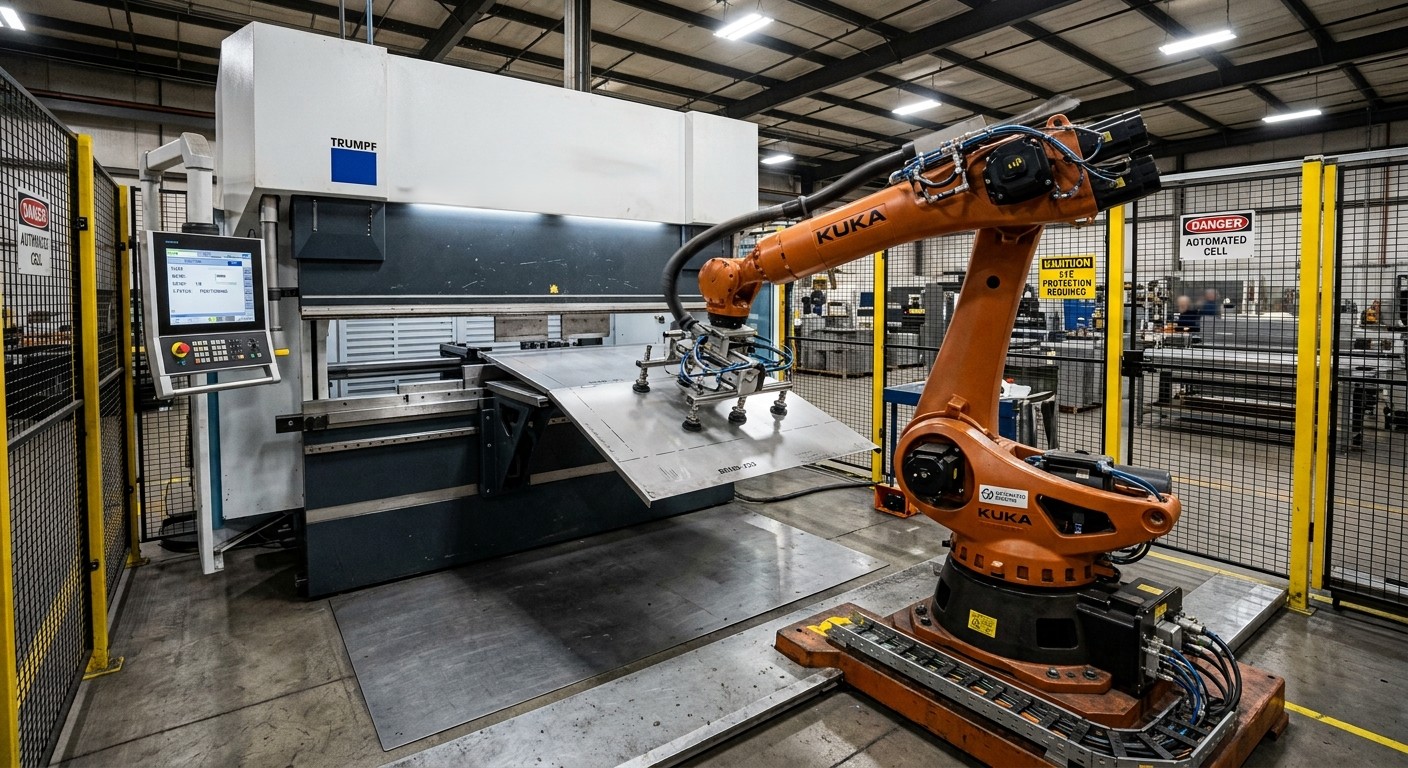
A robot may have enough payload and reach to handle a sheet metal blank and still be unsuitable for the bending operation. The real challenge with press brake tending robots is maintaining controlled workpiece positioning through loading, gauging, bending, reorientation, and unloading. A configuration that works for a flat blank may become impractical once the first flange changes the geometry and available gripping surfaces.
For manufacturers evaluating automated bending, the decision should begin with the parts and production sequence rather than a preferred robot model. Workpiece dimensions, bending order, gripper access, press brake controls, and production volume all influence whether a robotic cell can operate consistently.
The objective is not simply to replace manual loading. It is to develop a complete bending process in which the robot, press brake, tooling, and material handling equipment operate together without creating new bottlenecks.
Why press brake tending requires more than a material handling robot
Press brake tending differs from conventional machine loading because the robot may need to maintain contact with the workpiece during the forming operation. The workpiece changes orientation as bending progresses, and its geometry can restrict access to the tooling or gripping points.
In a straightforward machine tending application, the robot loads a part, withdraws, and waits for machining to finish. In robotic bending, the robot may need to support the sheet, follow its movement during forming, reposition it against the backgauge, and prepare it for subsequent bends.
These movements require coordination between the robot and the press brake. The robot cannot be evaluated independently from the machine’s bending sequence, tooling arrangement, and control capabilities.
The difference between loading and complete bending automation
Some applications require only automatic loading and unloading. Others require the robot to handle the complete bending sequence, including part rotation, flipping, and intermediate regripping.
The second configuration introduces additional requirements for motion planning, gripping stability, collision avoidance, and machine communication. A robot suitable for loading flat blanks may not be appropriate for a complex multi-bend application.
Before selecting equipment, manufacturers should determine which operations the robot must perform and which will remain manual. This distinction affects both the technical design and the financial justification.
Workpiece geometry determines the initial robot configuration
Part weight is an important selection variable, but it should not be treated as the only criterion. Sheet dimensions, material characteristics, center of gravity, and the geometry created during bending can be equally important.
A relatively lightweight sheet with a large surface area may be more difficult to manipulate than a compact, heavier component. Large sheets can require additional support, more demanding gripping arrangements, and a larger operating envelope.
Payload must include the complete handling assembly
The robot must support the workpiece together with the end-of-arm tooling and any additional equipment carried at the wrist. The required capacity must also account for the loads created during acceleration, deceleration, and workpiece reorientation.
For extended sheets, the distance between the load’s center of gravity and the robot wrist becomes particularly important. A configuration may satisfy the nominal payload requirement while exceeding permissible wrist moments or other operating limits.
The correct evaluation therefore includes the complete load configuration rather than comparing workpiece weight directly with the robot’s advertised payload.
Reach must be evaluated across the complete bending sequence
Robot reach determines whether the manipulator can access the blank supply, press brake, intermediate positioning stations, and finished-part area. However, maximum reach alone does not establish whether these positions are practical.
The robot must reach each required position with a suitable wrist orientation while avoiding collisions with the machine, tooling, guards, and workpiece.
As bends accumulate, the part may require different orientations and approach paths. These movements should be checked before selecting the robot and finalizing the cell layout.
Specification verification before cell design
Final payload, reach, wrist capacity, mounting options, and controller compatibility must be verified against official manufacturer documentation for the exact robot model and variant. A related model from the same product family should not be assumed to have identical capabilities.
Where exact specifications are not yet confirmed, the configuration should remain provisional. Robot selection should follow the validated handling requirements rather than determine them prematurely.
Gripper selection can determine whether robotic bending is practical
The end effector is one of the most application-specific elements of a press brake tending cell. It must hold the workpiece securely while allowing the required bending movements and maintaining access to the tooling.
A gripper that performs well during initial pickup may become unsuitable after the workpiece develops flanges or other formed features. This makes the complete bend sequence essential to gripper selection.
Vacuum gripping and mechanical gripping
Vacuum grippers can be appropriate for flat sheet metal components with suitable surface conditions and sufficient available contact area. Their performance depends on material surface quality, sheet geometry, sealing conditions, and the loads generated during handling.
Cutouts, perforations, surface contamination, and restricted contact areas can complicate vacuum gripping. The gripping system must be evaluated against the actual workpiece rather than a simplified flat-sheet assumption.
Mechanical grippers may be more appropriate where edge access is available or where vacuum gripping cannot provide sufficient holding security. However, mechanical gripping can introduce clearance problems around the punch, die, and formed flanges.
Neither approach is universally superior. The correct choice depends on how the workpiece must be supported and manipulated throughout the process.
Regripping and intermediate positioning
Complex bending sequences may require the robot to release and reposition the workpiece between operations. This can involve an intermediate support or regripping station that establishes a repeatable reference before the next bend.
Regripping adds equipment, handling time, and programming requirements. It can also introduce positioning errors if the intermediate reference is not controlled.
Manufacturers should identify every required grip change during process planning. If a part requires frequent repositioning, the resulting cycle time and cell complexity may change the automation business case substantially.
Automatic gripper changing
For production environments handling several part families, automatic gripper changing may provide additional flexibility. Different gripping arrangements can be selected according to part dimensions, geometry, and bending requirements.
However, automatic changing introduces further equipment, storage requirements, control sequences, and maintenance responsibilities. It should be justified by the actual production mix rather than included simply to increase theoretical flexibility.
Press brake integration determines process repeatability
Even a correctly sized robot with suitable gripping equipment cannot deliver consistent bending if the press brake and robot do not exchange the information required for coordinated operation.
The cell must establish reliable communication between the bending machine, robot controller, and associated safety and material handling systems.
Backgauge positioning and workpiece alignment
The press brake backgauge provides the reference used to position the workpiece for bending. The robot must present the sheet consistently against this reference without introducing unwanted forces or positioning errors.
Robot repeatability cannot compensate for inconsistent workpiece seating. If the blank is not correctly located, the bending result may vary even when the robot follows the same programmed path.
For this reason, part alignment and gauging should be validated with representative production components. Additional positioning stations or sensing may be required when blank presentation is inconsistent.
Coordination during the bending movement
Depending on the application, the robot may need to follow the workpiece as the press brake forms the bend. This requires a coordinated movement strategy that accounts for the changing orientation of the sheet.
The press brake control system must provide the necessary operating states and synchronization capabilities. The exact interface depends on the machine and controller configuration.
Before integration, engineers should verify which signals and operating modes are available, how the bending sequence is initiated, and how the system responds to interruptions or faults.
Compatibility with existing press brakes
Retrofitting a robot to an existing press brake can be practical, but the machine’s age and control architecture affect integration complexity.
Some machines may provide suitable interfaces for robotic operation. Others may require additional engineering, control modifications, or changes to the operating sequence.
The feasibility study should establish whether the existing machine can support coordinated robotic bending without compromising safety, serviceability, or normal production requirements.
This is closely related to the broader challenge of evaluating robot compatibility with existing production systems, particularly when legacy controllers or refurbished equipment are involved.
Cell layout, part flow, and safety affect the final configuration
A press brake tending robot must operate within a cell that supports the complete material flow. The configuration includes more than the manipulator and press brake: blank supply, part alignment, regripping equipment, finished-part storage, guarding, and maintenance access all influence performance.
Robot position and external axes
A fixed robot installation may be sufficient when the workpiece range and machine access requirements are limited. Larger parts or applications involving multiple workstations may require a linear track or another external positioning axis.
Adding a track can expand the robot’s accessible working area, but it also increases mechanical complexity, installation requirements, control coordination, and maintenance needs.
The decision should follow a complete reach and collision assessment. External axes should solve a defined access problem rather than compensate for an unsuitable initial layout.
Blank supply and finished-part handling
The robot’s bending sequence may be repeatable while material supply remains inconsistent. Blank separation, stack position, sheet orientation, and replenishment frequency can all affect cell availability.
Thin sheets may adhere to one another or arrive with positional variation. If the robot cannot reliably identify and collect a single blank, the process may require additional separation or verification equipment.
Finished-part handling also deserves attention. Formed components may not stack as easily as flat blanks, and the unloading arrangement must accommodate their final geometry without causing damage or obstructing subsequent cycles.
The same production-flow principles apply to robotic machine loading and unloading without creating bottlenecks. Automation must support the complete machine cycle, not simply transfer material between positions.
Safety and operator access
Robotic press brake cells introduce hazards associated with robot movement, forming equipment, workpiece handling, and stored energy. Safety planning must consider automatic operation, setup, maintenance, troubleshooting, and recovery after interruptions.
Guarding, interlocking, emergency stop functions, operating modes, and safe access arrangements must be engineered for the complete installation. The applicable requirements depend on the equipment and installation jurisdiction.
The cell should also provide practical access for tooling changes, inspections, maintenance, and manual production where required. A layout that prevents efficient intervention can increase downtime despite successful automatic operation.
For general industrial robotic safety considerations, OSHA’s robotics guidance provides useful context for evaluating hazards associated with integrated robotic systems.
Production volume and part variation determine the economic configuration
A technically feasible press brake tending application is not automatically a financially justified automation project. Production volume, part variety, setup requirements, and the current source of lost time determine whether the investment creates measurable value.
Stable production and repeated bending sequences
Parts produced repeatedly with consistent geometry, tooling, and bending sequences are often stronger candidates for robotic tending. The programming and setup effort can be distributed across more production cycles.
In these conditions, automation may reduce repetitive handling, improve cycle consistency, and allow operators to focus on preparation, inspection, or other production tasks.
However, these benefits depend on the existing process. If the press brake spends most of its time waiting for upstream material or downstream operations, adding a robot may not significantly increase output.
High-mix production and frequent changeovers
High-mix manufacturing introduces a different challenge. Each new part may require changes to the bending program, gripper configuration, tooling arrangement, and finished-part placement.
Offline programming and standardized part families can reduce some of this effort, but they do not eliminate the need to validate the physical bending sequence.
When production runs are short and part geometries vary substantially, programming and setup time may consume much of the expected productivity benefit.
Manufacturers should compare the complete automated cycle against the existing manual process, including setup, handling, bending, inspection, replenishment, and recovery.
Evaluating the complete investment
The cost of robotic press brake tending extends beyond the robot purchase. Grippers, fixtures, integration, programming, safety equipment, commissioning, operator training, and ongoing support all contribute to the investment.
Used or refurbished industrial robots may offer an alternative to purchasing new equipment when their mechanical condition, controller capabilities, and integration requirements are suitable.
However, the purchase-price difference must be evaluated alongside the potential cost of compatibility work, spare parts, support limitations, and downtime. The broader decision is explained in URT’s guide to choosing between new and refurbished industrial robots.
For press brake tending, the strongest financial case usually comes from identifiable improvements in productive machine time, handling consistency, labor allocation, or reduced production interruptions. These improvements should be measured rather than assumed.
When robotic press brake tending may not be the right solution
Robotic bending is not appropriate for every sheet metal operation. Some processes remain better suited to manual handling, assisted bending, or alternative automation arrangements.
Highly variable workpieces, unstable blank presentation, difficult gripping conditions, and complex reorientation requirements can make a fully automated cell disproportionately expensive or difficult to maintain.
Automation may also be unsuitable when the press brake lacks the necessary control interfaces or when production changes too frequently to justify programming and setup effort.
Comparing practical configuration options
The following comparison helps distinguish the operational conditions that may favor different approaches. It is a preliminary decision framework, not a substitute for detailed engineering validation.
| Configuration | Where it may fit | Main limitation to evaluate |
|---|---|---|
| Fixed industrial robot | Repeatable part families with controlled machine access | Reach, orientation, and clearance throughout bending |
| Robot with linear track | Larger working areas or multiple handling positions | Additional cost, space, controls, and maintenance |
| Robot with automatic gripper changing | Several part families requiring different gripping arrangements | Tooling investment, changeover time, and programming |
| Robot with regripping station | Multi-bend parts requiring intermediate repositioning | Cycle time, positioning accuracy, and additional equipment |
| Manual or assisted bending | Low-volume, highly variable, or difficult-to-grip components | Labor requirements, ergonomics, and manual cycle consistency |
A more complex configuration is not necessarily a better one. The appropriate solution is the arrangement that handles the required production mix with acceptable cycle time, operational risk, and total cost.
What to verify before selecting a press brake tending robot
Before requesting a robot quotation or approving a cell design, manufacturers should evaluate representative parts and document the complete bending process. The following checklist can be used to identify missing information and define the requirements for an initial feasibility study.
- Workpiece characteristics: Confirm material, dimensions, weight, center of gravity, and relevant surface conditions.
- Bending sequence: Document every bend, rotation, flip, and required regripping operation.
- Gripper feasibility: Identify suitable gripping surfaces before and after forming.
- Robot capacity: Verify payload, wrist loading, reach, and motion requirements for the exact model variant.
- Press brake interface: Confirm controller compatibility, machine signals, and synchronization requirements.
- Tooling clearance: Check access around the punch, die, backgauge, and formed workpiece.
- Material flow: Define blank supply, separation, positioning, unloading, and finished-part storage.
- Safety: Assess guarding, operating modes, intervention requirements, and maintenance access.
- Production economics: Compare complete manual and automated cycles, including setup and changeovers.
- Technical support: Establish responsibility for programming, commissioning, maintenance, spare parts, and troubleshooting.
The configuration should be validated against the most demanding representative parts, not only the easiest components in the production range. Simulation can help identify reach and collision problems, but physical validation remains necessary for gripping, positioning, material behavior, and process stability.
Before committing to equipment, the manufacturer and integrator should also agree on measurable acceptance criteria. These may include successful completion of the full bending sequence, acceptable part quality, repeatable handling, cycle performance, and defined recovery behavior.
FAQ
What type of robot is suitable for press brake tending?
Articulated industrial robots are commonly considered because they can manipulate workpieces through different positions and orientations. Suitability depends on payload, reach, wrist capacity, gripping requirements, bending sequence, and compatibility with the press brake. The complete application should be evaluated before selecting a specific model.
Can an industrial robot be integrated with an existing press brake?
Yes, integration may be possible when the press brake has suitable control capabilities and can support the required operating sequence. Older machines may require additional interface engineering or modifications. Compatibility, safety, and synchronization must be verified before committing to the project.
Is a vacuum gripper suitable for every sheet metal bending application?
No. Vacuum gripping depends on suitable contact surfaces, material conditions, available gripping area, and the loads generated during handling. Perforated parts, restricted contact areas, and complex bending sequences may require mechanical gripping or alternative tooling arrangements.
Does a press brake tending robot need a linear track?
Not necessarily. A fixed installation may be sufficient for smaller working areas and controlled part geometries. A linear track becomes relevant when the required positions or workpiece dimensions cannot be accommodated effectively by a fixed robot. Its use should be justified through reach, collision, and layout analysis.
Can refurbished robots be used for press brake tending?
Refurbished industrial robots can be considered when their mechanical condition, capacity, controller capabilities, and integration requirements match the application. The evaluation should include spare parts, software compatibility, safety integration, and technical support. A lower purchase price alone does not establish suitability.
What determines the return on investment of robotic press brake tending?
Return on investment depends on production volume, cycle time, setup requirements, labor allocation, machine utilization, and the total installed cost. Automation may be financially attractive when repetitive handling limits productive machine time or creates recurring operational costs. Frequent changeovers and complex programming requirements can weaken the financial case.
When should press brake bending remain manual?
Manual bending may remain appropriate when production volumes are low, part geometry changes frequently, or gripping and repositioning requirements make automation excessively complex. It may also be preferable when the existing press brake cannot support reliable robotic integration without substantial modification. The decision should compare complete operating costs and practical production requirements.
Talk to URT About Press Brake Tending Automation
If you are evaluating press brake tending robots and suitable configurations for your production process, contact URT. We will give you a direct, technical answer based on your actual production requirements.