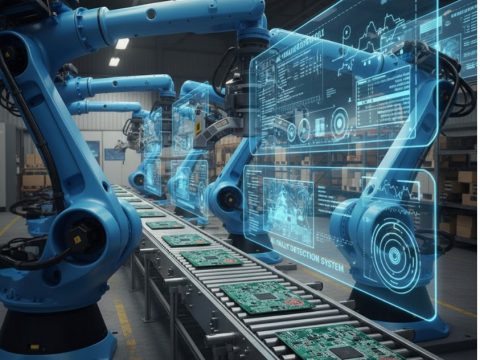
Failure detection in production has historically relied on a combination of human inspection, statistical controls, and traditional sensors. However, the increasing complexity of processes, the pressure to reduce scrap, and the need for real-time traceability have highlighted clear limits in these approaches. In this context, a frequently asked question on the shop floor is: How
Spec sheets vs shop-floor reality On paper everything looks precise. In production you face tolerances, scrap risk, manual tweaks, and material variability. The honest question is: “Will the robot actually be more accurate than what we do today?” Accuracy vs repeatability Repeatability The robot’s ability to return to the same point over and over. Typical
In many automation projects, the real bottleneck is not hardware or mechanical integration: it’s robot programming. Fine adjustments, repeated trials, last‑minute changes, and dependencies with other systems often extend commissioning far beyond expectations. A common question among engineering and production managers is: ➡️ What practical strategies can reduce robot programming time without sacrificing robustness or
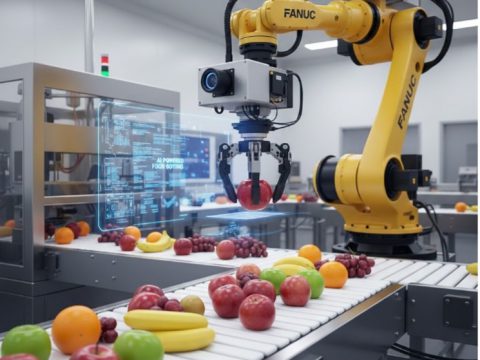
Machine vision has become one of the most in-demand technologies in the food industry. Quality control, inspection, sorting, traceability, and robotic guidance are now processes almost unimaginable without vision systems. However, real-world plant environments differ greatly from marketing promises: integrating machine vision in food production requires facing specific technical, operational, and regulatory challenges. Unstable lighting,
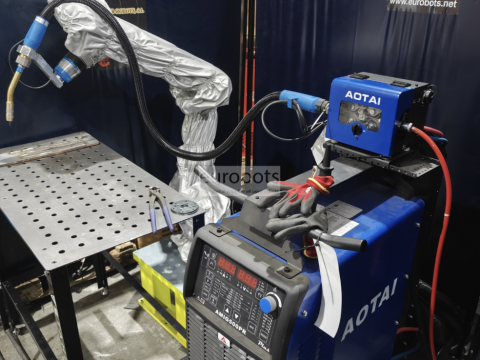
In industrial welding, the most expensive problems rarely come from the welding process itself but from its variability: differences between operators, inconsistent travel speed, positioning errors, or human fatigue. Robotic automation—especially in MIG/MAG and TIG welding—is widely used across the world to eliminate recurring failures that affect quality, production time, and cost per part. This
This question rarely appears when a robot first arrives on the production floor. It emerges months later. When everything works. When the cell is producing. When nobody questions the arm, the gearbox, or the repeatability anymore. The doubt appears in front of a screen: A pending update. A license about to expire. A file that
As robotic automation becomes increasingly connected and data‑driven, a question that once seemed secondary is now unavoidable: Who actually owns the data generated by an industrial robot? This is not a trivial issue. In many modern automation projects, operational data holds as much strategic value as the physical production itself. What Data Does an Industrial
In many companies, the decision to automate is not held back by the cost of the robot or by floor space, but by a less visible—yet decisive—concern: technical dependency. The question is not always stated openly, but it quickly emerges in any investment committee: What happens when the supplier leaves? Robotic automation introduces powerful technology,
In many industrial companies, robotic automation is no longer pursued only to “produce more in less time.” Today, most plants already operate at stable demand levels, and the main operational challenge is variability, not capacity. When no increase in production volume is expected, decision-makers often ask: “How do we justify investing in a robot if
Palletizing is one of the most critical stages at the end of the production line. Although it is often perceived as a simple process, in practice it involves occupational risks, production bottlenecks, and hidden operational costs. For many years this process has been handled using traditional systems: manual palletizing, semi‑automatic solutions, or low‑flexibility dedicated machines.