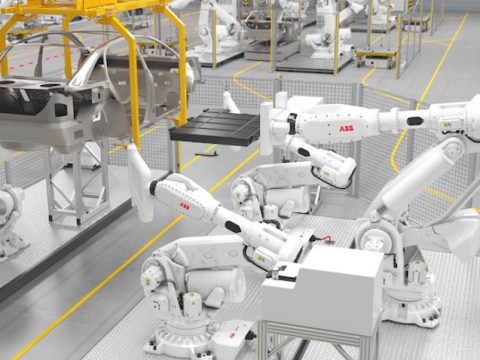
Purchasing a robot is not simply a technical decision. In reality, it is a financial one. Many companies believe that the most expensive robot is the best, or that buying new is the safest way to “avoid risks”. However, when looked at from a business perspective, with numbers and strategy in mind, the reality is
The electronics sector increasingly demands precision, speed and flexibility in production processes. From smartphones to automotive components, the miniaturisation of parts and the complexity of assemblies require technologies that surpass human limitations without compromising quality. In this context, the ABB IRB 1300 has established itself as a key industrial robot for high-demand electronic assembly, combining
In today’s age of intelligent automation, the real advantage for industrial companies lies not just in acquiring advanced robots, but in integrating entire systems that encompass hardware, software, safety features, and operator training. URT exemplifies this approach by evolving from a simple supplier of industrial robots into a full-service integrator. They specialise in delivering turnkey
Modern agriculture faces a challenge: producing more with fewer personnel and ever-increasing costs. Automation has become a necessity, not a luxury. However, many producers—especially medium and small ones—believe that bringing robotics to the field is beyond their reach. The reality is different: refurbished industrial robots are opening a new era for precision agriculture, offering advanced,
The KUKA KR 510 R3080, part of KUKA’s QUANTEC/FORTEC family, is one of the most powerful high-payload industrial robots available on the market. Designed to handle extremely large and heavy parts—with a nominal payload of around 510 kg and a reach exceeding 3 meters—it offers a combination of strength, reach, and repeatability that makes it
In the world of industrial automation, medium-payload robots represent an ideal balance between strength and agility. Among them, the FANUC M-710iC/50 has established itself as a reliable solution for processes that demand precision, speed, and adaptability. Supported by URT, this model remains a competitive alternative for companies seeking to optimize their operations with a cost-effective
The integration of 3D vision with used robots is taking operational precision to a whole new level. The combination of robotics and three-dimensional vision systems has profoundly revolutionized industrial manufacturing: not only does it enable the automation of complex processes, but it also allows production lines to be quickly adapted to the specific needs of
In an increasingly competitive industrial landscape, the choice between purchasing a brand-new industrial robot or opting for a refurbished one has become a crucial consideration for many manufacturing plants. This decision not only impacts the initial investment, but also factors such as ongoing maintenance, technological integration, installation speed and the overall sustainability of the project.
For years, factories were designed as rigid systems: fixed lines, dedicated stations and layouts that barely changed for an entire decade. But the days of mass, stable production are now behind us. The new industrial economy demands flexibility, customisation and immediate responsiveness. Thus, the concept of the reconfigurable factory was born, where refurbished industrial robots
Over the past ten years, a silent phenomenon has taken place in the global industry: while some manufacturing plants have closed due to cost pressures or failing to modernise in time, others have resurged with impressive strength without the need for multimillion-euro investments. What is the secret? Intelligent industrial reconstruction supported by refurbished robotics and