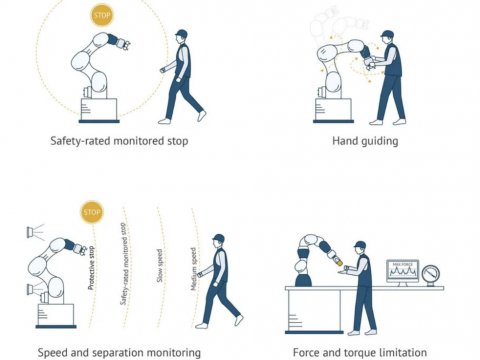
Collaborative robotics has positioned itself as an attractive solution for many industries: promises of safety, flexibility, fast deployment, and the ability to work side by side with operators. However, on the shop floor a critical and completely legitimate question arises: How do I know if my process can truly become collaborative without sacrificing safety, production
For years, industrial robotics seemed reserved for large corporations with massive budgets. Today, that reality has changed. Advances in technology, easier programming, and flexible financing have made automation accessible even to manufacturing startups from their earliest stages. According to the International Federation of Robotics (IFR), over 30% of new industrial robot installations in 2024 were
In industrial robotics, safety is not just a legal requirement—it is the foundation of responsible automation. As the use of refurbished robots continues to grow rapidly, understanding European regulations and safety standards becomes essential to ensure operations are both lawful and secure. In Europe, industrial robots are primarily governed by the Machinery Directive 2006/42/EC, which
In the age of advanced automation, industrial robots have become indispensable players within production facilities. Their efficiency, precision, and ability to operate continuously are highly valued. Yet, with their growing presence comes a crucial responsibility: ensuring the safety of human operators who interact with these machines. Protecting robots and robotic cells is not merely about
In the dynamic world of industrial automation, robot safety is essential to ensure efficient operations and protect workers. The Association for Advancing Automation (A3) recently announced the publication of the revised ISO 10218 standard, the global reference standard for industrial robot safety. This update, the first since 2011, introduces significant changes that reflect technological advancements