
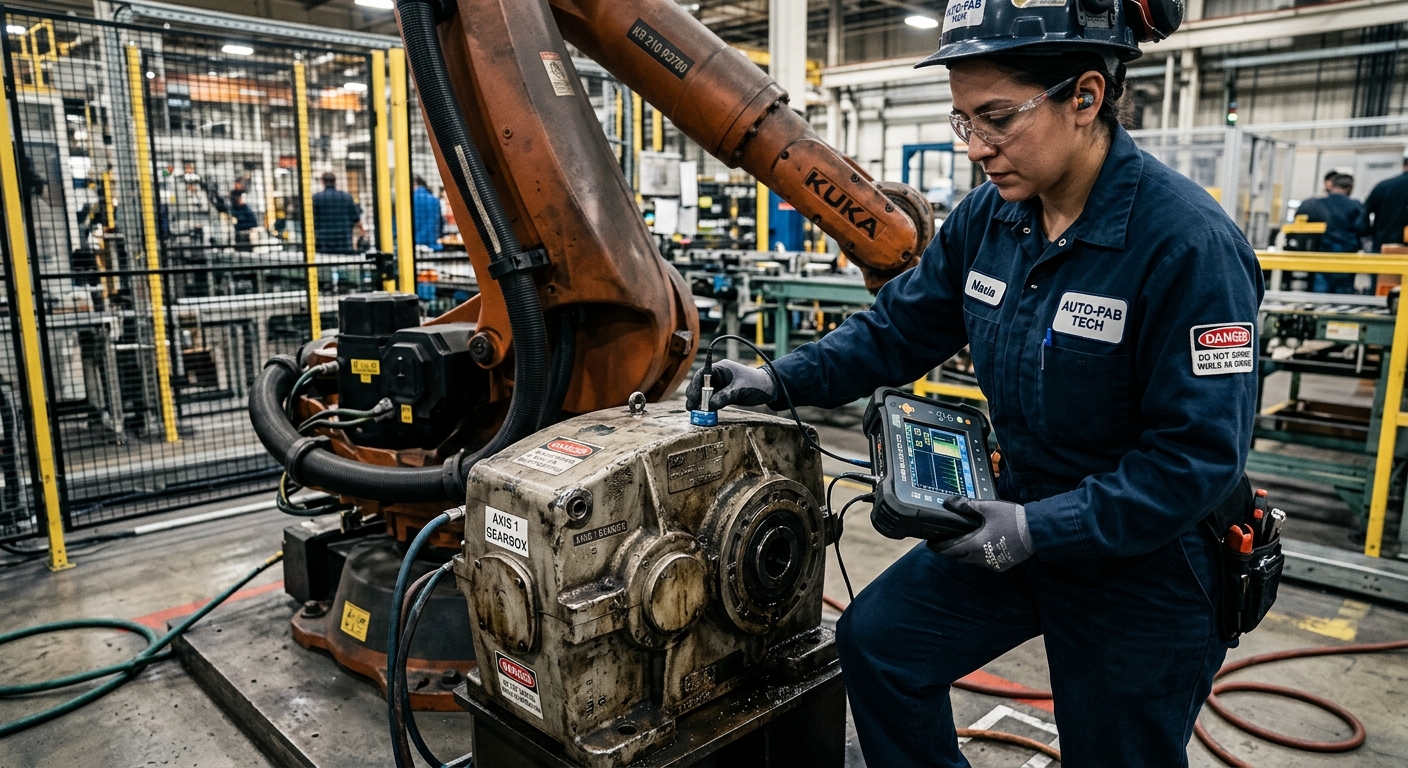
Backlash can reveal robot gearbox wear without opening the robot
Robot gearbox wear can become expensive long before a gearbox reaches obvious mechanical failure. Dismantling a robot simply to inspect internal components disrupts production. However, ignoring early changes in mechanical condition can turn a manageable maintenance issue into unplanned production downtime.
The practical objective is not to prove the internal condition of every gear tooth without opening the robot. Instead, maintenance teams should look for external evidence that justifies further investigation. This evidence can include increasing backlash, abnormal motion, changing vibration, unusual noise, or lubrication concerns.
No single non-invasive check proves that a gearbox is healthy. It also cannot identify the exact internal component responsible for a problem. A useful inspection combines several observations. Whenever possible, maintenance teams should compare them with a known baseline for the same robot and operating conditions.
Start with the robot’s behavior, not the gearbox housing
A gearbox problem often affects robot behavior before maintenance personnel know exactly what is happening internally. The useful question is whether an axis behaves differently from its established baseline under comparable conditions.
Changes can appear as lost motion during direction reversals, abnormal settling, unexpected vibration, or unusual sound. Maintenance teams may also notice deterioration in an application that previously ran consistently. These symptoms deserve investigation, but they should not immediately lead to a gearbox failure diagnosis.
Mechanical looseness elsewhere in the robot or cell can produce similar symptoms. Tooling problems, mounting issues, lubrication condition, brakes, bearings, motors, fixtures, and application-related loads can also affect robot behavior. Good troubleshooting separates the symptom from the diagnosis.
This distinction matters because replacing or rebuilding a gearbox requires significant intervention. Maintenance teams need enough evidence to justify that work. They should not treat every motion irregularity as internal gearbox damage.
Establish whether the change is repeatable.
A symptom that appears consistently at a particular axis position, direction change, or operating condition provides more diagnostic value than an isolated event. Maintenance personnel should document when the behavior occurs. They should also determine whether they can reproduce it under controlled conditions.
The comparison should account for the robot’s load, speed, posture, tooling, and production task. A robot operating under substantially different conditions does not provide a clean reference for evaluating mechanical changes.
Backlash Can Reveal Mechanical Deterioration Without Opening the Robot
Backlash is one of the most useful mechanical indicators when investigating a robot axis. As the axis reverses direction, excessive lost motion can indicate increased clearances somewhere in the drivetrain.
The important word is increased. A maintenance team needs a reference before deciding that observed movement is abnormal. Manufacturer procedures and tolerances vary by robot model and axis. For this reason, technicians should not apply a generic backlash limit across different robots.
A controlled backlash assessment can help determine whether an axis deserves deeper inspection. It cannot establish which internal gearbox component has worn. It also cannot confirm that the gearbox is the only source of movement.
Trend is usually more useful than a one-time reading.
If the plant records mechanical condition periodically, technicians can identify gradual changes more easily. A reading that remains stable across repeated inspections tells a different maintenance story. A reading that progressively increases under comparable test conditions deserves closer attention.
This is the same principle behind broader predictive maintenance for robot reliability. Condition data becomes more useful when it establishes a trend. An isolated measurement with no historical reference provides less diagnostic value.
When a manufacturer provides an approved backlash or mechanical inspection procedure, technicians should follow it. Robot construction, gearbox design, and acceptable movement differ across manufacturers and models.
Noise and vibration can add evidence, but context matters
An experienced maintenance technician may notice that an axis sounds different before the robot generates a fault. Grinding, knocking, or irregular mechanical noise can justify further inspection. Changes during acceleration, deceleration, or reversal can provide additional evidence.
Sound alone provides weak evidence because the robot operates inside a larger mechanical system. Motors, brakes, dress packs, tooling, external equipment and the production process can introduce noise. Technicians can easily attribute that noise to the wrong component.
Vibration analysis can provide a more structured condition-monitoring approach. Instead of asking whether an axis simply “sounds bad,” the maintenance team can compare vibration behaviour over time. Technicians can then investigate changes associated with particular operating conditions.
This approach can support a wider industrial robot predictive maintenance strategy using sensors and condition data. The objective is not to collect more data for its own sake. The objective is to identify deterioration early enough to plan the appropriate maintenance response.
Measurement conditions need to be repeatable.
Trend data loses value when technicians collect each measurement under different conditions. Robot posture, payload, speed, acceleration, and production state can all affect the results.
A meaningful comparison therefore requires a defined test condition. Without that discipline, technicians may mistake normal differences in robot operation for mechanical deterioration.
Lubrication condition can provide another warning signal
Gearboxes depend on the correct lubrication condition, but technicians must follow the requirements for the specific robot. Maintenance teams should not assume that grease type, quantity, replacement method, or inspection procedure transfers between robots.
Evidence of leakage or abnormal lubricant condition can strengthen the case for closer mechanical investigation. A maintenance history that shows missed lubrication work can also increase concern. However, these conditions do not automatically prove robot gearbox wear.
The maintenance history matters because technicians cannot evaluate a gearbox only from what the robot does today. Previous operating conditions, servicing, repairs, and known mechanical incidents can change the risk associated with an otherwise subtle symptom.
This is especially relevant when evaluating used equipment. Buyers should consider mechanical condition together with controller condition and available service history. They should also consider spare parts and support requirements instead of treating the robot arm as an unknown component that will simply continue operating.
Combine the evidence before deciding on mechanical intervention
The strongest non-invasive assessment usually combines several indicators. Backlash, vibration, sound, lubricant condition, and observed motion each answer a different part of the maintenance question.
For example, an unusual sound with no measurable change in motion may justify monitoring and investigation rather than immediate gearbox removal. Increasing backlash combined with changing vibration and deteriorating robot behavior presents a different risk profile.
This is why maintenance teams should make a condition-based decision rather than search for one definitive symptom. Plants that want to reduce unplanned stops can also review broader strategies for minimizing downtime in robotic automation. Gearbox condition is only one part of robotic system availability.
The consequences of waiting also matter. A questionable axis on a robot that supports a critical production process deserves a different response. The same symptom on equipment with redundancy and an available maintenance window may allow a different approach.
Compare several forms of evidence.
Use the following checklist to structure an initial condition assessment. It does not replace the manufacturer’s inspection procedure or specialist diagnosis.
- Check whether the axis shows repeatable abnormal behavior.
- Compare backlash or lost motion with previous measurements when reliable baseline data exists.
- Listen for changes in mechanical sound under controlled operating conditions.
- Compare vibration behavior with historical measurements when condition monitoring is available.
- Review the lubrication and maintenance history for the affected axis.
- Check for visible leakage or other external evidence of a mechanical issue.
- Confirm that tooling, fixtures, mounting, and other external mechanical components are not creating the symptom.
- Review whether the problem changes with robot posture, direction, load, or speed.
- Consult the manufacturer’s maintenance documentation for the exact robot model before performing model-specific mechanical tests.
- Escalate the inspection when several independent indicators point toward deterioration.
When non-invasive checks are not enough
External checks have an important limitation. They provide evidence about the mechanical condition without giving technicians direct visual access to internal gearbox components. These checks can help determine whether further work is justified, but they cannot guarantee an internal diagnosis.
Maintenance teams should seek specialist support when symptoms progress or multiple indicators point toward deterioration. Significant changes in robot motion also justify closer investigation. Continued operation may create additional production or equipment risk.
The next diagnostic step depends on the robot design, manufacturer procedures, and the evidence already collected. Maintenance personnel should also follow appropriate isolation and servicing procedures before performing intrusive work on a robotic system.
When intervention requires access to hazardous energy or robot components, OSHA’s hazardous energy control guidance provides useful general safety context for servicing and maintenance work.
The goal is not to avoid dismantling at all costs. The goal is to avoid unnecessary dismantling while recognizing when external evidence justifies a more detailed inspection.
Used robots need a mechanical condition check before production
A used robot creates a particular challenge because the buyer may not have a complete condition trend from its previous installation. A single inspection therefore provides less historical context than long-term monitoring of the same robot.
This makes mechanical evaluation before installation particularly important. Technicians should consider backlash, abnormal movement, sound, leakage, and available service history together. They should not assume that a robot is mechanically sound simply because it powers up and completes a motion test.
The same principle applies to spare parts planning. If an older robot has a questionable mechanical component, the plant should understand parts availability and support before making that robot production-critical.
URT’s guidance on robotic maintenance and spare parts planning explains why parts strategy forms part of uptime planning. Plants should not wait for a failure before addressing that issue.
A used robot does not need to be mechanically perfect to remain commercially viable. However, its actual condition needs to match the production risk that the buyer is prepared to accept.
FAQ
Can you confirm robot gearbox wear without dismantling the robot?
You can identify evidence consistent with mechanical deterioration without dismantling the robot. Backlash, vibration, noise, lubrication condition, and motion behavior can provide useful evidence. However, external checks do not provide direct inspection of internal gearbox components.
Is excessive backlash always caused by the gearbox?
No. More than one mechanical source can create lost motion. Technicians should consider the complete axis and related mechanical components before attributing the symptom specifically to internal gearbox wear.
Can vibration analysis detect a damaged robot gearbox?
Vibration monitoring can help technicians identify changes in mechanical behavior. It provides the most value when they collect measurements under repeatable conditions and track them over time. Other robot and cell components can also influence the vibration signature.
Does unusual gearbox noise mean the robot should be stopped?
Unusual noise deserves investigation, but noise alone does not establish the severity or source of a mechanical problem. Maintenance teams should consider the type of noise, other condition indicators, manufacturer guidance, and production risk before choosing a response.
Should backlash limits be the same for every industrial robot?
No. Mechanical construction and inspection requirements vary between robot models and axes. Technicians should use limits and test procedures for the exact robot rather than applying a generic value.
What should be checked when buying a used robot with no maintenance history?
Technicians should check axis behaviour, backlash, abnormal sound, leakage, and other accessible condition indicators. Buyers should also evaluate the controller, available service information, spare parts, and support requirements. Missing history increases uncertainty, so a successful motion test does not prove long-term mechanical condition.
Talk to URT About Robot Gearbox Condition
If you are evaluating robot gearbox wear, contact URT. We will give you a direct, technical answer based on your actual production requirements.