
Subtitle
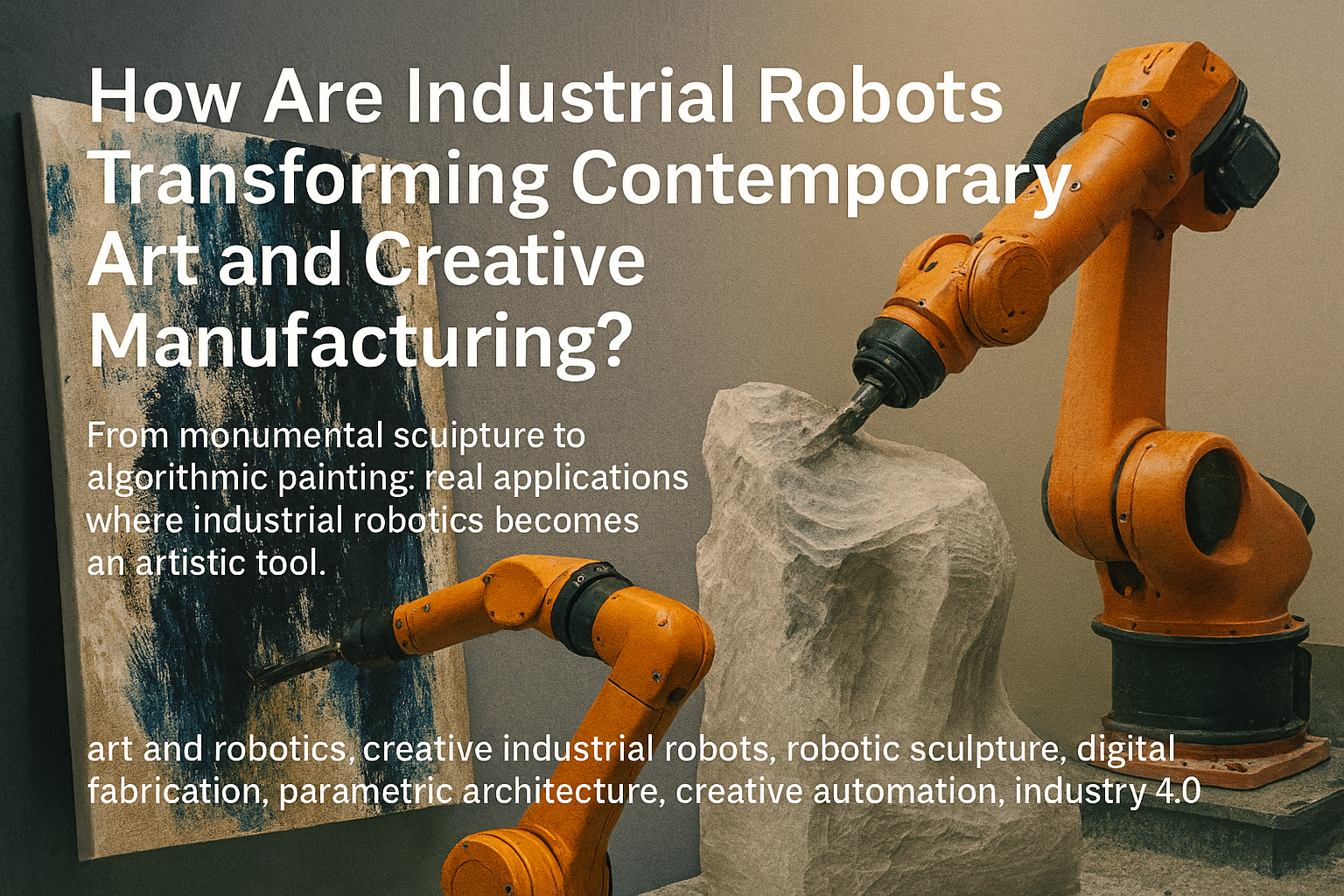
From monumental sculpture to algorithmic painting: real applications where industrial robotics becomes an artistic tool.
Slug
industrial-robots-contemporary-art-creative-manufacturing
Meta description
Discover how industrial robots are revolutionizing contemporary art, sculpture, and creative manufacturing with precision, scale, and new expressive possibilities.
Introduction
For decades, industrial robots have been associated exclusively with production lines, welding, palletizing, or machining. However, in recent years, these systems have begun to occupy an unexpected space: contemporary art and creative fabrication.
Far from replacing the artist, industrial robots have become tools of creative amplification, enabling:
- Large-scale sculptures with millimetric precision.
- Algorithm-driven automated painting.
- Fabrication of complex architectural structures.
- Carving hard materials such as marble or metal with geometries impossible to achieve by hand.
Universities, architecture studios, and international artists use robotic arms from manufacturers like KUKA, ABB, or FANUC to push the physical boundaries of the creative process.
Robotics does not eliminate artistic expression; it redefines its tools.
1️⃣ Robots in Large-Format Sculpture
Industrial robots excel thanks to their:
✔ Repetitive precision
✔ High payload capacity
✔ Multi‑axis freedom of movement
In contemporary sculpture, this enables:
- Robotic carving of stone and high‑density foam.
- Complex cutting in metal.
- Creation of parametric forms generated through software.
Academic institutions such as ETH Zürich have widely documented the use of robotic arms in experimental architectural and sculptural fabrication.
The robot becomes a digital extension of 3D design.
2️⃣ Robotic Painting and Algorithmic Art
Contemporary artists have used industrial robots for:
- Programmed gestural painting.
- Data‑driven brushstrokes.
- Interaction between artificial intelligence and mechanical arms.
German artist Patrick Tresset, for example, has developed robotic systems capable of creating portraits through algorithmic programming.
In these cases, the robot does not “create by itself” but executes rules and parameters defined by the artist.
3️⃣ Advanced Architectural Fabrication
In experimental architecture, industrial robots are used for:
✔ Fabrication of complex molds
✔ Large‑scale 3D printing
✔ Robotic cutting of wood or composite materials
✔ Non‑standard assemblies
The combination of parametric software (such as advanced CAD tools) with robotic arms enables geometries that would be unfeasible using traditional methods.
4️⃣ Precision and Repeatability as Creative Tools
In traditional art, manual variation is part of the process.
In robotic art, controlled repeatability makes it possible to:
- Reproduce complex patterns.
- Generate structurally identical series.
- Explore exact mathematical variations.
Industrial precision becomes its own artistic language.
5️⃣ Replacement of the Artist or New Collaboration?
It is important to clarify:
The robot does not replace artistic intention.
The creative process includes:
- Concept design
- Digital modeling
- Trajectory programming
- Material selection
- Final manual adjustments
The robot executes, but the artist defines.
In this sense, industrial robotics expands the physical capabilities of creators, especially for large‑scale works or complex geometries.
6️⃣ Applications in Museography and Interactive Installations
In contemporary exhibitions, some robots become part of the artwork itself:
- Robots that paint in real time
- Robotic arms interacting with visitors
- Programmed kinetic systems
These installations explore the relationship between machine, algorithm, and human perception.
7️⃣ Opportunities for Industry
Beyond pure art, the intersection of robotics and creativity influences:
✔ Industrial design
✔ Advanced prototyping
✔ Custom fabrication
✔ Production of unique pieces
The boundary between industry and art becomes increasingly blurred as technology enables large‑scale customization.
Conclusion
Industrial robotics no longer belongs exclusively to the traditional factory environment.
In the artistic and creative realm, industrial robots:
- Expand formal possibilities
- Enable monumental scales
- Integrate digital design with physical fabrication
- Transform the creative process into a human‑machine collaboration
Automation not only optimizes production; it also reshapes the way we conceive creation.
FAQs
❓ Can robots create art autonomously?
Not in the human sense. They execute algorithms and trajectories defined by programmers or artists.
❓ What advantages do robots offer compared to traditional tools?
Precision, repeatability, scalability, and geometric freedom.
❓ Are only universities using robots for art?
No. Architecture studios, independent artists, and research centers also use them.
❓ Do these applications require special robots?
Generally, standard industrial robots are used, adapted to specific tools.
Checklist to Evaluate a Robotic Artistic Application
✔ Is the design digitally modeled?
✔ Does the scale exceed manual capabilities?
✔ Is high repeatability required?
✔ Is the geometry complex or parametric?
✔ Is the human‑machine interaction clearly defined?