
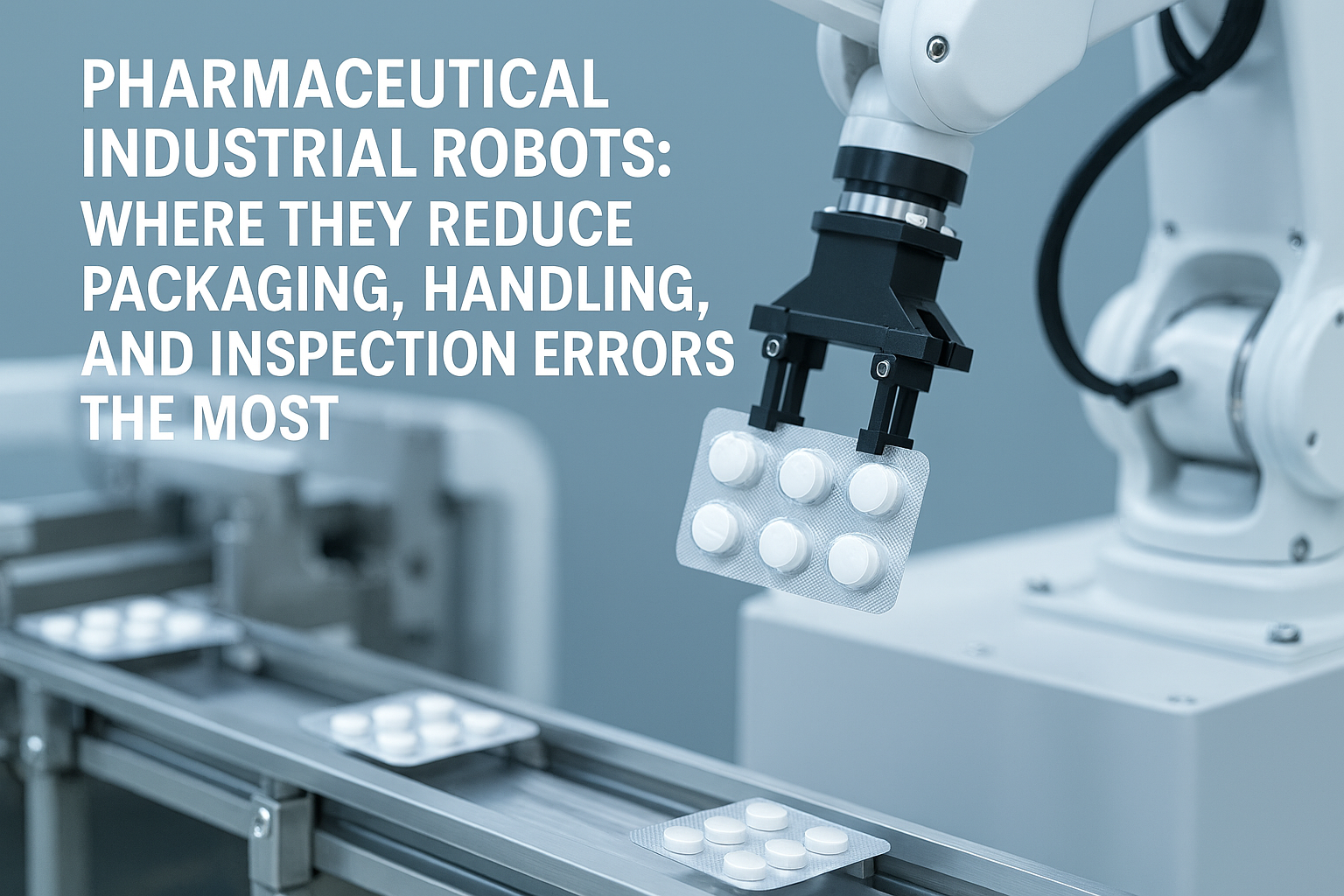
Industrial robots are increasingly central to pharmaceutical manufacturing strategies focused on quality, compliance, and operational resilience. Unlike other industries where automation is mainly driven by speed or labor costs, pharma automation is primarily about error reduction, repeatability, traceability, and risk control. When processes require consistent execution, minimal human contact, and complete documentation, robotic systems provide measurable value.
This article explains where industrial robots reduce the most errors in pharmaceutical environments, why these applications deliver faster returns, and how companies can approach automation projects with realistic expectations. The focus is not on replacing people, but on stabilizing critical processes where human variability introduces packaging, handling, or inspection risks.
Why the Pharmaceutical Industry Is Ideal for Robotics
Pharmaceutical manufacturing combines several conditions that align naturally with robotic automation:
- High repeatability requirements
- Strict quality and regulatory standards
- Mandatory traceability and documentation
- Sensitivity to contamination and handling damage
- Consistent product geometry over long production runs
In many pharmaceutical plants, the challenge is not throughput alone. It is the need to perform the same task thousands of times without deviation. Fatigue, shift changes, and manual handling variability introduce risks that are difficult to fully eliminate through training alone.
A properly integrated industrial robot executes predefined trajectories, applies consistent forces, and operates inside controlled environments. This stabilizes processes across shifts and reduces dependence on highly specialized manual skills for repetitive tasks.
Equally important, robotic systems generate process data. Cycle times, rejects, micro-stoppages, and inspection results can all be logged automatically. For operations and quality managers, this transforms automation from a productivity tool into a process control asset.
Pharmaceutical Processes Where Robots Reduce Errors Most
Secondary Packaging
Secondary packaging is often the first area where pharmaceutical companies see robust automation results. Tasks such as placing blisters, vials, bottles, syringes, or kits into cartons, trays, or aggregation lines are highly repetitive and sensitive to orientation errors.
Manual packaging frequently leads to:
- Incorrect product orientation
- Missing components
- Damaged packaging
- End-of-line bottlenecks
- Rework due to fatigue-related mistakes
Robots excel in these environments by maintaining constant motion, orientation accuracy, and placement consistency. When combined with vision systems, robots can verify presence and orientation before placement, reducing downstream rejects.
The return on investment is often fast because packaging errors are immediately visible, costly to rework, and directly tied to compliance risk.
Product Handling and Transfer Between Stations
Product handling is another high-impact area. In pharmaceutical lines, products often move between filling, capping, labeling, inspection, and packaging stations. Each transfer introduces potential risks:
- Mechanical shocks or surface damage
- Cross-contamination
- Product mix-ups
- Sequence errors between batches
Industrial robots provide controlled, repeatable transfers while maintaining separation and order. This is particularly valuable in multi-format lines or environments where frequent changeovers are required.
Robots can:
- Feed machines at stable rates
- Transfer products without contact stacking
- Maintain batch integrity
- Execute recipe-based changes between formats
By reducing unnecessary manual touches, robots also reduce contamination risk—an argument that resonates strongly with quality teams.
Vision-Assisted Inspection
Inspection is one of the most powerful applications when robotics and machine vision are combined. Robots provide the positioning precision; vision systems deliver objective evaluation.
Robotic inspection is commonly used to verify:
- Presence or absence of components
- Correct orientation
- Label application and alignment
- Barcode and data matrix readability
- Seal integrity
- Cosmetic defects
Instead of relying entirely on manual inspection—which can vary by operator, lighting, and fatigue—robotic systems apply consistent criteria. Inspection becomes uniform, repeatable, and auditable.
Importantly, inspection data can be stored and linked to serial numbers or batches, strengthening traceability across the line.
How Robotics Supports Traceability Rather Than Complicating It
A common misconception is that automation makes traceability more complex. In practice, well-designed robotic cells enhance traceability.
Robots can be integrated with:
- Barcode and serialization readers
- Vision systems
- Manufacturing execution systems (MES)
- Line controllers and databases
Each robot action can be associated with time, batch, recipe, and product status. This reduces the risk of mix-ups, incorrect labeling, or incomplete sequences.
When deviations occur, investigations are based on process data rather than assumptions. This shift from anecdotal analysis to evidence-based review is a major advantage for quality assurance teams.
Reduced Human Contact, Reduced Risk
In sensitive pharmaceutical processes, reducing human contact is often as important as improving efficiency. Every manual interaction introduces potential for:
- Contamination
- Handling damage
- Misidentification
- Process deviation
Robotic automation minimizes unnecessary contact while keeping operators in supervisory, setup, and validation roles. For regulated environments, this balance supports both compliance and operational stability.
What to Evaluate Before Investing in Robotics
Automation decisions should never be driven by technology alone. Before investing in industrial robots, pharmaceutical companies should evaluate four key variables:
- Process stability – Is the process already standardized?
- Production volume – Is repetition high enough to justify automation?
- Changeover frequency – How often do formats or recipes change?
- Cost of errors – What is the real cost of rejects, rework, and deviations?
In some cases, low-volume processes with high error costs are excellent automation candidates. In others, highly unstable processes should be standardized before introducing robots.
Equally important is the level of integration. Isolated robots rarely deliver full value. The biggest gains come when robots are integrated with conveyors, tooling, vision systems, sensors, safety systems, and monitoring software.
Building a Realistic Business Case
A credible business case compares the current process with an automated scenario using conservative assumptions. Typical metrics include:
- Reject and rework rates
- Cycle time consistency
- Availability and downtime
- Labor exposure to repetitive tasks
- Quality-related costs
In the pharmaceutical industry, so-called “soft benefits” matter. Reduced variability, improved audit readiness, and stronger documentation may not always appear immediately in a single ROI figure, but they are strategically valuable.
When framed correctly, robotics is understood not as a branding investment, but as a process control strategy.
The Role of the System Integrator
In pharmaceutical projects, success depends less on the robot itself and more on how the solution is engineered. A competent integrator translates operational needs into functional robotic cells.
This includes:
- Application evaluation
- End-effector and tooling selection
- Safety design
- Vision integration
- Performance indicators for validation
Just as important is understanding pharmaceutical requirements related to cleaning, validation, traceability, and changeover logic. The best solution is rarely the most complex—it is the one that solves the real problem with minimal operational risk.
URT approaches pharmaceutical robotics with this philosophy: focusing on error reduction, process stability, and measurable outcomes rather than technology for its own sake.
Practical Errors Pharma Plants Recognize
To resonate with real manufacturing environments, automation discussions must address concrete issues such as:
- Misoriented components during packaging
- Missing items in cartoning
- Failed barcode readings
- Excessive rework loops
- Inconsistent visual inspection
- Excessive manual handling between stages
These are problems most pharmaceutical plants already track. They are also the areas where robotics consistently delivers value.
Frequently Asked Questions (FAQ)
Which pharmaceutical process is usually automated first?
Secondary packaging and inter-station handling are common starting points because they combine repetitiveness with clear quality impact.
Does robotics completely replace human inspection?
Not always. Robotics often complements human inspection, standardizing criteria and providing more consistent documentation.
Can robotics handle frequent format changes?
Yes, when cells are designed with flexible tooling, recipe management, and structured changeover logic.
- U.S. Food and Drug Administration (FDA) – Pharmaceutical Quality Systems
- ISPE (International Society for Pharmaceutical Engineering) – Good Automation Manufacturing Practice (GAMP®)
- European Medicines Agency (EMA) – Manufacturing and Quality Guidelines
- Robotic Packaging Systems: https://usedrobotstrade.com/blog/industrial-robots-vs-traditional-palletizing-systems/
- Machine Vision Integration: https://usedrobotstrade.com/blog/automated-quality-control-machine-vision-robots/
- Pharmaceutical Automation Solutions: https://usedrobotstrade.com/blog/abb-robots-in-sterile-pharmaceutical-environments-safety-and-precision-in-biomanufacturing/
URT supports pharmaceutical manufacturers in implementing industrial robotics focused on real operational results: higher quality, fewer errors, safer processes, and scalable production. From packaging and handling to inspection and integration, URT designs automation that fits regulated environments.
If your organization is evaluating automation, improving a manual process, or planning the next step toward a more controlled and competitive factory, URT can help identify the right solution for your process and objectives.