
The financial problem of scrap
In manufacturing, few words generate more losses than these two:
scrap and rework.
They’re not just defects:
- They are lost hours.
- They are wasted materials.
- They are delivery delays.
- They are dissatisfied customers.
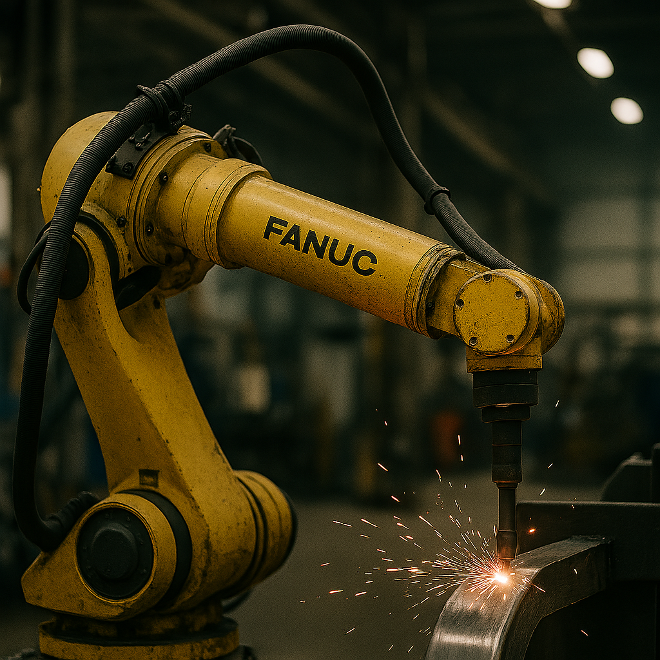
In plants where each defective part carries both a direct cost and a hidden cost (energy, wear, lost cycle time), robotic automation becomes a strategic tool to stabilize the process and protect operating margins.
Robotic repeatability: the metric with the biggest impact on scrap
Every industrial robot has a repeatability value defined by the manufacturer.
In most models used in manufacturing, this repeatability falls within the range:
±0.02 mm to ±0.06 mm
Why does it matter?
Because every robot cycle is practically identical to the previous one.
In business terms, this means:
- Less variation → fewer defects
- Fewer defects → less scrap
- Less scrap → less money wasted
Repeatability is not a promise: it is a certified technical specification provided by the manufacturer.
What causes scrap in manual processes?
A plant manager knows this very well:
- Differences in how work is performed across shifts
- Operator fatigue
- Inconsistent speed
- Positioning errors
- Variation in force or angle
These factors don’t just affect quality—they affect financial predictability.
Automation minimizes these variables.
Direct impact of robotic movement on scrap reduction
An industrial robot provides three key benefits:
✔ Consistent paths
Each part receives the same process with identical movements.
✔ Controlled conditions
Speed, pressure, positioning, and orientation remain stable.
✔ Elimination of human variability
An operator can do excellent work, but cannot do it the exact same way 2,000 times a day.
A robot can.
This transforms a high‑risk process into a predictable one.
How rework affects ROI—and how a robot reduces it
Rework is the silent trap of manufacturing costs:
- It uses double labor
- It consumes additional energy
- It increases downtime
- It disrupts scheduling
- It affects production flow
- It increases cost per part
When a robot ensures consistent precision, rework drops significantly.
The financial benefit appears in two areas:
- Reduction of unit production cost
- Increase in throughput without additional infrastructure
Key metrics a plant manager should monitor
To measure the real impact, these industrial metrics are essential:
- Scrap rate (%)
- Cost per defect
- Rework per shift (hours)
- Overall Equipment Effectiveness (OEE)
- Cycle time variation
- WIP accumulated due to failures
- Cost per part before vs. after automation
Automation doesn’t just improve quality—it improves the economics of the operation.
Industries where scrap reduction is critical
Robotic repeatability is especially valuable in:
- Welding
- Surface finishing
- Light machining
- Precision assembly
- Handling of parts with tight tolerances
- Processes where rework exceeds 5% of total output
When margins are tight, repeatability determines whether an operation is profitable or not.
Scrap and rework are not just technical problems—they are financial problems
Reducing them does not depend solely on operator skill, but on operational stability, process consistency, and controlled movement.
Robotic repeatability turns a variable process into a predictable, measurable, and highly profitable operation.
For any plant looking to protect margins and improve competitiveness, automation is one of the most effective strategies.
If scrap or rework are affecting efficiency or costs in your plant, now is the ideal time to evaluate how automation can stabilize your process and improve your results.
Analyze your metrics, identify your variations, and take the next step toward more profitable and controlled production.
Call us for any information!