
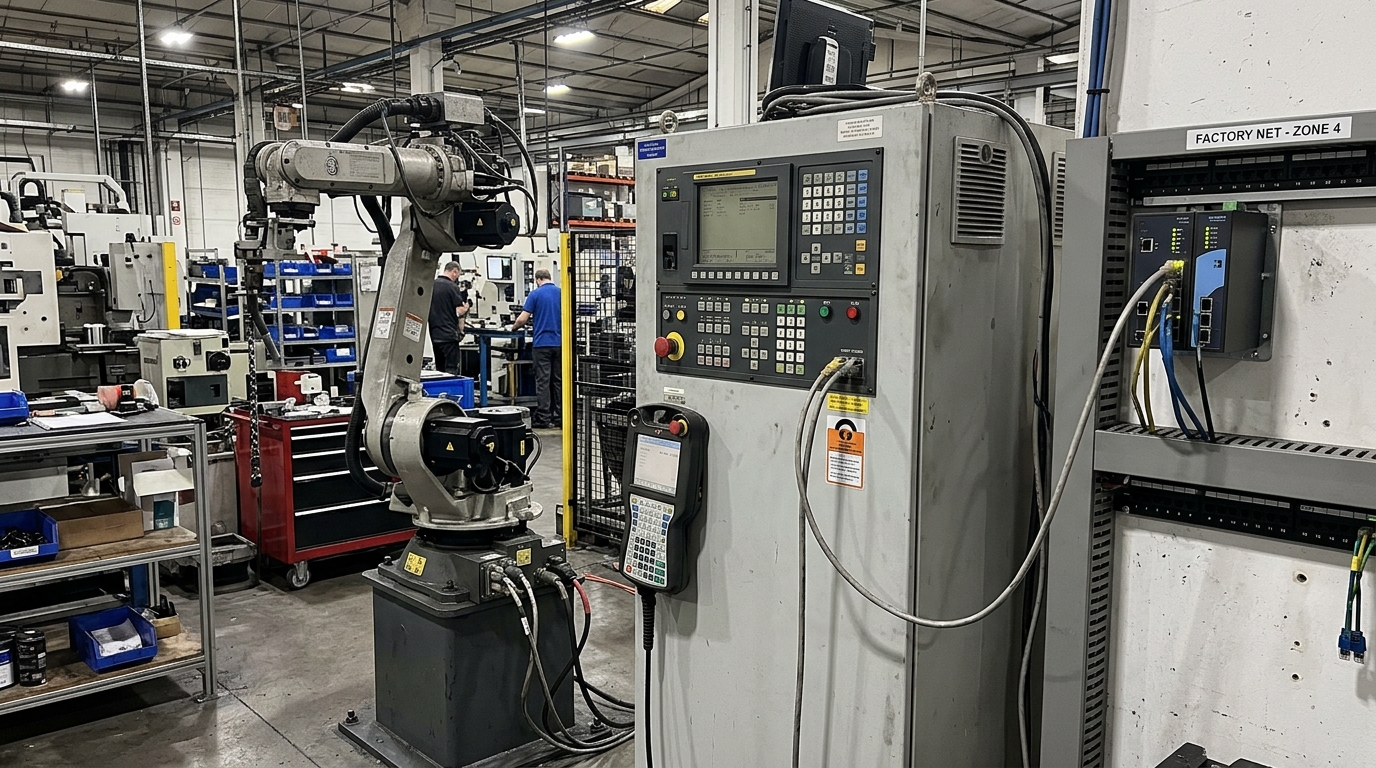
A robot can run reliably for years and still create new production risks when a plant connects it to a wider network. The mechanical system may stay the same, but the industrial robot cybersecurity context changes. The controller can now exchange data with PLCs, engineering computers, monitoring systems, remote-support tools, and other equipment.
This does not make an older robot unsafe by default. It changes how the plant must evaluate the system. Mechanical condition, controller reliability, spare parts, and application fit still matter, but connectivity adds another question: who can communicate with the controller, and what happens if that communication fails?
What Changes When a Legacy Robot Joins a Plant Network
Many older industrial robots spent most of their operating life inside a limited automation environment. The controller may have communicated only with the cell PLC, safety equipment, process equipment, and a local programming device.
Modernization often expands that environment. Plants may want production data, remote diagnostics, maintenance information, recipe management, backups, or links to higher-level manufacturing systems.
Each new connection can serve a useful purpose. It also changes the boundary of the robotic cell and introduces new dependencies.
The robot does not need internet access to create network risk.
A robot can face cybersecurity issues without a direct internet connection. A link to a wider internal production network already creates paths between the controller and other systems.
That matters because a problem elsewhere on the network can affect production. A configuration error, failed device, compromised workstation, or unauthorized change may interfere with the cell even when nobody can reach the robot directly from the internet.
The controller becomes part of a larger production system.
Once the plant connects the robot, the controller no longer operates as a mostly independent machine. It becomes one part of a larger production architecture.
Engineering computers, PLCs, switches, gateways, monitoring platforms, and remote-access tools can all influence how information reaches the cell. The plant must understand that complete path rather than focus only on the robot controller.
The same principle applies to conventional integration. URT’s guidance on important factors when integrating a robot shows why connectivity belongs inside the cell design process. Teams should not treat it as an IT task added after commissioning.
Mechanical reliability does not guarantee network resilience.
A robot may have a long record of stable production while its controller presents new integration limits on a current network. These are separate issues.
Older controllers may come from a period when manufacturers expected simpler communication environments. Plants therefore need to identify the exact controller version, interfaces, software dependencies, communication settings, and support status.
They should not assume that every robot from the same brand or series behaves the same way on a network.
Controller Compatibility Comes Before Cybersecurity Architecture
Cybersecurity discussions often start with possible attacks. For a legacy robot, the first practical question is usually more basic: can the controller communicate with current equipment in a controlled and supportable way?
A plant may want the robot to exchange information with newer PLCs, production databases, monitoring platforms, or supervisory systems. That connection may require extra hardware or software.
Extra communication layers add more points to manage.
A gateway, engineering computer, interface device, or software layer can solve a compatibility problem. It can also add another component that maintenance and automation teams must support.
The plant should therefore evaluate more than whether two systems can exchange data. It must also ask who maintains the interface, how technicians diagnose failures, and how the cell behaves if that interface stops working.
A technically successful connection can still create poor production architecture if nobody owns the added dependency.
The controller generation matters more than the age of the arm.
The age of the robot arm tells little about network suitability by itself. Controller generation gives a more useful starting point.
Installed software, communication options, past modifications, and current cell architecture also affect the decision. These differences become especially important with used or refurbished equipment.
Two similar robot arms may arrive with different controllers, communication hardware, software packages, or previous integration changes. Plants should document those differences before connecting either robot to newer systems.
The same discipline applies when evaluating refurbished robot compatibility with existing systems. Compatibility involves the complete cell, not only the mechanical arm.
An available port does not justify a connection.
Teams sometimes assume that an available interface should connect directly to the wider production network. That approach starts with technical possibility instead of production need.
First define why the connection exists. Identify the data that must move, the systems that need access, and the production functions that depend on that exchange.
This exercise often reveals unnecessary connectivity. A narrower communication path may meet the requirement with less complexity and fewer dependencies.
Production Risk Goes Beyond Data Theft
Office cybersecurity discussions often focus on confidential information. Robotic production introduces another major concern: availability.
A network problem does not need to damage the robot to create cost. The cell may stop if it loses a recipe, production command, status signal, or coordination message.
That interruption can lead to downtime, delayed orders, extra troubleshooting, lost machine utilization, or scrap during recovery. Plants should therefore treat cybersecurity as part of uptime planning.
Network dependencies can turn small faults into production stops.
A robot may continue to function mechanically while the wider cell cannot complete its sequence. For example, the controller may wait for information from another system before it starts the next cycle.
The fault may sit outside the robot. Even so, production still stops at the robot cell.
This distinction matters during troubleshooting. Maintenance teams need enough documentation to separate controller faults from network, software, PLC, or interface problems.
Recovery planning matters as much as prevention.
No plant can prevent every software, communication, or configuration problem. A stronger approach also asks how the team will recover.
The plant needs clear ownership of robot programs, controller settings, backups, connected equipment, and restart procedures. Technicians should know which configuration represents the approved production state.
Without that control, a small interruption can turn into a long troubleshooting event. URT’s guide to minimising downtime in robotic automation provides useful context for this wider recovery problem.
Where Connected Legacy Robots Can Create Real Value
The answer is not to isolate every older robot forever. Connectivity can create real production value when the plant has a clear objective and a suitable architecture.
The key is to connect for a reason. The plant should know what information it needs and how teams will use it.
Maintenance visibility can support faster decisions.
Maintenance teams may want better visibility into robot events, controller status, or equipment condition. That information can help technicians identify patterns and prepare for intervention.
However, collecting more data does not automatically improve maintenance. Someone must define which conditions matter and what action follows when those conditions appear.
The same principle applies to using sensors and data for predictive maintenance. Data creates value only when the plant turns it into a practical maintenance decision.
Production coordination may justify connectivity.
Operations teams may need several cells to share production status, product recipes, or sequence information. In that case, network communication can support a real process requirement.
The design still needs limits. Each system should receive the access and information it actually needs.
A plant should avoid broad connectivity when a smaller and simpler data exchange can support the same production function.
Remote support needs clear boundaries.
Remote access can help specialists diagnose a controller or integration problem without traveling to the plant. That can reduce response time in some situations.
However, remote access also changes who can reach the production system. The plant should define when that access is available, who controls it, and who approves changes.
Remote support works best when operations, automation, maintenance, and IT agree on those boundaries before an incident occurs.
Where the Connected-Factory Argument Becomes Overhyped
A weak smart-manufacturing strategy assumes that more connections always make production better. They do not.
Every connection should solve an operational problem. Otherwise, the plant adds infrastructure, support work, and possible failure points without gaining a clear production benefit.
Some stable cells do not need extensive connectivity.
An older robot may perform a simple and stable task with little need for external data. In that case, a large connectivity project may create more work than value.
The plant should compare the expected benefit with the engineering effort and long-term support burden. The goal is not to connect the robot because newer equipment offers more network features.
The goal is to improve a measurable production or maintenance function.
A network upgrade does not modernize the whole robot.
Connectivity does not change the robot’s mechanical condition, controller age, spare-parts situation, process capability, or safety architecture. It also does not make the arm suitable for an application that exceeds its technical limits.
A plant should therefore avoid treating a network project as a complete robot modernization. Cybersecurity forms one part of a wider equipment decision.
Cybersecurity cannot fix an unsuitable robot
A well-planned network cannot compensate for poor mechanical condition or weak process compatibility. It also cannot solve a lack of spare parts or support for an obsolete controller.
The opposite also applies. A plant should not reject an older robot only because it comes from an earlier controller generation.
The better question is whether the plant can support that exact controller within a controlled network architecture. Production criticality, support options, integration effort, and expected remaining service life all affect the answer.
What to Check Before Connecting an Older Robot
Use the following checks before the team approves the network architecture. The goal is to expose unclear dependencies, unnecessary connections, and gaps in ownership before they create production problems.
Document the installed controller first
- Identify the exact controller and software environment. Do not judge network capability from the robot arm model alone.
- List available communication interfaces. Record the interfaces the cell already uses and any interfaces the project plans to add.
- Check support options. Confirm that the plant can still obtain the documentation, tools, and technical support needed for that controller generation.
Define the purpose of every connection
- State why the connection exists. Link it to a production, maintenance, monitoring, or integration requirement.
- Map the communication path. Identify the PLCs, computers, gateways, switches, and supervisory systems involved.
- Remove unnecessary access. Do not maintain a connection simply because the hardware allows it.
Control access and ownership
- Identify who needs access. Separate operator, engineering, maintenance, integrator, and remote-support needs.
- Assign configuration ownership. Make one team or defined group responsible for approved controller and network settings.
- Define change control. Decide who can approve software, communication, and configuration changes.
Prepare for failure and recovery
- Control backups. Keep current copies of the robot programs and controller configurations that production depends on.
- Plan for communication loss. Identify which functions stop when another system becomes unavailable.
- Define the recovery path. Make sure technicians know how to return the cell to its approved operating state.
- Test connectivity during acceptance. Include network behavior and communication failures in commissioning checks where relevant.
These controls become especially important when several suppliers share responsibility. The integrator may understand the robot and PLC, while the internal IT team controls the network. Maintenance may own production recovery.
Those teams need clear boundaries. URT’s discussion of the systems integrator’s role in industrial automation explains why cell architecture, commissioning, and support need coordinated ownership.
The Business Case Must Include Connectivity Costs
Connecting a legacy robot creates more than a technical task. It can add costs for engineering, network hardware, software, documentation, testing, support, training, backup management, and troubleshooting.
The plant should compare those costs with the value the connection creates. A clear business case may come from faster diagnostics, better maintenance information, or required coordination with other equipment.
Measure the value of the connection
A plant should define what will improve before it approves the project. Possible measures include diagnostic time, recovery time, maintenance response, production visibility, or another relevant operational KPI.
If the team cannot explain what the connection improves, the project may not have a strong operational case.
Do not use “Industry 4.0 ready” as the business case
A goal such as making an old robot “Industry 4.0 ready” does not define a production outcome. It describes a technology direction, not an operating requirement.
The plant should instead state what changes in daily production. It should also identify who will support the added network dependency through the remaining life of the system.
Compare modernization with replacement
Some legacy controllers can fit a new network architecture with manageable effort. Others may require enough extra hardware, software, and support that replacement deserves serious consideration.
Purchase price alone cannot answer that question. The comparison should include controller support, integration work, internal skills, downtime exposure, production criticality, and expected service life.
In some plants, keeping the existing robot will remain the lower-risk decision. In others, the networking requirement may expose broader controller limitations that make modernization or replacement more practical.
FAQ
Does connecting an old industrial robot automatically make it insecure?
No. Age alone does not determine the cybersecurity risk. The controller generation, software, network design, access rules, connected devices, and support status all matter.
Does an industrial robot need internet access to create a cybersecurity risk?
No. A robot can face network risks inside a closed production network. Internal systems can still create communication dependencies and possible access paths to the controller.
Should legacy robots remain completely isolated?
Not always. Some cells work best with very limited connectivity, while others need controlled data exchange. The production requirement should determine the architecture.
What should a plant check before connecting a used or refurbished robot?
Start with the exact controller, installed software, interfaces, current configuration, support options, and network requirements. Then identify every system that needs to communicate with the robot.
Who should be responsible for robot cybersecurity in a factory?
No single department owns every part of the problem. Automation, maintenance, operations, IT, and outside integrators may each control part of the system. The plant should define responsibility for access, backups, configuration, changes, and recovery.
Can network segmentation reduce risk around a legacy robot?
A controlled network design can limit which systems communicate with the robot. The exact approach depends on the controller, plant architecture, and production requirement. Qualified automation and network specialists should define the final design.
Is cybersecurity a reason to replace every older industrial robot?
No. Plants should not replace equipment based on age alone. They should compare the risks and costs of supporting the current controller with the integration, support, and production impact of modernization or replacement.
Talk to URT About Legacy Robot Connectivity
If you are evaluating legacy robot connectivity, contact URT. We will give you a direct, technical answer based on your actual production requirements.