
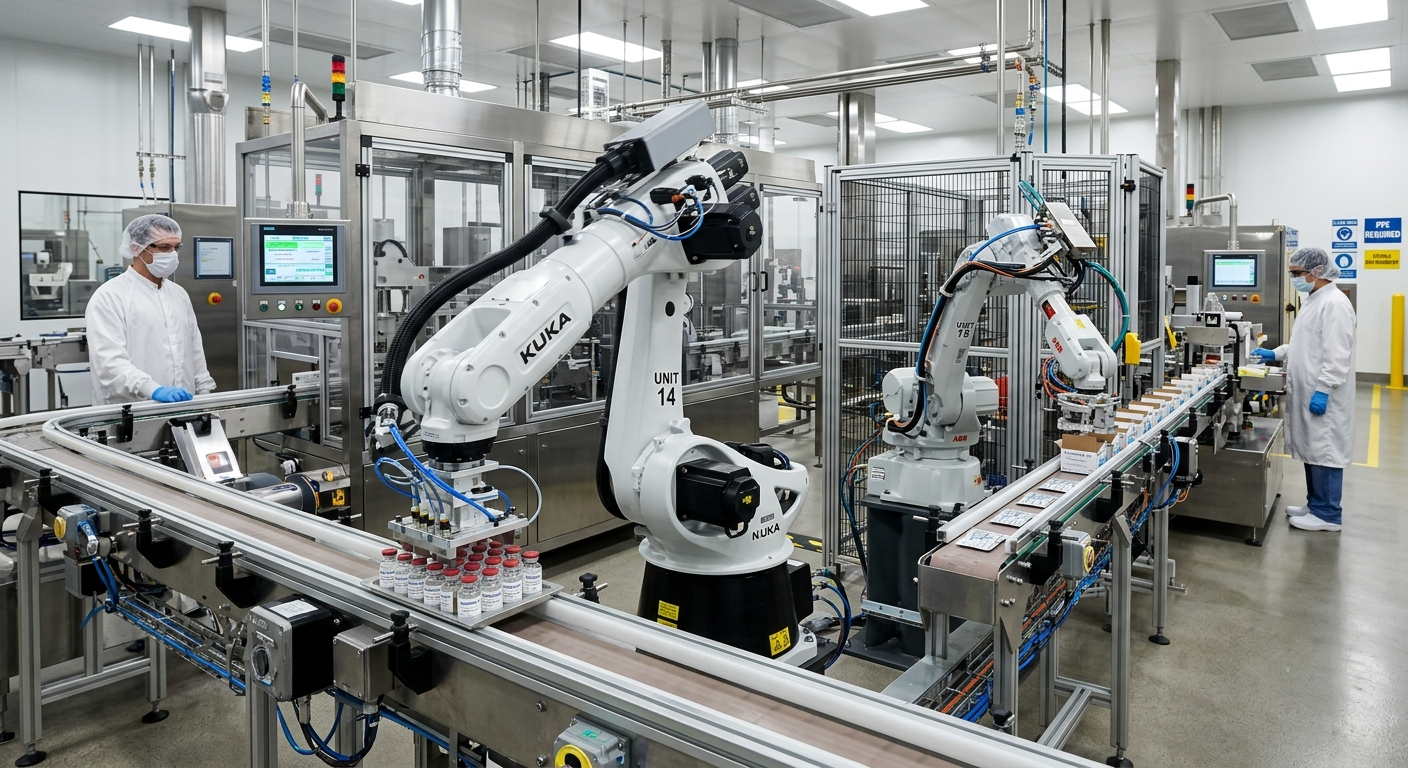
The Decision Is Not Whether to Automate, but Whether the Process Is Ready
The question is rarely whether pharmaceutical robots can perform a manufacturing task. The more important question is whether the production process, validation strategy, and operating environment allow automation to deliver reliable results without introducing unnecessary operational risk. In pharmaceutical manufacturing, consistency is often more valuable than speed, and automation projects succeed when they reinforce process control rather than compensate for unstable production conditions.
Unlike many industrial sectors, pharmaceutical manufacturing operates under strict quality and documentation requirements. A robotic cell that performs well mechanically may still fail to meet production expectations if cleaning procedures, validation requirements, traceability, or equipment integration were underestimated during planning.
For manufacturers evaluating robotic automation, the objective should be to determine where robots genuinely improve repeatability, reduce handling risk, and support regulatory compliance while recognizing the situations where conventional processes or additional process improvements should come first.
When Pharmaceutical Manufacturing Is a Good Candidate for Robotics
Robotic automation is most effective when production involves repetitive handling tasks performed under controlled conditions. Applications such as packaging, pick-and-place operations, laboratory sample handling, palletizing, machine tending, and material transfer often provide suitable environments because the sequence of operations can be clearly defined and repeated consistently.
The strongest automation candidates usually share several characteristics:
- Stable product presentation with minimal variation.
- Well-defined operating procedures.
- Repeatable production cycles.
- Documented quality requirements.
- Measurable production bottlenecks.
- A clear business objective beyond reducing labor.
Many successful pharmaceutical automation projects focus on reducing contamination risks associated with manual handling, improving production consistency, increasing equipment utilization, or supporting continuous manufacturing rather than simply increasing production speed.
Before selecting robotic equipment, manufacturers should also determine whether the automation project addresses the actual production constraint. If delays originate from upstream formulation, inspection, or batch release processes, installing a robot at the end of the line may produce limited operational benefit.
Technical Requirements That Extend Beyond the Robot Arm
One of the most common misconceptions is that robotic success depends primarily on the robot itself. In practice, pharmaceutical automation depends on the performance of the complete production system.
Cleanability and Hygienic Design
Equipment installed in pharmaceutical environments must be compatible with applicable cleaning procedures and production requirements. Material selection, accessible surfaces, cable routing, enclosure design, and end-of-arm tooling all influence how easily equipment can be cleaned and maintained.
A gripper that performs well mechanically but creates cleaning challenges may increase maintenance effort or validation complexity throughout the equipment lifecycle.
Validation and Documentation
Automation projects frequently require documented validation activities alongside technical commissioning. Software changes, process modifications, controller updates, and equipment configuration should be managed through established quality procedures rather than treated as ordinary engineering changes.
This means that project planning often extends beyond installation, incorporating documentation, testing, and approval activities before equipment enters routine production.
Integration with Existing Systems
Robotic cells rarely operate independently. Communication with production equipment, inspection systems, conveyors, serialization equipment, packaging machinery, manufacturing execution systems, and plant controls must be considered during project planning.
The complexity of these interfaces often determines implementation effort more than robot programming alone.
Process Stability Must Come Before Automation
Robots repeat programmed motions with high consistency, but they do not correct unstable production processes automatically.
If product positioning varies significantly, incoming materials fluctuate beyond acceptable limits, or manual operators regularly compensate for uncontrolled variation, those conditions should be addressed before automation proceeds.
Otherwise, automation simply reproduces the same variability more consistently.
Production teams should evaluate:
- Consistency of incoming materials.
- Repeatability of fixtures and product presentation.
- Equipment uptime.
- Environmental controls.
- Documented process capability.
- Root causes of current quality deviations.
Only after these factors are reasonably controlled does robotic automation become easier to validate, maintain, and justify.
Where Return on Investment Usually Comes From
Return on investment in pharmaceutical robotics is rarely based solely on labor reduction.
Operational value frequently comes from multiple measurable improvements working together, including:
- Improved production consistency.
- Reduced manual handling.
- Lower contamination risk.
- More predictable cycle times.
- Higher equipment utilization.
- Reduced product damage.
- Improved ergonomic conditions for operators.
- More consistent documentation and traceability.
Projects supported by clearly defined performance indicators are generally easier to justify internally than those relying on broad assumptions about automation benefits. Metrics should be established before implementation begins so production teams can evaluate whether expected improvements are actually achieved.
Common Risks That Companies Underestimate
Technical implementation is only one part of a pharmaceutical automation project. Several operational risks can affect long-term success.
Validation Effort
Validation activities may require significantly more time than mechanical installation. Companies that underestimate documentation, testing, and approval processes often experience delayed production start-up.
End-of-Arm Tooling Complexity
Grippers designed without considering product geometry, packaging variation, or cleaning requirements may create reliability problems that outweigh the benefits of automation.
Maintenance Readiness
Internal maintenance teams require sufficient training to support robotic equipment throughout its operating life. Without appropriate technical capability, even relatively small faults may lead to unnecessary production downtime.
Change Management
Production personnel, quality teams, engineering departments, and maintenance staff all influence automation success. Clearly defined ownership and documented operating procedures help reduce implementation risk after commissioning.
When Automation Should Be Delayed
Not every pharmaceutical process should be automated immediately.
Automation should generally be postponed when:
- The process itself remains unstable.
- Quality deviations have not been fully understood.
- Product presentation changes frequently.
- Production volumes are too unpredictable to justify investment.
- Cleaning procedures have not been clearly defined.
- Equipment interfaces remain undefined.
- Validation responsibilities have not been assigned.
In these situations, improving process stability often provides greater long-term value than introducing robotics too early.
Practical Checklist Before Investing
The following checklist helps evaluate whether a pharmaceutical process is genuinely prepared for robotic automation.
- Is the production process stable and repeatable?
- Can product presentation be controlled consistently?
- Have cleaning and hygienic requirements been defined?
- Are validation responsibilities clearly established?
- Can existing equipment communicate with the planned robotic cell?
- Have measurable project KPIs been identified?
- Does the maintenance team have adequate technical support?
- Will automation address the actual production bottleneck?
FAQ
Are robots commonly used in pharmaceutical manufacturing?
Yes, particularly for repetitive handling, packaging, laboratory automation, machine tending, palletizing, and material transfer. Suitability depends on production conditions rather than the robot alone.
Do robots automatically improve pharmaceutical quality?
No. Robots improve consistency when the underlying manufacturing process is already stable and well controlled. They do not correct uncontrolled process variation.
What is the biggest technical challenge during implementation?
Many projects find system integration, validation activities, and process documentation more demanding than robot programming itself.
Can pharmaceutical automation reduce contamination risks?
It can reduce manual product handling when properly designed, but cleanliness also depends on equipment design, operating procedures, maintenance, and validated cleaning practices.
When should a pharmaceutical company postpone automation?
If production remains unstable, validation plans are incomplete, or process variability has not been addressed, improving the manufacturing process first is usually the lower-risk approach.
Talk to URT About Pharmaceutical Robotics
If you are evaluating robotic automation for pharmaceutical manufacturing, contact URT. We will give you a direct, technical answer based on your actual production requirements.