
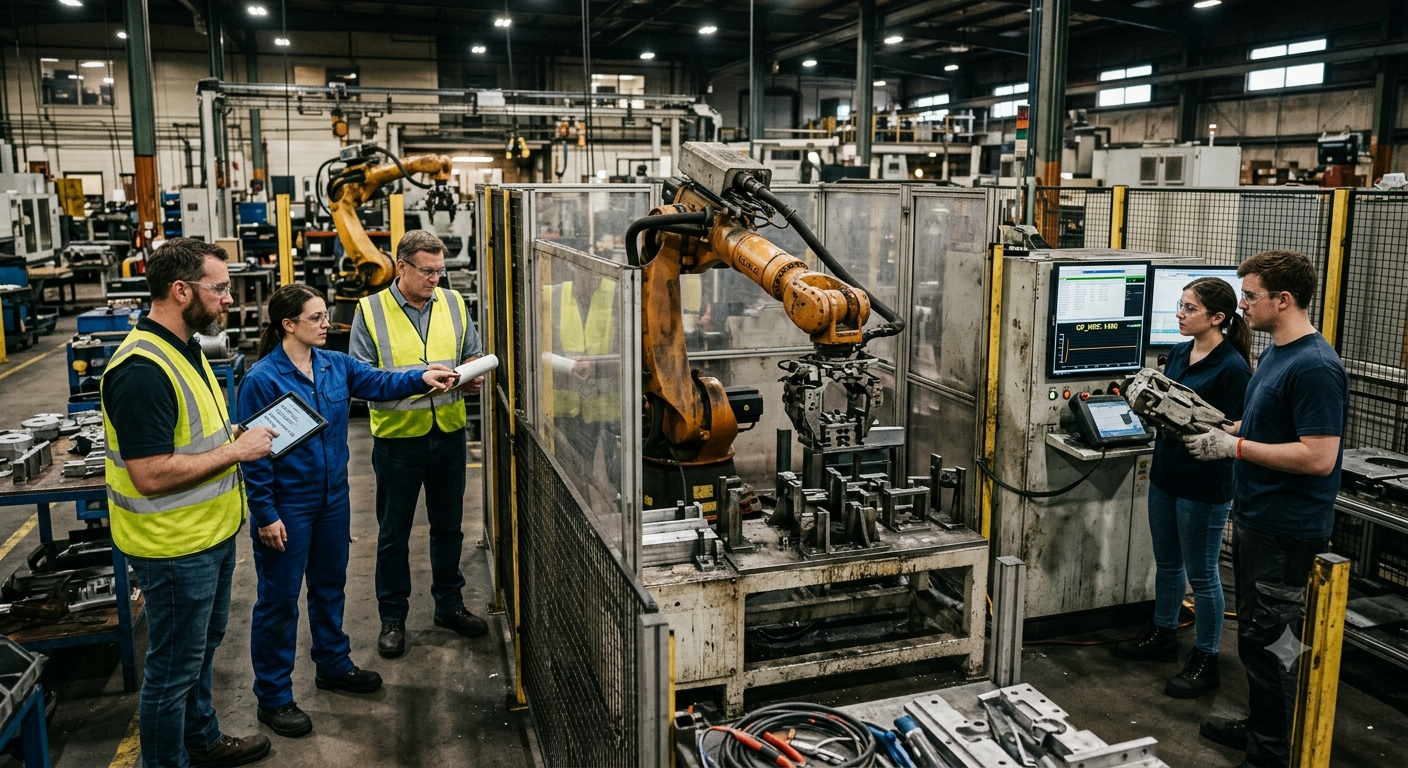
Automation project performance depends on much more than a successful commissioning. A robotic cell can pass acceptance testing and reach the expected cycle. Yet the plant must still maintain the process, recover from faults, manage changes, and preserve technical knowledge over time.
Problems can appear when those conditions change. Parts may arrive differently. Tooling may wear. New product variants may enter production. Operators may change roles, and documentation may fall behind actual modifications.
None of these conditions automatically means the robot has failed. Commissioning proves that the system can operate under defined conditions. Long-term production tests whether the plant can sustain those conditions and adapt when they change.
Successful Commissioning Does Not Prove Long-Term Production Results
Commissioning creates a controlled environment around the project. Engineers stay close to the cell. Programmers have recently tested the sequences. Tooling starts in known condition, and the project team focuses on acceptance targets.
Normal production creates a different test. The cell must run across shifts and recover from realistic interruptions. It must also handle approved product changes without creating new instability.
The robot represents only one part of that system. Fixtures, sensors, tooling, PLC logic, safety devices, conveyors, upstream machines, and downstream equipment all affect production. Operator actions and maintenance capability also influence the result.
A cell can therefore meet its commissioning target and still lose production value later. The plant needs production data to identify that change. Commissioning status alone cannot show whether the original business case still holds.
URT’s guide to robotic automation KPIs after implementation explains how manufacturers can connect system operation with measurable results.
The distinction matters. Commissioning shows that the cell can execute its intended process. Ongoing measurement shows whether that process still creates the expected production value.
Production Changes Can Move the Cell Outside Its Original Conditions
Every automation project starts with assumptions. Engineers design the system around expected part positions, tooling conditions, product dimensions, cycle requirements, and machine interfaces.
Those assumptions may change during normal production. A new supplier may introduce more variation. A fixture may wear differently than expected. Production may add another product variant or change the batch sequence.
The robot may continue running exactly as programmed. The surrounding process, however, may no longer match the conditions used during validation.
Small variations can create repeated interruptions
An experienced operator can sometimes compensate for variation without recording every adjustment. A part arrives slightly out of position, and the operator corrects it. A fixture needs extra attention, and the operator adapts.
A robotic system needs a different approach. The process must control the variation, detect it, or include it in the automation strategy. Otherwise, small changes can create more stops and manual interventions.
When that happens, the plant should not classify every event as a robot fault. The investigation should include part presentation, sensors, fixtures, tooling, PLC logic, and production tolerances. It should also examine upstream and downstream equipment.
New products can change the integration requirement
A cell may start with one product family and later receive additional variants. Those variants may require different gripper positions, fixture conditions, recipes, sensors, or recovery logic.
The new product does not automatically create a problem. The risk appears when the plant assumes that the original cell can support the change without a technical review.
Before adding a new variant, engineering should check the complete process. Tooling, sensing, programming, safety, cycle time, and recovery all deserve attention.
This principle also applies before the first automation project starts. URT’s article on whether automation improves quality or repeats an existing process problem explains why process stability matters before and after installation.
Fault Recovery Can Matter as Much as the Automatic Cycle
Project teams naturally focus on the normal production sequence. They need to prove cycle time, part flow, and acceptance criteria. Those targets matter, but production also includes abnormal states.
A missing part can interrupt the sequence. A sensor can report an unexpected condition. A conveyor can stop. A machine alarm or safety stop can leave several devices in different states.
The plant then needs a clear recovery path. If only a specialist understands that path, a minor interruption can create unnecessary downtime.
Recovery belongs in the cell design
A maintainable cell needs clear equipment states and understandable alarms. It also needs defined restart conditions and suitable operator information.
The goal is not to let every operator change technical settings. The goal is to make routine recovery predictable for authorized personnel.
This becomes more difficult when several systems interact. The robot may be ready to continue while another machine remains in an incompatible state. A PLC, conveyor, scanner, fixture, vision system, or machine tool may block the restart.
Good integration logic helps the plant understand those conditions. It also reduces dependence on individual programmers for routine production events.
Programming decisions can affect future support as much as initial commissioning. URT’s guide to reducing robot programming time in industrial automation provides additional context on planning programming work around the full production system.
Maintenance Capability Becomes More Important After Handover
Installation concentrates technical support around the cell. Integrators, programmers, suppliers, production engineers, and maintenance teams may all participate.
That support structure changes after handover. The plant must then manage routine operation with its normal personnel and support resources.
This does not mean every technician needs advanced robot programming skills. The plant does need enough capability to identify where a fault starts.
A stop can originate in the robot, but it can also begin elsewhere. Tooling, fixtures, sensors, PLC logic, safety devices, and connected machines can all contribute.
For broader safety context, OSHA’s robotics guidance treats robotic systems as more than the robot arm. It also considers associated controls, equipment, sensors, and end effectors.
Documentation must match the real cell
A drawing has little value when it no longer represents the equipment. The same applies to old program backups, outdated procedures, and obsolete configuration records.
Production teams often make legitimate changes after commissioning. They may update tooling, revise PLC logic, add recipes, or change an interface.
Each change should enter the technical record. The plant should know which robot program is current and which PLC backup belongs to production. It should also track relevant tooling and electrical changes.
Accurate documentation reduces dependence on memory. It gives internal teams and external support a better starting point when they diagnose a problem.
Spare-parts planning should focus on production risk
A low-cost component can create serious downtime when the plant cannot replace it quickly. Purchase price alone does not determine spare-parts priority.
The plant should consider lead time, compatibility, failure consequence, and support availability. It should also consider whether technicians can identify the failed component quickly.
This does not justify stocking every item in the cell. Instead, the company should identify parts that could create unacceptable downtime and plan a response in advance.
Training Must Continue Beyond the Original Project Team
People who participate in commissioning often develop valuable knowledge. They understand sequence logic, common alarms, permitted recovery actions, and escalation points.
The plant can lose part of that knowledge when trained people change roles or shifts. Staff turnover can create the same risk. This does not happen in every project, but the possibility deserves planning.
Informal knowledge creates a particular weakness. One operator may teach another how to clear an alarm without explaining the underlying condition. Over time, a workaround can replace the intended procedure.
Different roles need different knowledge
Operators do not need the same technical depth as programmers. Maintenance technicians do not need the same responsibilities as system integrators.
Operators should understand normal states and authorized recovery actions. Maintenance teams need enough knowledge to diagnose equipment within their responsibility. More complex programming or integration changes may require specialist support.
The plant should therefore ask a practical question after commissioning. Does each shift still have the competence needed to run and support the cell?
Training also needs review after major changes. New tooling, revised recipes, new product variants, and different recovery procedures can make older instructions incomplete.
Unclear Ownership Can Create Long-Term Performance Problems
Automation projects usually have clear leadership before handover. Someone manages the budget, suppliers, technical decisions, milestones, and acceptance process.
That project structure may change once production takes control. Maintenance may own mechanical problems. Engineering may own programming. Production may own output, while purchasing manages replacement parts.
This structure can work well when responsibilities remain clear. Problems appear when no one owns losses that cross departmental boundaries.
Production may report recurring downtime to maintenance. Maintenance may identify an integration issue. Engineering may view the original project as complete. The same problem can then continue without a clear owner.
Ownership should connect directly to KPIs
The responsible team needs data that reflects the original investment case. Uptime may matter. So may scrap, operator intervention, cycle stability, changeover time, or machine utilization.
The right measure depends on the reason for automation. A project that targeted higher machine utilization should not rely only on robot cycle time. A project that targeted consistency should not rely only on labor savings.
Clear ownership makes recurring losses easier to investigate. It also gives the plant a better basis for deciding whether it needs maintenance, programming changes, process improvement, or redesign.
The Business Case Can Change While the Robot Still Runs
A functioning robot does not guarantee that the original ROI remains unchanged. The financial result depends on the production system around it.
Volume may fall or increase. Product mix may become more complex. Changeovers may take longer. Maintenance demand may exceed the original assumption.
The cell may also spend more time waiting. Upstream equipment can limit material flow. Downstream capacity can block production. Operators may need to intervene more often than expected.
None of these conditions automatically turns the project into a failure. They do show why companies should compare actual production data with the original business case.
A robot can remain available while the process fails to use that capacity. In that case, robot availability alone gives an incomplete view of the investment.
Project selection matters for the same reason. URT’s framework for choosing which process to robotize first focuses on controlled variation, measurable loss, process stability, and organizational readiness.
What to Review Around the First Year of Production
The first year does not represent a universal failure point. No general rule says that automation projects should fail after twelve months.
However, a review around that point can provide useful production evidence. The cell has usually accumulated more operating experience than it had during commissioning.
Use the following checklist as a practical review framework. Adapt it to the application, production risk, support model, and original business case.
- Compare current KPIs with the baseline and targets used to approve the project.
- Separate downtime by cause instead of labeling every interruption as a robot fault.
- Check whether product variants, materials, fixtures, or part presentation have changed.
- Review changes in upstream and downstream equipment.
- Identify recurring manual interventions that were not part of the intended sequence.
- Check which routine faults still require external specialist support.
- Confirm that robot, PLC, tooling, safety, and electrical records match the current cell.
- Verify that program backups and configuration records are current.
- Review operator and maintenance knowledge across all relevant shifts.
- Identify critical spare-parts and support dependencies.
- Assign ownership for recurring losses that involve several departments.
- Compare current operating conditions with the assumptions in the original ROI calculation.
The objective is not to classify every deviation as a project failure. The review should identify structural losses that repeatedly reduce production value.
Recurring downtime deserves attention. So do excessive manual intervention, difficult recovery, outdated documentation, and growing dependence on specialist support.
When More Troubleshooting Is Not the Right Answer
Some recurring problems need more than another robot adjustment. The underlying process may require a broader redesign.
Unstable part presentation can create repeated picking problems. Weak fixturing can create positioning errors. A changed product mix can push the cell beyond its original design conditions.
Integration architecture can also become difficult to maintain. Teams sometimes add one exception after another to solve immediate production issues. Those changes may eventually make recovery and troubleshooting harder.
The plant should separate symptoms from causes before authorizing more programming work. A robot stop is a symptom. The root cause may come from the robot, but it may also come from a fixture, sensor, signal, tool, or connected machine.
The same logic applies when the company considers adding more automation. A plant should not automatically expand a system that already depends heavily on outside support.
First, it should understand the existing weaknesses. Better documentation, process control, training, recovery logic, maintenance capability, or ownership may create more value than another robot.
FAQ
Do automation projects normally fail after one year?
No. Industrial automation has no universal one-year failure point. The first year simply offers a useful moment to compare real production experience with the assumptions made during the project.
Why can a robotic cell work during commissioning and struggle later?
Commissioning uses defined conditions and concentrated technical support. Later production can introduce equipment wear, process variation, new product requirements, personnel changes, and recurring interruptions.
Does repeated robot downtime mean the robot is unreliable?
Not necessarily. Tooling, fixtures, sensors, PLC logic, safety systems, conveyors, machine tools, and production flow can also cause interruptions. Troubleshooting should examine the complete cell.
How should a plant measure automation results after commissioning?
The plant should use KPIs that match the original business case. These may include uptime, downtime causes, cycle stability, operator intervention, scrap, changeover performance, or machine utilization.
Can maintenance alone prevent automation problems?
No. Maintenance can address many reliability issues, but it cannot correct every process problem. Poor part presentation, unsuitable tooling, changed production requirements, or weak integration may require engineering changes.
Why does training still matter after the cell enters production?
The plant needs people who understand normal operation, authorized recovery, maintenance responsibility, and escalation. Changes in personnel or equipment can make the original training incomplete.
When should a company redesign part of an automated cell?
A redesign may make sense when recurring losses come from structural conditions. Examples include unstable presentation, unsuitable fixtures, changed requirements, difficult equipment coordination, or recovery logic that has become hard to maintain.
Should a plant add another robot when the current cell needs frequent specialist support?
Not automatically. The company should first review documentation, recovery logic, internal capability, ownership, and production data. Expanding automation without solving those weaknesses can reproduce the same operating problems.
Talk to URT About Long-Term Automation Performance
If you are evaluating long-term automation performance, contact URT. We will give you a direct, technical answer based on your actual production requirements.