
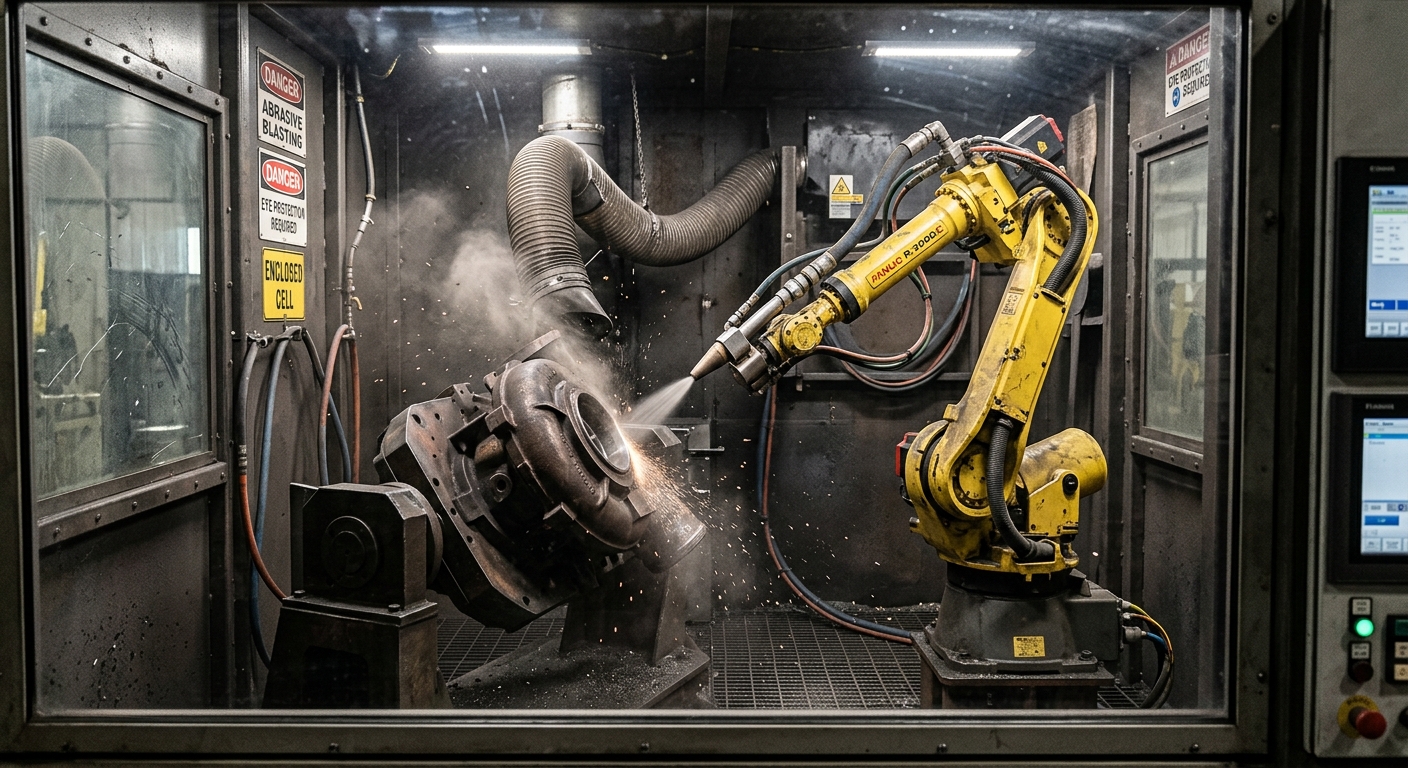
A robotic sandblasting project can remove repetitive manual nozzle work, but robot motion alone does not control the surface result. Part location, abrasive delivery, nozzle condition, access, and incoming surface variation still affect the process. A robot can repeat the same path while the finished parts continue to vary.
This creates the main decision for a blasting project. The plant must determine whether it has a repeatable process that a robot can execute. If operators constantly compensate for changing parts or process conditions, the team should address those variables before automating them.
When Sandblasting and Shot Blasting Are Good Candidates for Automation
A strong automation candidate combines repetitive work with controlled process conditions. The parts should arrive in predictable positions. Their geometry should also allow the blasting nozzle to reach the required surfaces.
Production volume matters, but it does not settle the decision. A moderate volume of similar components may support automation better than a large volume of highly variable parts. The difference comes from programming, setup, fixturing, and process control.
Start by studying what the operator does during a normal cycle. Does the operator mainly follow the same path on every component? Or does the operator make frequent decisions based on surface condition, part position, or geometry?
The first situation gives the robot a defined task. The second requires the engineering team to understand those decisions before it can automate them.
Stable part geometry reduces programming complexity
A programmed robot expects the workpiece to match the path stored in the controller. Consistent components make that relationship easier to maintain.
Variation creates a different problem. Distorted fabrications, inconsistent castings, and manually positioned parts can move the target surface away from the programmed path. The cell may then need better fixtures, sensing, additional programs, or another method of locating each part.
Plants should not assume that the robot will compensate for uncontrolled geometry. The integration team needs a specific method for handling each meaningful source of variation.
The nozzle must reach every required surface
Nominal robot reach does not prove that a robot can complete the application. The nozzle must approach each surface from a useful direction. The robot must also avoid the fixture, part, enclosure, and other equipment.
Deep cavities and internal surfaces can create difficult access conditions. Corners and structural features can also restrict nozzle orientation. These areas deserve attention during application testing and cell simulation.
The engineering team should map the complete blasting path before selecting the robot. This approach reduces the risk of discovering inaccessible surfaces after equipment arrives.
Product mix affects the automation case
A robot can process several component types when the cell supports those changes. Each product may require a different program, fixture, recipe, or loading method.
That changeover work becomes part of the production cycle. Plants with small batches should therefore measure programming and setup effort as carefully as blasting time.
High product variety does not automatically rule out automation. It does require a clear strategy for identifying parts, locating them, selecting programs, and validating the result.
Control the Blasting Process Before Adding the Robot
Robot repeatability cannot correct an unstable abrasive process. Before choosing automation equipment, the plant should confirm that repeatable process settings can produce an acceptable surface.
Abrasive condition and delivery can affect the result. Nozzle condition, incoming contamination, component material, and equipment performance can also introduce variation. The project team should identify which variables matter for its specific process.
This work prevents a common commissioning problem. Without process stability, engineers may keep changing robot paths to correct defects that originate outside the robot.
Define an acceptable surface condition
The team needs a clear acceptance criterion before it starts programming. The exact requirement will depend on the purpose of the blasting process.
For example, the operation may prepare a surface for a later process. It may remove contamination or an existing coating. Other applications may use blasting to create a required finish.
The team should define how it will judge the finished component. Otherwise, commissioning becomes a sequence of subjective adjustments instead of a controlled production test.
Separate robot motion from blasting variables
The robot controls the nozzle path, orientation, sequence, and movement. The blasting equipment controls another group of process variables.
These variables interact, but they are not the same. A surface problem may come from the programmed motion. It may also come from abrasive delivery or another process condition.
The cell should make that distinction clear during troubleshooting. Engineers can then correct the actual cause instead of changing several variables at once.
Control part presentation
Even a stable blasting process can fail when the robot cannot find the workpiece reliably. Fixtures should place each component in a known position.
The fixture also needs to support nozzle access. A fixture that locates the part accurately can still create problems if it masks surfaces that require treatment.
Plants often face this same issue in other robotic processes. The principle remains consistent: part presentation must support the robot program rather than force the robot to compensate for unpredictable placement.
Design the Complete Robotic Blasting Cell Around the Process
The robot arm represents only one part of a blasting cell. Tooling, process equipment, fixtures, controls, containment, extraction, safety systems, and maintenance access all affect the final design.
For that reason, the team should define the application before selecting a robot. Buying the robot first can create avoidable restrictions later.
Account for the abrasive environment
Abrasive blasting creates demanding conditions for equipment inside the cell. Media and airborne material can reach the robot and surrounding components.
The project team should evaluate how the environment affects joints, cables, connectors, sensors, and the process package. It should also assess the protection needs of the selected equipment.
Do not assume that normal industrial construction provides enough protection. The application environment and exact robot configuration must work together.
Plan the process package around robot movement
The robot must manipulate the blasting equipment without losing access to the workpiece. Hoses and cables can restrict movement if the cell designer treats them as an afterthought.
The engineering team should evaluate the complete dress package throughout the robot path. It should check difficult orientations, not only convenient test positions.
This check becomes especially important around corners and fixtures. Large changes in wrist orientation can alter the way hoses move around the arm.
Evaluate tooling load without guessing specifications
The robot must support the complete process package used in the application. However, a general article cannot establish the required payload or reach for a specific cell.
Those values depend on the exact nozzle assembly, hoses, mounting hardware, robot configuration, and motion requirements. The integrator should calculate them before final robot selection.
If the project uses a specific robot model, verify its limits against official manufacturer documentation. Do not use specifications from a similar model or another variant.
Consider workpiece positioning early
Some components expose all required surfaces from one position. Others need movement during the blasting cycle.
A positioner can change how the robot reaches difficult areas. It can also reduce the need for extreme robot postures. However, it adds equipment, controls, programming, and integration work.
The team should make this decision during cell development. Adding part movement late in the project can force major changes to the layout and program.
Design containment and maintenance access together
The enclosure must contain the blasting process while supporting production and service work. Designers need to consider loading, unloading, cleaning, inspection, and equipment access.
Maintenance teams also need practical access to the robot and process equipment. A cell that runs well but makes routine intervention difficult can create unnecessary downtime.
The layout should account for these requirements before fabrication begins. Simulation alone may not reveal every service-access problem.
Where Robotic Blasting Can Create Measurable Value
The business case should reflect the production problem that automation will actually change. Labor reduction may contribute to ROI, but it should not become the only variable.
Plants should compare the automated concept with the current process. That baseline creates a defensible way to measure results after commissioning.
More consistent robot motion
A programmed robot can repeat the same motion sequence when parts remain in predictable positions. This removes one source of variation from the blasting operation.
It does not guarantee a consistent surface by itself. The blasting process must remain stable as well.
This distinction matters when quality drives the investment. The plant should identify which current defects come from operator motion and which come from other causes.
Reduced direct operator involvement
Automation can move repetitive blasting work into an engineered cell. This can reduce the amount of direct manual nozzle work during normal production.
However, personnel still interact with the system. Loading, unloading, inspection, maintenance, cleaning, recovery, and troubleshooting can require intervention.
The safety concept must address those activities. It should cover the complete cell rather than the robot arm alone.
Cycle stability
Manual cycle times may change as operators adjust technique or respond to demanding work. A programmed robot can provide a more consistent motion sequence when the process remains controlled.
That does not mean the plant will automatically gain throughput. Upstream and downstream operations may still limit production.
Before investing, identify the actual constraint. If another process controls output, faster blasting may only move the bottleneck.
Rework and process losses
Rework can strengthen the automation case when inconsistent manual motion causes a measurable share of the problem. The plant needs production data to support that conclusion.
Automation cannot eliminate defects that come from unstable abrasive delivery or uncontrolled incoming parts. The ROI model should separate these causes.
This approach follows the same logic used when companies choose which process to robotize first. The strongest project usually has measurable losses and controlled operating conditions.
Common Mistakes in Robotic Sandblasting Projects
Most project risks become easier to control when the team identifies them before robot selection. Use the following points to challenge the assumptions behind the proposed cell.
- Choosing a robot before mapping nozzle access. The team should verify the complete path around the real part and fixture first.
- Confusing robot repeatability with process stability. Stable robot motion cannot correct unstable abrasive delivery or inconsistent parts.
- Ignoring hoses and cables. The process package can restrict motion and create interference inside the working envelope.
- Underestimating the blasting environment. The team must consider abrasive exposure when selecting and protecting cell equipment.
- Designing fixtures only for part location. Fixtures must also preserve access to every surface that requires blasting.
- Using labor as the entire ROI case. Downtime, rework, maintenance, changeovers, and surrounding processes can change the economics.
- Skipping acceptance criteria. The team needs a defined surface result before it can validate the automated process.
Another mistake involves treating integration as a final installation task. The cell design should connect robot motion, tooling, process control, safety, and production flow from the beginning.
Programming also affects the project when the plant processes many part types. URT’s guide on reducing robot programming time explains why programming strategy can influence production availability.
When a Blasting Process Is Not Ready for Automation
Some blasting operations need process improvement before they need a robot. Repetitive work alone does not prove automation readiness.
Consider delaying the project when operators constantly compensate for unknown part positions. The same applies when incoming surface conditions change enough to require frequent judgment.
Unstable abrasive delivery also deserves attention before automation. Otherwise, the robot may execute the correct program while the process continues to produce variable results.
Very high product variation can create another limitation. If almost every component needs a new program and setup, engineering effort may consume much of the expected benefit.
Access can also stop an otherwise promising project. Critical surfaces may sit behind features that prevent a useful nozzle orientation. The plant may need different fixtures, a positioner, multiple operations, or another process concept.
Finally, automation may target the wrong constraint. If blasting already keeps pace with production, a robotic cell may not increase plant output. The investment must solve a measurable operational problem.
This is why companies should evaluate automation readiness before committing capital. URT’s guidance on common mistakes when automating manual processes provides a broader framework for that decision.
What to Check Before Investing in a Robotic Blasting Cell
This checklist helps teams test the project before equipment selection. Each answer should connect to a real production requirement rather than a general expectation about robotics.
- Define the required surface result and the method used to accept or reject a processed part.
- Document the main component families and the variation within each family.
- Confirm how the cell will locate every workpiece.
- Map all surfaces that the blasting nozzle must reach.
- Identify areas where fixtures could restrict nozzle access.
- Determine whether the cell needs to reposition the workpiece.
- Separate abrasive-process variables from robot-motion variables.
- Assess abrasive exposure for the robot, tooling, cables, sensors, and other cell equipment.
- Plan hose routing across the complete robot path.
- Include containment, extraction, loading, unloading, cleaning, and maintenance in the layout.
- Check whether upstream and downstream operations can support the proposed cycle.
- Measure current cycle time, rework, downtime, changeover effort, and operator involvement.
- Define who will own programming, maintenance, troubleshooting, and production recovery.
The team should also decide whether new or refurbished equipment fits the project. Purchase price alone should not drive that choice. Controller support, mechanical condition, compatibility, and expected downtime also affect the decision.
For projects considering pre-owned equipment, URT’s comparison of new and refurbished robots explains the conditions that should guide that evaluation.
FAQ
Can industrial robots perform sandblasting and shot blasting?
Yes, industrial robots can automate abrasive blasting processes when the complete application supports repeatable operation. Engineers must evaluate the process equipment, component geometry, part location, nozzle access, environment, and cell design. The robot arm represents only one part of the system.
Does robotic sandblasting automatically improve surface consistency?
No. The robot can repeat its programmed motion, but other variables still affect the surface. Stable results require control of the blasting process, part position, incoming condition, and process equipment.
What matters most when selecting a robot for abrasive blasting?
Start with the application rather than a robot specification sheet. Map the required nozzle paths, tooling load, orientations, fixtures, process package, environmental conditions, and cell layout. Then verify candidate robot models against those requirements.
Can one robotic blasting cell handle different parts?
It can when the cell has a practical method for handling product changes. Different parts may require separate programs, fixtures, recipes, or positioning strategies. Plants should include that changeover effort in the production and ROI analysis.
How does abrasive exposure affect robot selection?
Abrasive material can reach equipment inside the blasting environment. The project team should assess the required protection for the robot, cables, connectors, sensors, tooling, and other cell components. The exact requirements depend on the application and selected equipment.
Is robotic blasting mainly a labor-saving investment?
Not always. Plants may also pursue more consistent motion, lower rework, more stable cycles, or reduced direct operator involvement. The strongest business case uses measured production losses rather than generic automation benefits.
When should a company delay a robotic blasting project?
Delay the project when major process variables remain uncontrolled. Unpredictable part location, unstable abrasive delivery, unclear acceptance criteria, or inaccessible surfaces can make automation difficult. Addressing those issues first can reduce integration risk.
Talk to URT About Robotic Sandblasting and Shot Blasting
If you are evaluating robotic sandblasting and shot blasting, contact URT. We will give you a direct, technical answer based on your actual production requirements.