
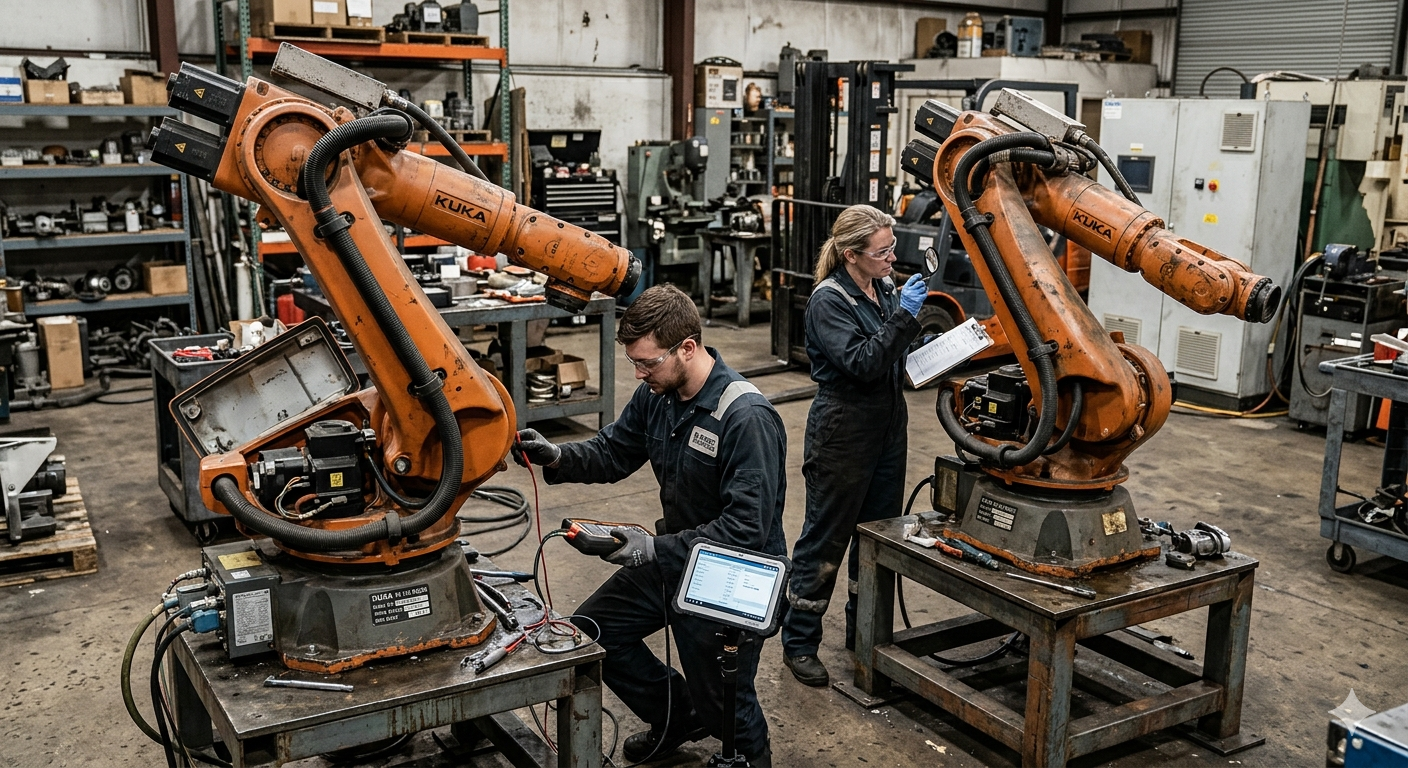
The Lowest Price Is Not Always the Lowest Total Cost
The price of the used industrial robot is often treated as if it were determined only by the robot model. In practice, two robots carrying the same model designation can have very different values because they represent different levels of technical risk, remaining service life, integration effort, and production readiness.
A lower purchase price can be attractive during procurement, but it may conceal costs that only become visible during installation or after production starts. Mechanical wear, controller compatibility, incomplete documentation, obsolete components, or limited refurbishment can all increase the real cost of ownership long after the initial purchase.
For companies evaluating refurbished industrial robots, the more useful question is not “Why is this robot cheaper?” but rather “What explains the price difference, and what risks does it transfer to the buyer?”
Operating Hours Tell Only Part of the Story
Operating hours are commonly used to compare used robots, but they should never be evaluated in isolation. Two robots with similar recorded hours may have experienced completely different mechanical loads depending on the production process they performed.
Application History Matters
A robot used for light material handling generally experiences different stresses than one performing continuous spot welding, heavy palletizing, foundry work, or machine tending in demanding production environments. The duty cycle, payload utilization, acceleration patterns, and environmental conditions all influence long-term wear.
Understanding where the robot has worked provides context that raw operating hours cannot. A complete application history allows buyers to assess whether components may have experienced unusually high mechanical or thermal stress.
Cycle Count Can Be More Meaningful Than Hours
Whenever available, cycle information can provide a better indication of mechanical usage than operating hours alone. A robot that has executed millions of high-speed cycles may require different inspection priorities than another robot with similar operating time but significantly fewer production movements.
The Exact Variant and Controller Generation Influence Value
Two robots may appear identical while actually being different variants. Model suffixes often indicate differences in reach, payload, mounting configuration, or other characteristics that directly affect application suitability.
Specification Verification Before Cell Design
The exact model variant should always be verified using the robot nameplate and official manufacturer documentation before cell design begins. Similar model names do not guarantee identical capabilities, controller compatibility, or available options.
Controller generation is equally important. A newer controller may provide improved communication options, easier integration with modern automation systems, better diagnostic tools, and longer software support. Older controllers can remain excellent production assets, but compatibility with the intended cell should be confirmed before purchase.
Mechanical Condition Is One of the Largest Price Drivers
The visible appearance of a robot rarely reflects its internal condition. The components that most influence long-term reliability are often hidden inside the mechanical structure.
Reducers, Servo Motors, and Cabling
Reducers should be inspected for signs of excessive wear, backlash, or abnormal operating characteristics. Servo motors, internal wiring, dress packages, and cable routing also deserve careful evaluation because replacing these components after installation can significantly increase project costs.
A robot that has undergone thorough mechanical inspection and replacement of worn components will naturally command a higher price than one that has received only cosmetic cleaning.
The Scope of Refurbishment Makes a Significant Difference
The word “refurbished” does not describe a single level of work. Different suppliers may use the same term while performing very different refurbishment processes.
A comprehensive refurbishment may include mechanical inspection, replacement of worn components where required, electrical testing, cleaning, repainting, controller inspection, calibration, software verification, and production testing. A lower-cost offer may involve little more than cosmetic preparation and a basic functional check.
For this reason, buyers should request a clear description of exactly what refurbishment work has been completed instead of relying solely on marketing terminology.
Calibration and Testing Reduce Integration Risk
Successful integration depends on more than powering up the robot. Calibration and functional testing help confirm that the robot performs consistently before it reaches the production floor.
Testing procedures may include axis movement verification, controller diagnostics, input/output checks, safety functions, and repeatability validation appropriate to the refurbishment process. A robot that has completed documented testing generally reduces commissioning uncertainty compared with equipment that has only been powered on for demonstration purposes.
Included Equipment Can Explain Large Price Differences
The robot arm itself is only one part of the purchase. Accessories included with the system often represent substantial value.
Depending on the offer, additional equipment may include the controller, teach pendant, cables, mounting hardware, communication interfaces, software licenses (where applicable), or application-specific accessories. Two quotations that appear similar may therefore represent very different overall packages.
Comparing complete system contents rather than the robot arm alone allows buyers to evaluate quotations more accurately.
Documentation, Support, and Warranty Also Have Value
Technical documentation, commissioning support, and warranty coverage reduce project uncertainty. Suppliers that provide detailed documentation, inspection records, and post-sale technical assistance generally invest more resources into preparing the equipment for deployment.
Warranty terms should also be evaluated carefully. The duration of coverage is only one consideration; buyers should also understand what is included, what exclusions apply, and how technical support is delivered if an issue occurs after installation.
Spare Parts Availability Influences Long-Term Cost
A competitively priced robot may become expensive if replacement components are difficult to obtain or if controller support has become limited. Spare parts availability should therefore be evaluated as part of the purchasing decision rather than after production begins.
The long-term serviceability of the robot affects maintenance planning, expected downtime, and the total cost of ownership throughout its operational life.
Hidden Costs Behind the Cheapest Offer
A lower purchase price may conceal additional expenses that only become visible during integration or production. These may include unexpected mechanical repairs, replacement cables, obsolete controller components, missing accessories, software compatibility issues, transportation damage, incomplete testing, or extended commissioning time.
The cheapest quotation, therefore, does not necessarily represent the lowest investment. Comparing offers requires evaluating technical condition, refurbishment scope, documentation quality, support, warranty, and long-term maintainability alongside the purchase price.
For many buyers, a higher initial investment in a properly inspected and refurbished robot can reduce project risk and produce a lower total cost over the life of the automation system.
FAQ
Why can two identical robot models have different prices?
Because factors such as application history, controller generation, mechanical condition, refurbishment quality, included accessories, documentation, warranty, and spare parts availability all influence the robot’s overall value.
Are operating hours enough to evaluate a used robot?
No. Operating hours should always be considered together with application history, duty cycle, maintenance records, and overall mechanical condition.
Is every refurbished robot refurbished to the same standard?
No. Refurbishment processes differ considerably between suppliers. Buyers should request detailed information describing the inspections, repairs, replacements, calibration, and testing performed.
Should controller generation affect the purchasing decision?
Yes. Controller compatibility influences integration, software support, communications, diagnostics, and future maintenance planning.
Why is the cheapest robot not always the best investment?
A lower purchase price may shift costs into commissioning, repairs, spare parts, or production downtime. Evaluating total ownership cost generally provides a more reliable basis for comparison.
Talk to URT About Used Industrial Robot Evaluation
If you are evaluating used industrial robots and comparing quotations from different suppliers, contact URT. We will give you a direct, technical answer based on your actual production requirements.