
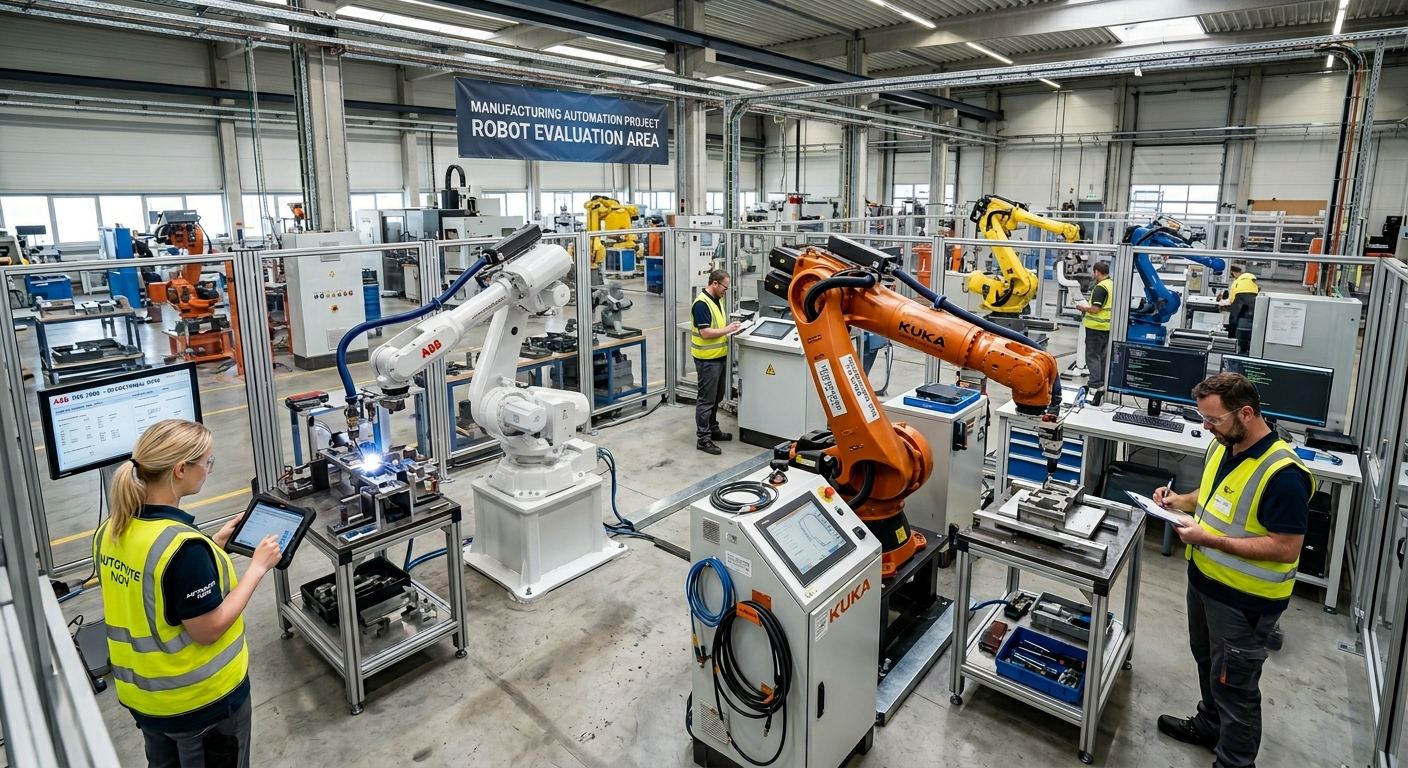
The Purchase Price Is Only the Beginning
The decision between used vs new industrial robots is rarely determined by the purchase price alone. A lower acquisition cost can make a refurbished robot attractive, but the real financial outcome depends on how well the equipment fits the production process, how much integration work is required, and how reliably the robot will operate once it enters production.
Many automation projects are evaluated with a simple comparison: the cost of a new robot versus the cost of a refurbished alternative. In practice, that comparison overlooks the largest contributors to total ownership cost. Integration engineering, tooling, safety systems, production downtime, operator training, maintenance capability, and future support often represent a greater financial impact than the robot itself.
The better question is not which option is cheaper. It is which option creates the lowest total cost while meeting production requirements over the expected life of the automation project?
Why the Purchase Price Can Be Misleading
A new industrial robot typically arrives with the latest controller generation, manufacturer support, current software compatibility, and warranty coverage. Those factors reduce uncertainty during commissioning, but they increase the initial capital investment.
A refurbished industrial robot generally requires a lower upfront investment and can provide excellent value when it has been properly inspected, refurbished, and matched to a suitable application. However, the savings achieved during procurement can disappear if additional engineering work becomes necessary because of compatibility issues, controller limitations, unavailable spare parts, or unexpected mechanical wear.
The purchase price should therefore be treated as only one line in the investment calculation rather than the final answer.
The Major Cost Categories That Determine Total Ownership
A realistic comparison includes every cost that affects production rather than focusing only on equipment acquisition.
Initial Investment
The most visible difference is the acquisition cost. Refurbished robots generally require less capital expenditure, allowing manufacturers to automate earlier or allocate more budget to integration, tooling, or peripheral equipment.
Integration Engineering
Integration costs often remain similar regardless of whether the robot is new or refurbished. Safety systems, fixtures, end-of-arm tooling, PLC communication, programming, and commissioning still require engineering effort. In some projects, these costs exceed the robot purchase price itself.
Maintenance and Spare Parts
A new robot may reduce maintenance uncertainty during the early years of operation. A refurbished robot can achieve comparable reliability when its mechanical condition, controller version, and service history have been properly evaluated. The availability of spare parts should always be confirmed before purchase.
Software and Controller Compatibility
Legacy controllers may require additional engineering when integrating with newer production equipment. Before selecting a refurbished robot, manufacturers should verify controller compatibility, communication protocols, software licensing, and long-term support availability.
Downtime Risk
Unexpected downtime often becomes the most expensive cost category because production losses quickly exceed equipment savings. A technically suitable refurbished robot may present little additional operational risk, while an incompatible system can generate repeated production interruptions.
Representative Production Scenarios
The financial case for a new or refurbished industrial robot depends on the production environment rather than the age of the robot itself. The following examples are representative scenarios intended to illustrate how different operating conditions can influence the total cost of ownership. They do not describe specific customer projects.
Scenario 1: Stable Material Handling Operations
A manufacturer with a mature material handling process, consistent part presentation, and limited product variation may find that a refurbished industrial robot delivers the required performance while reducing initial capital expenditure. In this type of environment, where the application places predictable demands on the robotic cell, the lower acquisition cost can improve the overall business case without significantly increasing operational risk.
Scenario 2: Highly Integrated Manufacturing Lines
Production environments that rely on communication between robots, PLCs, vision systems, traceability software, and other automated equipment often place greater importance on controller compatibility and long-term software support. In these situations, investing in a new robot with the latest controller generation may reduce integration complexity and simplify future upgrades, even if the initial investment is higher.
Scenario 3: Capacity Expansion Using Existing Robot Platforms
Companies that already operate the same robot brand and controller generation across multiple production lines may choose refurbished robots when expanding capacity. Existing maintenance knowledge, spare parts inventory, and operator familiarity can reduce implementation costs and shorten commissioning time, provided the refurbished equipment has been properly inspected and is technically compatible with the intended application.
These representative scenarios demonstrate that the most economical option depends on production requirements, system compatibility, maintenance capability, and long-term operational objectives rather than on purchase price alone.
When Refurbished Robots Usually Make Financial Sense
Refurbished robots are often a strong option when:
- The production process is stable and repeatable.
- The plant already supports the controller generation.
- Qualified maintenance personnel are available.
- Compatible spare parts remain accessible.
- The integration requirements are well understood before purchase.
Under these conditions, lower capital expenditure can significantly improve project economics without increasing operational risk.
When Buying New May Be the Lower-Risk Investment
A new industrial robot may represent a better financial decision when the project depends on the latest communication standards, manufacturer software, warranty coverage, or future production flexibility.
Similarly, organizations without in-house robotics expertise may benefit from the reduced uncertainty that accompanies new equipment, particularly during commissioning and long-term service planning.
The objective is not to minimize purchase cost but to minimize production risk over the lifetime of the automation project.
A Practical Cost Comparison Checklist
Before comparing quotations, evaluate each option against the complete project scope rather than the equipment price alone.
- Purchase cost
- Mechanical condition (for refurbished robots)
- Controller generation
- Software compatibility
- Integration engineering
- Safety system requirements
- End-of-arm tooling
- Operator training
- Maintenance capability
- Spare parts availability
- Expected downtime risk
- Future expansion plans
This broader evaluation produces a more accurate ownership comparison than a simple equipment quotation.
FAQ
Are refurbished industrial robots always cheaper?
No. Although acquisition costs are generally lower, integration work, maintenance requirements, compatibility issues, and downtime risk can significantly influence the total cost of ownership.
Can a refurbished robot perform as well as a new one?
Yes, provided the robot has been properly refurbished, inspected, and matched to an application that suits its capabilities and the production environment.
Which industries commonly use refurbished robots?
Manufacturers in material handling, machine tending, palletizing, packaging, and many general industrial applications often evaluate refurbished robots where production conditions are stable.
When should a company avoid buying a refurbished robot?
Projects involving highly complex integration, unsupported controller generations, uncertain spare parts availability, or demanding future expansion plans may justify investing in new equipment instead.
What is the biggest mistake when comparing used and new robots?
The most common mistake is evaluating only the purchase price. Long-term operating costs, engineering effort, maintenance capability, and production risk often have a much greater impact on the overall investment.
Talk to URT About Used vs New Industrial Robots
If you are evaluating used vs new industrial robots, contact URT. We will give you a direct, technical answer based on your actual production requirements.