
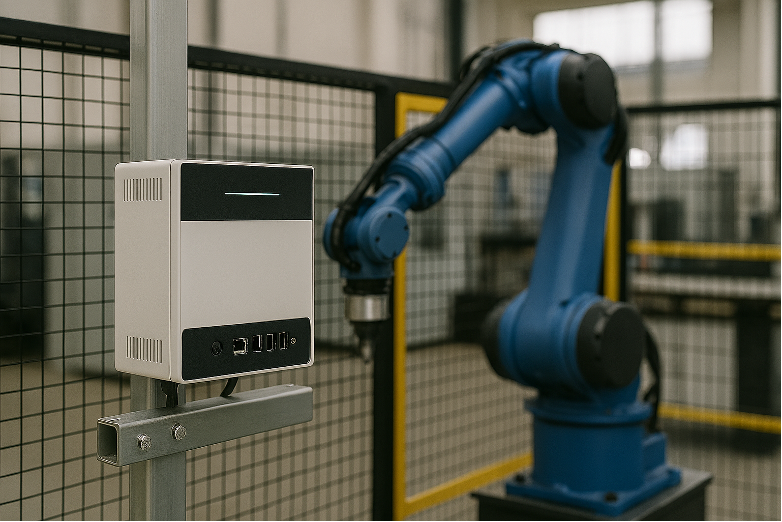
For decades, industrial robots relied on a centralized model in which all data was processed by a PLC or a main server.
Today, thanks to edge computing, processing moves to the very edge of the system—closer to sensors, cameras, and actuators—allowing real‑time decision‑making without depending on the cloud.
In other words, edge computing turns robotic cells into intelligent, autonomous systems capable of analyzing data as they work.
A modern robotic cell generates thousands of data points every second: torque, temperature, vibration, surface quality, and energy consumption.
In the past, all this information had to travel to a remote server, introducing latency and making the system dependent on a stable connection.
Edge computing completely shifts this paradigm.
Instead of sending everything away for processing, calculations take place locally on industrial gateways, microcontrollers, or compact servers installed directly on the shop floor.
This enables:
- Millisecond‑level reaction times, ideal for milling, welding, or inspection tasks.
- Reduced network congestion, since only relevant data is sent to the cloud.
- Instant predictive maintenance, with algorithms detecting anomalies before they cause downtime.
Robots no longer wait for instructions—they process, interpret, and correct themselves in real time.
Edge computing relies on a combination of distributed hardware and software:
- Industrial sensors and cameras collect raw data.
- An edge node (for example, a Siemens Industrial Edge gateway or an NVIDIA Jetson microcontroller) processes this information locally.
- Lightweight AI or machine‑learning models detect abnormal patterns.
- The robot adjusts its behavior—trajectory, speed, or tool pressure—in real time.
- Only summaries or long‑term trends are sent to a central server or the cloud for historical analysis.
This hybrid approach (edge + cloud) forms the foundation of decentralized Industry 4.0.
A documented case is the collaboration between Haier Smart Home, ABB, and China Mobile, where edge computing was implemented in an appliance production plant for automated quality inspection.
According to an RCR Wireless report (2021), each cell uses a 575 W industrial camera connected to an ABB robotic arm and linked to a MEC (Multi‑access Edge Computing) server.
The system analyzes images in real time to detect surface defects without interrupting production.
- Processing latency: reduced to under 20 ms
- Defect detection rate: improved by 23%
- Inspection time: cut by nearly 30% compared to cloud‑based systems
This demonstrates that edge computing is not just a technological trend—it is a commercially viable tool that improves productivity in real robotic cells.
The future of industrial robotics lies in connected, intelligent cells where data processing no longer depends on distant servers.
With edge computing, even refurbished robots—such as those offered by URT—can integrate distributed AI systems and achieve performance comparable to next‑generation models.
This approach enables medium‑sized factories to adopt advanced automation without massive investments, bringing Industry 4.0 technologies within reach of many sectors.
The result: robots that learn locally, produce more efficiently, and adapt faster.
If you’re exploring how to bring edge computing or advanced robotics into your production line, reach out to us—we’re ready to provide all the support you need for your next robotic project.