
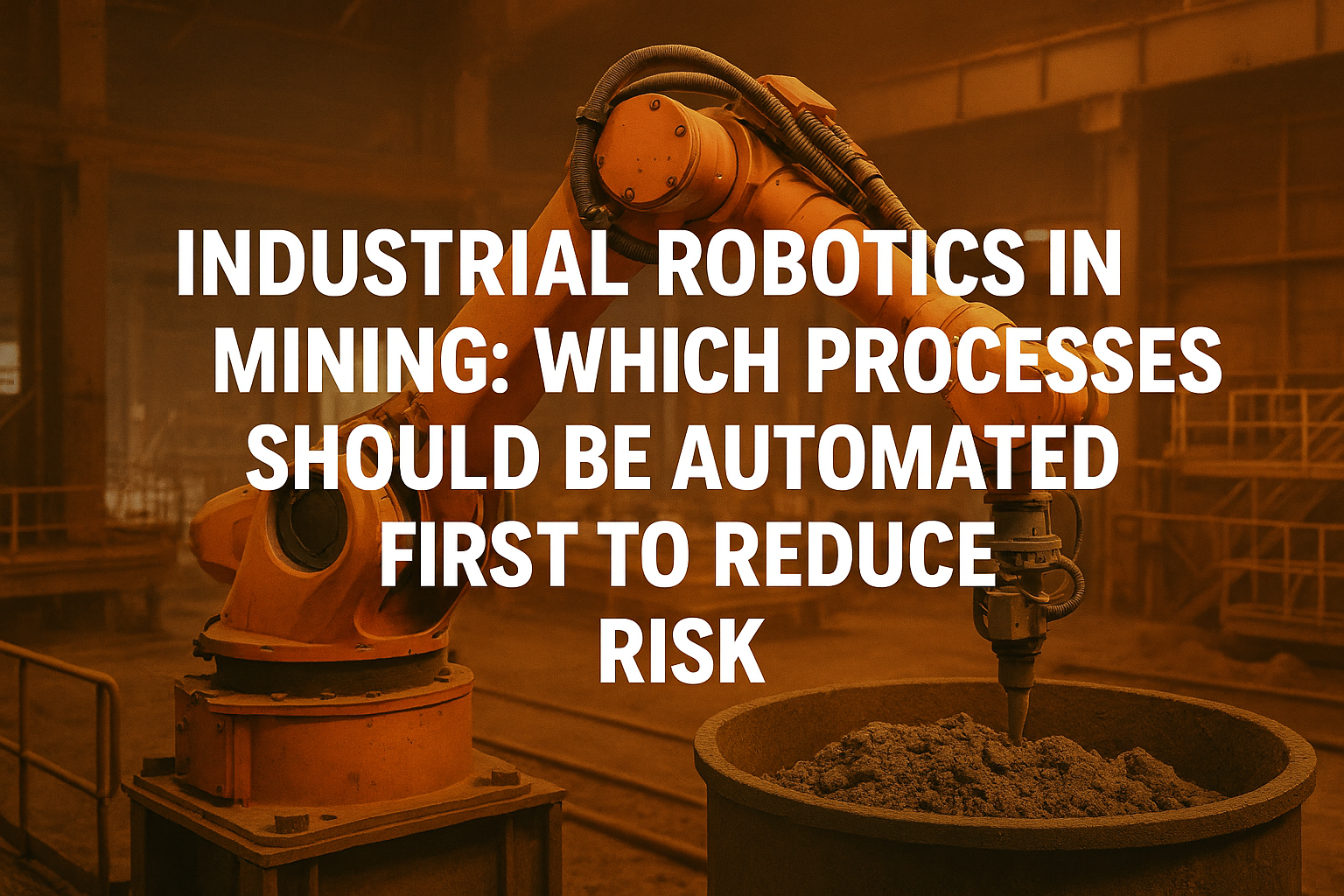
Mining is one of the few sectors where the case for industrial robotics is not mainly about speed. It is about reducing human exposure to tasks performed near dust, vibration, heat, heavy equipment, falling material, or hard-to-reach areas.
Operations managers in this industry rarely need to be convinced that automation can be useful. The real question is more practical: which process should be automated first, and what conditions must be in place for the project to work reliably?
In most cases, the best starting point is not full process automation. A stronger approach is to identify a specific task where risk, repetition, and technical feasibility overlap. This may include heavy part handling, loading and unloading, sampling preparation, assisted inspection, robotic welding, machining, or maintenance workshop operations.
This article explains how to evaluate industrial robotics in mining, which applications usually make the most sense as a first step, and where used or refurbished robots can be a practical option when the project is correctly scoped.
Why Industrial Robotics in Mining Demands a Different Approach
Mining environments are more demanding than standard manufacturing environments. Equipment is exposed to dust, vibration, temperature variation, abrasive particles, heavy loads, and production conditions that are rarely ideal.
This is why automation in mining cannot simply be copied from automotive, packaging, or clean factory environments. A robotic cell that performs well in a controlled production plant may require additional protection, guarding, maintenance access, and environmental adaptation before it can operate reliably in a mining-related setting.
The cost of failure is also different. In many industrial sectors, a stopped robot may affect one line or one production cell. In mining and mineral processing, downtime in the wrong area can affect a larger operational chain. For this reason, robotic automation must be evaluated with a pragmatic mindset.
Mining companies should evaluate automation through three main lenses:
- Risk reduction: how much direct human exposure can the robotic cell remove?
- Reliability: can the system be maintained, serviced, and recovered quickly in real operating conditions?
- Environmental suitability: can the robot, tooling, sensors, and control systems tolerate dust, vibration, heat, humidity, or other site-specific constraints?
Cycle time improvements may still matter, but in mining they are often secondary. The first objective is usually to remove people from the most repetitive, physically demanding, or hazardous exposure points.
The Process Types Worth Evaluating First
The strongest first automation projects in mining-related operations usually share two characteristics: the task involves repeated human exposure to risk, and the process is controlled enough to be automated without excessive complexity.
The following process types are often worth evaluating first.
1. Heavy Part Handling and Maintenance Support
Mining equipment includes large, heavy, and difficult-to-handle components. Maintenance work may involve awkward positioning, repetitive lifting, impact risk, and prolonged manual effort around machinery.
Industrial robots can support these operations when the parts are sufficiently repeatable and the cell can be engineered around the real handling conditions. This may include lifting, positioning, turning, or transferring components in maintenance workshops or controlled repair areas.
The key is not simply the nominal weight of the part. Payload calculations must include the part, gripper, tooling, brackets, movement dynamics, and a suitable safety margin. A robot that looks sufficient on paper may be unsuitable if the end-of-arm tooling or handling path is underestimated.
2. Loading and Unloading of Equipment
Loading and unloading tasks are often good first candidates because they are repetitive, measurable, and easier to standardize than open-ended field operations.
Robots can be used to move components between stations, load parts into machines, unload processed items, or support transfer operations inside a defined cell. In mining-related environments, this type of automation is strongest when the part geometry is predictable, the process sequence is stable, and the robot can operate in a guarded or protected area.
The value is not only speed. A well-designed robotic cell can reduce manual handling, lower variability, and keep operators away from repetitive or uncomfortable tasks.
3. Sampling and Assay Laboratory Work
Sampling and laboratory operations are often more controlled than other areas of a mine. They may involve repeatable cycles, traceable workflows, controlled part dimensions, and defined process steps.
This can make sampling preparation, sample transfer, weighing, sorting, or positioning good candidates for robotic automation. In many cases, these applications are easier to automate than tasks performed directly in harsh open-field or underground environments.
The main advantages are consistency, traceability, and reduced repetitive handling. However, the application still needs proper evaluation. Sample variability, contamination risk, cleaning procedures, and data integration may all affect the final cell design.
4. Inspection in Protected Stations
Inspection is another area where robotics can create value without requiring the robot to operate freely across the mine.
Instead of sending a robot into a highly variable environment, the company can bring parts or components to a protected inspection station. The robot can then position a sensor, move a camera, rotate a part, or repeat an inspection path with greater consistency.
This approach avoids some of the most difficult challenges of mobile robotics, while still reducing operator exposure and improving repeatability.
5. Welding, Repair, and Component Refurbishment
Maintenance workshops attached to mining operations often perform welding, repair, machining, rebuilding, and component preparation work. These areas can be strong candidates for robotic automation because the environment is more controlled than the mine itself.
Welding applications are especially relevant when the parts are repeatable enough, the weld path can be programmed, and the cell can be designed with proper fixturing, safety guarding, extraction, and operator access.
For this type of application, used or refurbished welding robots can make sense when the process is stable and the robot is correctly selected. The quality of the integration matters as much as the robot itself.
For a broader decision framework, see our guide on which process delivers the fastest ROI when automated.
A Decision Framework for Mining Operations
Once several candidate processes have been identified, the next step is to choose the right starting point. A first robotic project should not be selected because it looks impressive. It should be selected because it has a clear operational case.
A useful evaluation framework includes four questions.
- How frequent is the risk exposure?
If operators perform the task daily or repeatedly across shifts, the safety case becomes stronger. - How repeatable is the task?
Robots are strongest when the sequence, part position, tooling, and movement path can be defined with reasonable consistency. - What is the cost of an error?
If manual variation can damage equipment, interrupt production, create safety exposure, or increase rework, automation may provide additional value. - Can the cell be isolated?
A robotic cell is easier to integrate when it can operate in a guarded, controlled area without interfering with adjacent operations.
A strong first project should perform well on most of these criteria. If the task is hazardous but highly variable, the project may require more engineering. If the task is repetitive but low-risk and low-value, the business case may be weak.
The best starting point is usually where risk reduction, repetition, and controlled integration meet.
What Most Mining Robotics Projects Get Wrong
Many automation projects do not fail because robots are unsuitable. They fail because the application was poorly selected, the environment was underestimated, or the total system was not planned correctly.
Choosing the Wrong Robot for the Environment
A standard robot may not be suitable for dust-heavy, humid, corrosive, or high-temperature environments without additional protection. The right specification depends on the actual installation area, not just the industry label.
Before selecting a robot, the company should evaluate ingress protection, cable routing, controller cabinet location, tooling exposure, cleaning procedures, and maintenance access. In potentially explosive environments, applicable ATEX, IECEx, or IEC 60079-related requirements should be reviewed by qualified specialists before equipment is selected.
Underestimating the Engineering Around the Robot
The robot is only one part of the system. A functioning cell also requires tooling, fixturing, safety equipment, sensors, grippers, guarding, programming, PLC integration, operator procedures, and commissioning.
This is why buying the robot first and defining the application later is a mistake. The application should define the robot, not the other way around.
Ignoring Spare Parts and Support
Mining operations often work in remote or logistically difficult locations. A robotic system that depends on rare components, unavailable service support, or long lead times for basic parts can become a problem during production.
Before choosing a robot model, the company should check spare parts availability, controller support, teach pendant condition, cable condition, documentation, and the ability to maintain the system over time.
Treating Automation as a One-Time Purchase
A robotic cell is not a single piece of equipment. It is a production system. It needs training, maintenance planning, safety procedures, fault recovery logic, spare parts, and future support.
The project should be evaluated as an operational investment, not just as a robot purchase.
Building the Right Robotic Cell for Mining-Related Applications
Robot specifications are important, but the surrounding cell determines whether the project will perform reliably in production.
For mining-related applications, the design should consider the following elements:
- Environmental protection: dust, humidity, heat, vibration, abrasive material, and cleaning procedures.
- End-of-arm tooling: grippers, fixtures, sensors, welding equipment, or machining tools designed for the real part condition.
- Safety integration: fencing, scanners, interlocks, emergency stops, access control, and safe recovery procedures.
- Maintenance access: the cell must be serviceable without creating unnecessary downtime or safety exposure.
- Control system integration: the robot must communicate properly with the existing production, PLC, or process control environment where required.
- Operator training: the team must understand how to use, recover, and maintain the system safely.
Safety system design should follow the applicable industrial robot safety standards and the site’s internal safety requirements. In practice, this usually means that the robotic cell must be designed by qualified specialists, validated before operation, and documented clearly for the team that will use it.
End-effector design deserves particular attention. In dusty or abrasive environments, grippers and tools may experience faster wear than expected. They should be designed for easy inspection, cleaning, replacement, and adjustment.
A good robotic cell is not the most complex one. It is the one that performs the required task reliably, safely, and with a maintenance burden the operation can actually sustain.
New, Refurbished, or Used: Which Makes Sense for Mining?
Mining-related applications can be a strong case for refurbished industrial robots, especially when the task is fixed, repeatable, and installed inside a controlled cell.
The advantage of a refurbished robot is not only the lower purchase cost. In many projects, choosing the right refurbished robot can free more budget for the parts of the system that determine real performance: tooling, safety equipment, guarding, integration, programming, training, and spare parts.
For applications such as handling, welding, machine tending, machining support, or workshop automation, a used or refurbished robot can be technically suitable when it is correctly inspected and matched to the application.
However, not every used robot is a good investment. The evaluation should include:
- robot condition;
- controller condition;
- service history, where available;
- payload and reach;
- compatibility with the application;
- spare parts availability;
- software and programming support;
- cables, motors, reducers, and teach pendant condition;
- integration requirements;
- safety system requirements.
A new robot may be preferable when the project requires the latest controller generation, direct OEM support, specific warranties, or a standardized vendor package. A refurbished robot may be preferable when the application is stable, cost control matters, and the robot can be properly inspected, tested, and integrated.
We cover this trade-off in detail in our comparison of refurbished and new industrial robots, and the integration question specifically in how to evaluate refurbished robot compatibility with existing systems.
The important point is simple: a used robot should not be selected because it is available or inexpensive. It should be selected because it fits the task, the environment, the support requirements, and the expected return.
What a Successful Mining Automation Project Looks Like
A well-scoped mining-related robotic project should aim to deliver a clear operational result, not just install a robot.
A successful first project usually has these characteristics:
- It removes a clearly defined hazardous or repetitive task from daily manual work.
- It operates in a controlled or protected cell.
- It uses a robot suitable for the payload, reach, environment, and process requirements.
- It includes proper safety guarding, access control, and recovery procedures.
- It has tooling designed for the real part condition, not an idealized version of the part.
- It includes maintenance planning and spare parts evaluation from the beginning.
- It can generate useful operational data, such as cycle counts, faults, intervention frequency, or downtime causes.
This last point is important. A first robotic cell should create a foundation for future automation. If the project produces clear data and stable results, it becomes easier to justify the next cell. If the first project is oversized, poorly documented, or difficult to maintain, it may slow down automation adoption across the company.
Mining automation should therefore start with a project that is narrow enough to control, valuable enough to justify, and robust enough to survive in real conditions.
How URT Approaches Mining Robotics Projects
Mining clients do not need abstract promises about digital transformation. They need a realistic view of what can be automated, what should not be automated first, and which robot can perform reliably in the intended environment.
URT helps companies evaluate industrial robotics applications across mining-related operations, heavy industry, automotive, and general manufacturing. The focus is on practical automation: selecting the right robot, matching it to the application, and avoiding the common mistakes that make robotic projects more expensive or fragile than they need to be.
In mining-related projects, the first step is not choosing a robot from a list. The first step is defining the application clearly:
- What task should be automated?
- What risk should be reduced?
- What parts, tools, or materials are involved?
- What payload and reach are required?
- What environmental conditions must be considered?
- What safety requirements apply?
- What maintenance and spare parts support will be needed?
- What return would make the project worthwhile?
Once these questions are clear, it becomes possible to evaluate whether a new, used, or refurbished industrial robot is the right choice.
In mining, getting this right matters because the objective is not simply to add robotics. The objective is to reduce exposure, improve consistency, and create a system that the operation can maintain over time.
FAQ
Is industrial robotics in mining limited to autonomous haul trucks?
No. Autonomous haul trucks are only one part of mining automation. Industrial robots can also be used in fixed cells, maintenance workshops, sampling laboratories, inspection stations, part handling, welding, and machining applications.
For many companies, fixed robotic cells are a more realistic first step than autonomous mobile systems because they are easier to isolate, control, test, and maintain.
What mining tasks are best suited for robotic automation?
The best first candidates are usually repetitive, hazardous, or physically demanding tasks that can be performed in a controlled cell. These may include heavy part handling, loading and unloading, sampling preparation, inspection support, welding, machining, and maintenance workshop operations.
Can refurbished industrial robots be used in mining environments?
Yes, refurbished industrial robots can be used in mining-related applications when they are properly inspected, correctly specified, and installed in a suitable environment. They are especially relevant for fixed-cell applications such as handling, welding, machine tending, machining support, or workshop automation.
The application must be evaluated carefully. Environmental protection, payload, reach, tooling, safety integration, spare parts, and service support all matter.
Are industrial robots suitable for dusty or harsh environments?
They can be suitable, but the installation must be engineered for the actual conditions. Dust, vibration, humidity, abrasive particles, heat, and cleaning procedures may require additional protection, specific tooling, protected cable routing, suitable enclosures, or more frequent maintenance planning.
How should a mining company choose the first process to automate?
The first process should be selected where risk reduction, repetition, and technical feasibility are strongest. A good first project should be limited enough to control, valuable enough to justify investment, and practical enough to maintain.
The best first project is rarely the most complex one. It is usually the task that can prove value safely and reliably.
When does a refurbished industrial robot make sense for mining-related operations?
A refurbished industrial robot can make sense when the process is stable, the robot matches the technical requirements, spare parts and support are available, and the integration plan is realistic.
It may be especially useful for handling, welding, machine tending, machining, or workshop operations where a new robot is not strictly necessary for the application.
Evaluate Robotics Applications in Mining With Controlled Risk
At URT, we help operations teams across mining, heavy industry, and manufacturing implement industrial robotics solutions focused on operational results: lower exposure to hazardous work, improved consistency, fewer manual errors, and systems that real production environments can sustain.
We work on applications including palletizing, assembly, part handling, welding, measurement and inspection, and machining and robotic milling.
Our approach combines technical expertise with realistic project scoping. It is not about selecting the most impressive robot on paper. It is about selecting the right solution for the task, the operating environment, the available budget, and the long-term maintenance requirements.
If your operation is evaluating its first robotic cell, expanding existing automation, or revisiting a stalled project, contact URT and we will help you identify the right starting point for your industry, environment, and operational goals.