
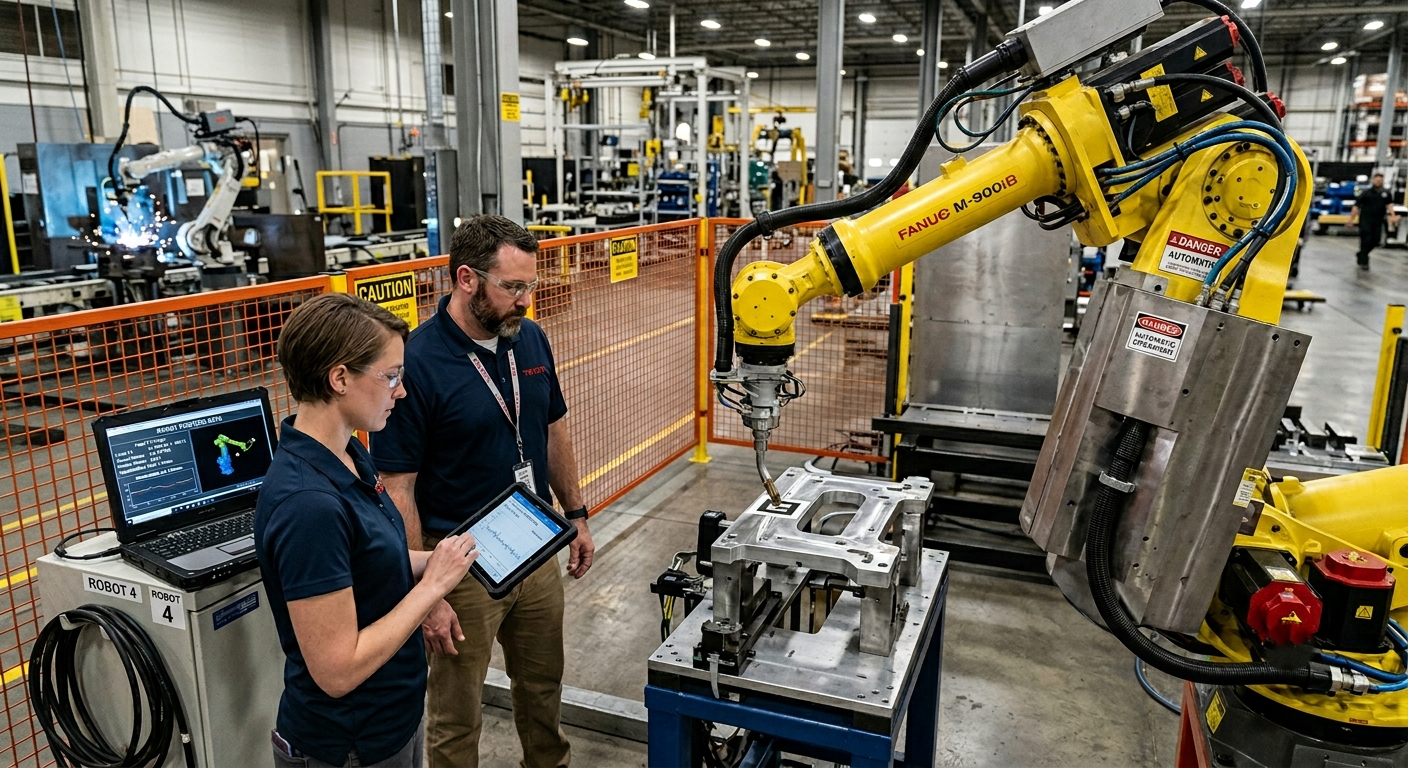
Why a Repeatable Robot Can Still Miss the Real Target
Robot accuracy vs. repeatability matters because a robot can return to the same position consistently and still be offset from the position the process actually requires. That distinction is easy to overlook when buyers compare datasheets, but it becomes important as soon as programs are generated offline, parts move between fixtures, vision systems provide coordinates, or several robots must perform the same task.
In a manually taught application, a small position offset may not create a problem. The programmer moves the robot to the correct physical point, stores that point, and relies on the robot to return there consistently. In a data-driven application, however, the robot may be expected to move to a coordinate calculated somewhere else. In that case, repeatability alone may not be enough.
The production question is therefore not whether accuracy or repeatability is universally more important. The correct question is which type of positioning performance the application depends on, what other sources of error exist in the cell, and how those errors will be measured and controlled.
What Robot Repeatability Means
Robot repeatability describes how consistently a robot returns to the same programmed position under defined conditions. If the robot is commanded to visit one point many times, repeatability describes how closely those repeated positions group together.
A highly repeatable robot may return to a tightly grouped set of positions even if that group is slightly offset from an externally measured coordinate. The movement is consistent, but the position may not be perfectly accurate in absolute space.
Repeatability is especially useful in taught applications
Many industrial robot programs are created by teaching points directly in the physical cell. The programmer moves the robot to the required position relative to the real fixture, machine, workpiece, or process tool and stores that location.
In this type of application, the robot does not need to calculate the point from a perfect factory coordinate model. It needs to return to the physically taught point with enough consistency for the process.
This is why repeatability is often central in palletizing, machine tending, spot welding, arc welding, handling, and other repetitive applications. The robot follows a proven sequence relative to stable equipment.
Repeatability does not include every source of process variation
The robot may repeat its own movement correctly while the production result changes. A fixture can move, a gripper can wear, a workpiece can arrive in a different position, or a process tool can deflect.
In welding, the robot may follow the same path while joint location changes because of inconsistent fit-up. In machine tending, the robot may repeat the loading motion while chips prevent the part from seating correctly. In assembly, the robot may reach the same point, while component tolerances make insertion unreliable.
Repeatability is therefore a characteristic of the robot system under defined conditions. It is not a guarantee that the complete manufacturing process will repeat with the same quality.
What Robot Accuracy Means
Robot accuracy describes how closely the robot reaches a commanded position in relation to the intended real-world coordinate. It asks whether the robot arrives where the coordinate system says the point should be, not only whether it returns to the same place consistently.
This distinction becomes important when the robot is expected to use positions that were not taught directly at the final installation.
Accuracy matters when positions come from external data
Some robot programs are built from CAD models, simulation software, vision systems, measurement equipment, or process-planning systems. The robot may receive a coordinate and be expected to move to that position without a technician manually correcting every point.
If the robot’s real geometry differs from the mathematical model used to generate the program, the tool may arrive at an offset position. That offset can come from manufacturing tolerances, calibration conditions, base installation, tool definition, or work-object definition.
Applications that depend heavily on externally generated coordinates may require stronger calibration, measurement, and correction methods than applications taught entirely on the shop floor.
Accuracy is linked to the complete coordinate chain
The robot is only one part of the positioning system. The final tool position can also be affected by the robot base, mounting surface, tool center point, fixture coordinates, vision calibration, part location, and external axes.
A highly accurate robot can still miss the target if the tool center point is defined incorrectly. A precise vision system can still produce poor results if the camera-to-robot calibration is weak. An offline program can still be offset if the digital fixture does not match the installed fixture.
Accuracy should therefore be evaluated as a chain of coordinate relationships rather than a single number taken from a robot datasheet.
The Simple Difference Between Accuracy and Repeatability
The distinction can be understood through a target. Repeatability describes whether repeated attempts land close together. Accuracy describes whether those attempts land close to the intended center.
| Positioning condition | What it means in production |
|---|---|
| High repeatability and high accuracy | The robot returns consistently and reaches the intended coordinate closely. |
| High repeatability and lower accuracy | The robot returns consistently, but the repeated position is offset from the intended coordinate. |
| Lower repeatability and high average accuracy | The average position may be near the target, but individual cycles vary too much. |
| Lower repeatability and lower accuracy | The robot does not reach the target closely or consistently enough for the process. |
In practical terms, a repeatable offset can sometimes be corrected through teaching or calibration. An inconsistent position is usually harder to manage because the error changes from cycle to cycle.
That does not make repeatability more important in every application. It means the consequences of each error are different and require different controls.
Where Repeatability Usually Matters Most
Repeatability is often the main concern when the robot performs the same motion relative to stable fixtures and equipment. The process is taught in the actual cell, and the robot is expected to return to those positions through many cycles.
Machine tending
In machine tending, the robot must repeatedly load and unload a known machine position. If the machine, fixture, gripper, and part presentation remain stable, the robot can be taught directly to the loading and unloading points.
Production reliability still depends on more than the robot. Chips, clamp condition, part orientation, gripper wear, and machine-door movement can all affect the result.
URT’s guide to robotizing CNC loading and unloading without creating bottlenecks explains why part flow, machine communication, and recovery logic matter alongside robot positioning.
Repetitive handling
Handling applications often depend on the robot returning to fixed pickup and placement locations. Repeatability becomes valuable when the product arrives consistently, and the receiving fixture does not move.
If the part position varies, however, the application may require vision, mechanical location, or a better presentation method. Robot repeatability cannot compensate for uncontrolled input variation by itself.
Palletizing
Palletizing usually uses programmed patterns with repeated product and pallet positions. Robot repeatability supports consistent placement, but stack quality also depends on case dimensions, product stability, gripper behavior, pallet location, and infeed timing.
A robot can repeat every placement point correctly, while unstable cases or changing packaging dimensions create poor pallet formation. The process must support the robot’s consistency.
Where Accuracy Becomes More Important
Accuracy becomes more important when the robot must trust coordinates that were not individually taught in the final production cell. These applications depend on the relationship between the digital model and the physical installation.
Offline programming
Offline programming can reduce the time spent teaching production points on the shop floor. It is especially useful when a large number of points must be generated or when access to the real cell is limited.
However, the programmed path will only match the real cell if the robot, tool, fixture, workpiece, and base coordinate systems are accurately represented. Small differences between the digital and physical systems can create visible offsets.
URT discusses related planning considerations for how to reduce robot programming time in industrial automation.
Vision-guided robotics
A vision system may identify a part and send its position to the robot. For that movement to work, the camera, robot, tool, and work-object coordinate systems must be related correctly.
Poor calibration can create a consistent offset, an orientation error, or a position error that changes across the camera’s field of view. The vision system may identify the part correctly while the robot still approaches it incorrectly.
Accuracy in vision-guided applications depends on camera calibration, lighting, lens selection, part features, robot calibration, and tool definition. It should not be assigned to the robot arm alone.
Multi-station or transferable programs
A manufacturer may want one program to run across several similar cells or robots. This can reduce engineering effort, but only if the physical installations and coordinate systems are controlled closely enough.
Differences in robot mounting, fixture location, tool geometry, calibration state, and external equipment can create offsets between nominally identical cells. Transferable programming requires a stronger measurement and calibration strategy than teaching each cell independently.
Machining, trimming, and process paths
Applications such as robotic milling, trimming, cutting, dispensing, or inspection may rely on paths derived from product geometry. Position and orientation errors can affect edge location, material removal, bead placement, or measurement results.
The robot may also experience process forces, tool deflection, thermal effects, and structural compliance. As a result, nominal positioning accuracy is only one contributor to the finished result.
Why Robot Specifications Do Not Predict Final Part Quality
Robot specifications describe defined aspects of robot performance under test conditions. Production quality depends on the complete cell, the process, and the stability of every input.
Tool center point errors
The tool center point tells the controller where the working point of the tool is located relative to the robot flange. An incorrect tool definition can shift every programmed position.
This is especially important with long tools, welding torches, spindles, dispensing nozzles, and multi-tool systems. A small angular error at the flange can create a larger positional error at the end of a long tool.
Fixture movement
A fixture that moves or wears changes the relationship between the robot and the workpiece. The robot may return correctly to its programmed point while the part is no longer in the same location.
Fixture repeatability should be measured separately from robot repeatability. The weaker element controls the practical result.
Part variation
Part dimensions, distortion, molding variation, packaging condition, and upstream process variation can all change the target location.
Automation should not assume that nominal drawings represent every production part. The real range of variation needs to be measured and either reduced, located, or accommodated by the system.
Tool deflection and process forces
A robot may reach the commanded point correctly before the process begins, but cutting, grinding, pressing, or contact forces can move the tool away from that position.
Tool stiffness, robot posture, load direction, process force, and speed all affect the final path. Static positioning data alone may not predict behavior under load.
Calibration and maintenance condition
Mechanical wear, collision recovery, motor replacement, encoder work, base movement, or tool changes can alter the relationship between the programmed model and the physical system.
Plants should understand which events require checking or restoring calibration. A robot that still runs programs may not retain the positioning condition needed for externally generated paths.
How Accuracy and Repeatability Affect Robotic Welding
Robotic welding illustrates why the distinction must be tied to process conditions. A repeatable robot can follow the same programmed path on every cycle, but the weld may still miss the joint if part fit-up or fixture location changes.
If every assembly is located consistently, direct teaching and strong repeatability may support a stable process. If joint position varies, the system may need improved fixturing, seam-location methods, sensing, or adaptive process control.
Accuracy becomes more significant when weld paths are generated offline or transferred between cells. The programmed geometry must align with the installed fixture, tool center point, robot base, workpiece position, and positioner coordinates.
Weld quality also depends on torch angle, contact-tip condition, wire feeding, shielding gas, parameters, material condition, and joint preparation. Robot positioning performance cannot correct an unstable welding process on its own.
For a broader production assessment, see URT’s guide to real-world welding problems that robotic automation can solve.
Why Used Robot Buyers Should Check Calibration History
A used robot may remain highly repeatable while its absolute positioning no longer matches the original factory model closely enough for a specific application. This does not automatically make the robot unsuitable.
For a taught handling or machine-tending application, the robot may perform well after installation and point teaching. For offline programming, vision-guided work, path transfer, or measurement-sensitive processes, calibration conditions may require closer attention.
Buyers should review the robot’s mechanical condition, collision history where available, controller status, mastering or calibration records, and any major component replacement. They should also confirm whether the intended application depends mainly on taught repeatability or on accurate external coordinates.
A lower purchase price is not enough reason to accept uncertainty. URT’s refurbished robot buying considerations provide a broader framework for assessing condition, compatibility, documentation, and support.
How to Decide Which Positioning Performance Matters
Use this checklist to identify whether the application depends mainly on repeatability, accuracy, or both. It should be completed before selecting equipment, defining calibration work, or promising process capability.
- Determine whether points will be taught physically or generated from CAD, vision, measurement, or external software.
- Define the acceptable final process tolerance rather than relying only on the robot specification.
- Measure part, fixture, machine, and presentation variation.
- Confirm how the robot base and surrounding equipment will be located.
- Define and verify the tool center point using the actual production tool.
- Identify whether programs must transfer between robots or cells.
- Check whether external axes, positioners, or conveyors add coordinate errors.
- Determine whether process forces can deflect the robot or tool.
- Plan how vision, tools, fixtures, and work objects will be calibrated.
- Define when calibration should be checked after collisions, repairs, or equipment changes.
- Validate performance using the real production process, not robot motion alone.
When Better Robot Specifications Will Not Solve the Problem
A robot with stronger repeatability will not solve inconsistent fixtures, changing part location, or worn tooling. A robot with stronger absolute accuracy will not correct a poorly calibrated camera or an incorrect tool center point.
Buying a higher-specification robot may be justified when the process and integration strategy genuinely need that capability. It is not a substitute for controlling the rest of the system.
The plant should first identify the dominant error source. If most variation comes from the fixture, the fixture needs attention. If points generated offline are consistently offset, calibration and coordinate definition may be the issue. If results change from cycle to cycle, part presentation, tooling, mechanical condition, or process variation may be more important than absolute accuracy.
The best selection is the robot that meets the actual process requirement within a cell, designed to preserve that performance. The largest or smallest positioning number on a datasheet is not automatically the best production decision.
FAQ
What is the simple difference between robot accuracy and repeatability?
Accuracy describes how closely the robot reaches the intended real-world coordinate. Repeatability describes how consistently it returns to the same programmed position over repeated cycles.
Can a robot be repeatable but not accurate?
Yes. A robot can return consistently to a tightly grouped position that is offset from the intended coordinate. The offset may be manageable through teaching or calibration, depending on the application.
Which is more important in industrial robotics?
Neither is universally more important. Repeatability is often central in directly taught repetitive tasks, while accuracy becomes more important when coordinates come from CAD, vision, measurement systems, or transferable programs.
Does high repeatability guarantee product quality?
No. Product quality also depends on fixtures, part tolerances, tooling, process parameters, calibration, sensors, material condition, and maintenance. Robot repeatability is only one contributor.
Why can an offline robot program be offset in the real cell?
The digital model may not perfectly match the physical robot base, fixture, tool, workpiece, or calibration state. These differences can cause the real tool path to deviate from the simulated path.
Does a vision system eliminate accuracy problems?
No. Vision can locate parts and correct positions, but the camera, robot, tool, and work-object coordinate systems must be calibrated correctly. Lighting, lens selection, image quality, and part features also affect performance.
Can a used robot still be accurate and repeatable?
Yes, but its condition and intended application must be evaluated. A used robot may perform well in taught repetitive work while requiring calibration checks for offline programming, transferred paths, or measurement-sensitive applications.
How should positioning performance be validated?
It should be validated through the real production process using the final tool, fixture, workpiece, speeds, loads, and environmental conditions. Robot motion tests alone do not confirm finished-part quality.
Talk to URT About Robot Accuracy and Repeatability
If you are evaluating robot accuracy vs repeatability, contact URT. We will give you a direct, technical answer based on your actual production requirements.