
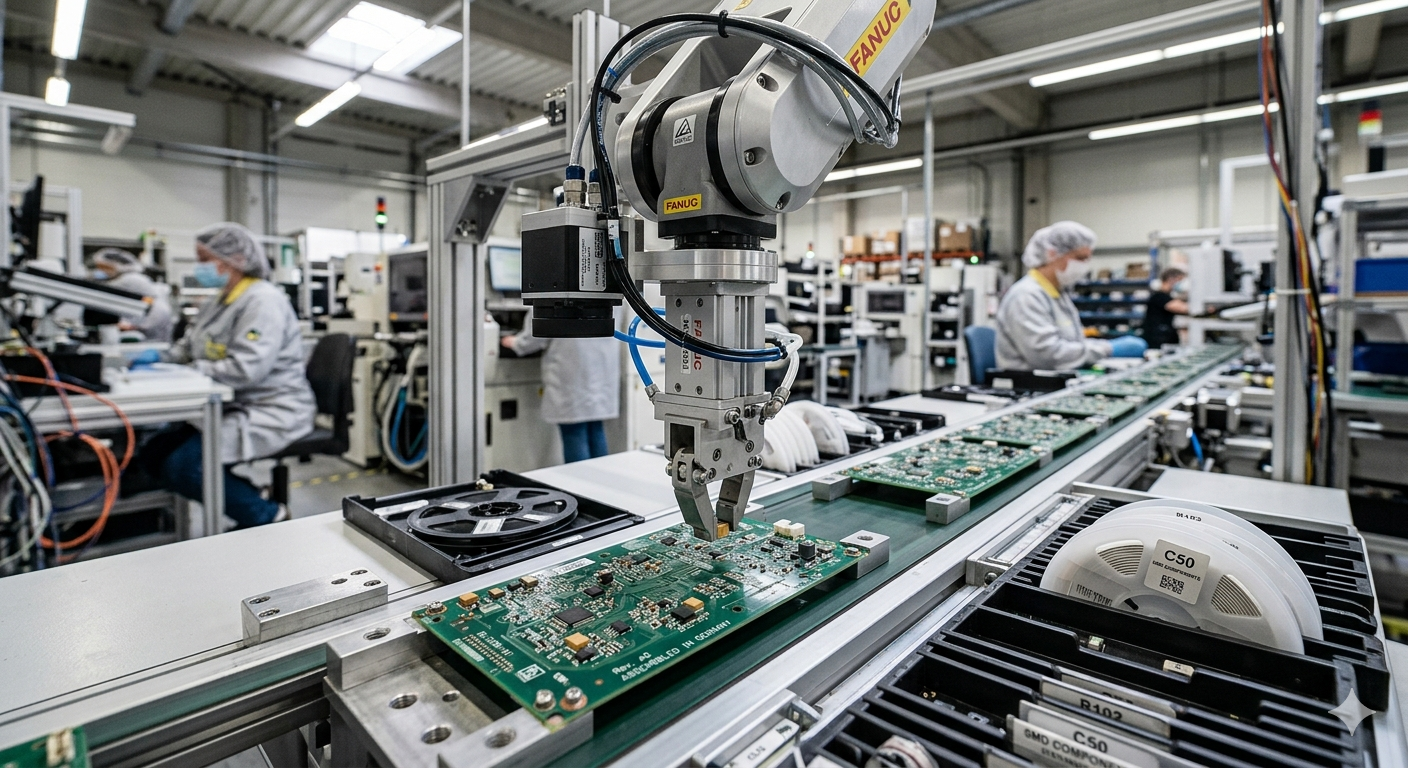
Why Small-Part Electronic Assembly Is More Difficult Than It Looks
The question is not whether industrial robots can assemble small electronic components. The question is whether the production process is stable enough for robotic handling to remain reliable over thousands of cycles without creating alignment problems, component damage, or intermittent quality failures.
Electronic assembly automation often looks attractive because the parts are lightweight, repetitive, and produced at high volume. In practice, however, small and delicate components introduce integration challenges that are less visible in larger industrial handling applications. Connector alignment tolerances become tighter. Static electricity becomes more important. Minor positioning variation can create recurring insertion failures. A gripper that works perfectly during testing may struggle once production conditions change.
For this reason, successful electronic assembly projects depend as much on process control, fixturing, and end-of-arm tooling as on the robot itself. The robotic system must interact with the product consistently under real production conditions, not only under ideal demonstration scenarios.
When Electronic Assembly Automation Is Usually Worth the Investment
Not every electronics assembly process benefits equally from robotic automation. Some operations remain too variable, too low-volume, or too dependent on human judgment to justify the integration complexity. Others become strong automation candidates because the process conditions are already controlled.
High Repetition With Stable Geometry
Electronic assembly automation makes the most sense when the assembly sequence repeats consistently and the component geometry remains stable across production batches.
Examples include:
- Connector insertion
- PCB handling and transfer
- Screwdriving operations
- Small-part pick-and-place tasks
- Tray loading and unloading
- Electronic module assembly
- Dispensing and adhesive application
Processes with controlled positioning and repeatable alignment conditions are generally easier to automate than operations requiring constant visual judgment or manual compensation.
Consistent Production Volumes
Automation investment becomes easier to justify when production volumes are stable enough to support long-term utilization of the robotic cell.
Low-volume, high-mix environments can still be automated, but the flexibility requirements usually increase programming complexity, fixture changeover requirements, and operator support demands.
Manufacturers evaluating broader automation strategy should also consider which process to robotize first for the fastest ROI, especially when several assembly operations compete for investment priority.
Quality Consistency Requirements
Many electronic manufacturers automate not primarily to reduce labor, but to stabilize quality. Small manual inconsistencies that appear insignificant at the operator level can create large downstream costs through intermittent failures, connector damage, rejected assemblies, or warranty claims.
Robotic systems can improve consistency when the process conditions themselves are controlled and measurable.
Part Presentation Is Often the Real Automation Challenge
In small-part assembly, the robot motion itself is rarely the main technical difficulty. The larger challenge is presenting components to the robot in a stable and repeatable orientation.
A robot can repeat a programmed path consistently, but it cannot compensate automatically for trays loaded incorrectly, inconsistent feeder positioning, warped parts, or unstable fixture conditions.
Tray and Fixture Design
Electronic assembly automation depends heavily on fixture repeatability. Small dimensional shifts that are insignificant in larger handling applications can create insertion errors when working with miniature connectors or precision assemblies.
Fixtures must control:
- Part orientation
- Vertical positioning
- Component stability during insertion
- Tolerance stack-up across assemblies
- Access clearance for tooling
The fixture should simplify the robotic process rather than forcing the robot to compensate for uncontrolled variation.
Feeder Stability
Vibratory feeders, trays, tape-and-reel systems, and indexing mechanisms must deliver components consistently throughout the production cycle. Inconsistent feeding creates cascading downtime that often appears incorrectly as a robot reliability issue.
When evaluating automation performance, manufacturers should separate feeder instability from robotic repeatability problems.
Static Electricity and Surface Sensitivity
Electronics assembly introduces environmental factors that are less critical in heavier industrial applications. Electrostatic discharge protection, contamination control, and delicate surface handling can all affect cell design.
Gripper materials, grounding strategies, air flow management, and workstation layout may all influence long-term process reliability.
Choosing the Right Robot and Gripper Strategy
Electronic assembly applications frequently prioritize precision handling, compact movement, and controlled interaction over raw payload capacity.
The robot must fit the assembly process, but the end effector usually determines whether the handling operation becomes stable enough for continuous production.
Small Industrial Robots
Compact industrial robots are often used when the assembly process requires repeatable positioning in limited workspaces. Their smaller footprint can simplify integration inside electronics production cells where floor space is restricted.
However, the robot should not be selected only based on size. Controller compatibility, programming workflow, communication requirements, and maintenance support remain important operational considerations.
Manufacturers evaluating compact robotic systems may also review ABB IRB 1300 applications in electronic assembly environments when comparing integration approaches.
Vacuum and Mechanical Grippers
Vacuum systems are commonly used for PCB transfer, lightweight component handling, and delicate surface applications. Mechanical grippers may provide better positional control when insertion precision matters.
The safest gripping strategy depends on:
- Component rigidity
- Surface sensitivity
- Orientation requirements
- Cycle speed targets
- Dimensional variation
- Static sensitivity
Overly aggressive gripping force can damage miniature components even when the robot path itself is correct.
Compliance and Force Control
Some assembly operations benefit from compliance tooling or force sensing that allows controlled insertion movement. This is especially important when slight alignment variation exists between mating components.
Rigid insertion without controlled compliance can create recurring damage during high-speed operation.
Vision Systems and Sensors in Electronic Assembly
Vision guidance is widely used in electronic assembly because many small components require positional correction before handling or insertion.
However, vision systems should not be treated as a replacement for process stability.
Alignment Verification
Cameras are often used to confirm orientation, detect missing parts, and verify positioning before insertion. This can reduce scrap and improve process reliability when variation remains within controlled limits.
The most reliable systems combine vision with stable mechanical positioning rather than depending entirely on software correction.
Inspection Integration
Electronic assembly cells frequently combine robotic handling with inspection systems that verify connector seating, label presence, adhesive position, or assembly completeness.
Inspection becomes particularly valuable when manual verification is inconsistent or difficult to standardize across shifts.
Sensor Feedback
Force sensing, torque monitoring, and position feedback can help identify abnormal assembly conditions before damage occurs.
For example, screwdriving applications may monitor torque signatures to identify stripped threads or incomplete seating conditions automatically.
What Usually Creates Downtime in Electronic Assembly Cells
Many manufacturers assume robotic downtime comes mainly from the robot arm itself. In electronics assembly, downtime is more commonly linked to peripherals, presentation systems, sensors, and process variation.
Component Feeding Problems
Feed interruptions are one of the most common causes of assembly stoppages. Parts may jam, misalign, or feed inconsistently under production conditions.
The robotic cell should therefore be evaluated as a complete system rather than as an isolated robot installation.
Programming Complexity
High-mix assembly environments can create large programming and changeover workloads. Product revisions, fixture updates, and SKU variation may require frequent adjustment.
Manufacturers planning flexible automation environments should also evaluate how to reduce robot programming time in industrial automation before scaling deployment across multiple assembly lines.
Maintenance Access
Compact assembly cells sometimes become difficult to maintain because too much equipment is integrated into limited space. Access for cleaning, feeder maintenance, cable replacement, or sensor adjustment should be considered during the design stage.
A highly compact cell that is difficult to service may reduce uptime despite strong robotic performance.
ROI Drivers in Electronic Assembly Automation
The ROI of electronic assembly automation depends on more than labor replacement. In many operations, the largest financial gains come from consistency, traceability, reduced rework, and improved throughput stability.
Reduced Handling Damage
Small electronic components are vulnerable to handling damage, contamination, and improper insertion. Stable robotic interaction can reduce variability when the process conditions are controlled correctly.
Improved Throughput Consistency
Robotic systems can stabilize cycle times and reduce operator-dependent variation during repetitive assembly sequences.
However, unstable upstream feeding or inconsistent part quality can still limit throughput performance regardless of robot capability.
Traceability and Process Monitoring
Automated assembly systems often integrate data collection more effectively than manual processes. Torque values, cycle times, inspection data, and process events can be logged automatically for quality analysis.
This becomes especially valuable in regulated or quality-sensitive manufacturing environments.
When Electronic Assembly Automation May Not Be the Right Choice
Not every electronics assembly process should be automated immediately. Some operations remain too variable or too dependent on flexible human judgment.
Automation may not be the best option when:
- Product designs change continuously
- Production volumes remain inconsistent
- Component presentation cannot be stabilized
- Manual operators constantly compensate for variation
- The process requires subjective visual inspection
- Fixture repeatability is poor
- Engineering support for ongoing maintenance is limited
In those situations, stabilizing the process first may produce better operational results than introducing robotics prematurely.
What to Verify Before Investing in an Electronic Assembly Cell
Before approving an electronic assembly automation project, manufacturers should evaluate the complete production environment instead of focusing only on robot selection.
- Whether component presentation is stable across shifts
- Whether fixtures maintain repeatable positioning tolerances
- Whether ESD protection requirements are defined clearly
- Whether feeders can support continuous production reliably
- Whether the assembly sequence changes frequently
- Whether maintenance teams can support sensors and tooling
- Whether cycle time targets allow stable insertion movement
- Whether inspection systems are required for quality verification
- Whether future product revisions will affect tooling compatibility
- Whether upstream process variation has already been stabilized
Manufacturers evaluating broader handling and assembly integration strategies may also review when end-of-line automation makes operational sense as production systems become more interconnected.
FAQ
Can industrial robots handle very small electronic parts?
Yes, but successful handling depends heavily on fixture precision, gripper design, component presentation stability, and process consistency.
What is the biggest challenge in electronic assembly automation?
In many projects, the largest challenge is not robot programming but stable part presentation and repeatable alignment conditions during handling and insertion.
Are vision systems necessary for electronic assembly robots?
Not always. Vision systems are useful when positional correction or inspection is required, but stable mechanical fixturing can reduce the need for complex vision compensation.
Does robotic electronic assembly always reduce labor costs?
Labor reduction may contribute to ROI, but many manufacturers automate primarily to improve consistency, reduce defects, and stabilize production throughput.
Can collaborative robots be used in electronics assembly?
Collaborative robots can be suitable for some assembly environments, especially low-payload applications with shared operator interaction. However, cycle requirements and precision demands still need careful evaluation.
Why do some electronic assembly automation projects fail?
Many failures occur because unstable feeders, inconsistent fixtures, uncontrolled variation, or unrealistic cycle expectations are underestimated during the planning stage.
Talk to URT About Electronic Assembly Automation
If you are evaluating electronic assembly automation for small or delicate components, contact URT. We will give you a direct, technical answer based on your actual production requirements.