
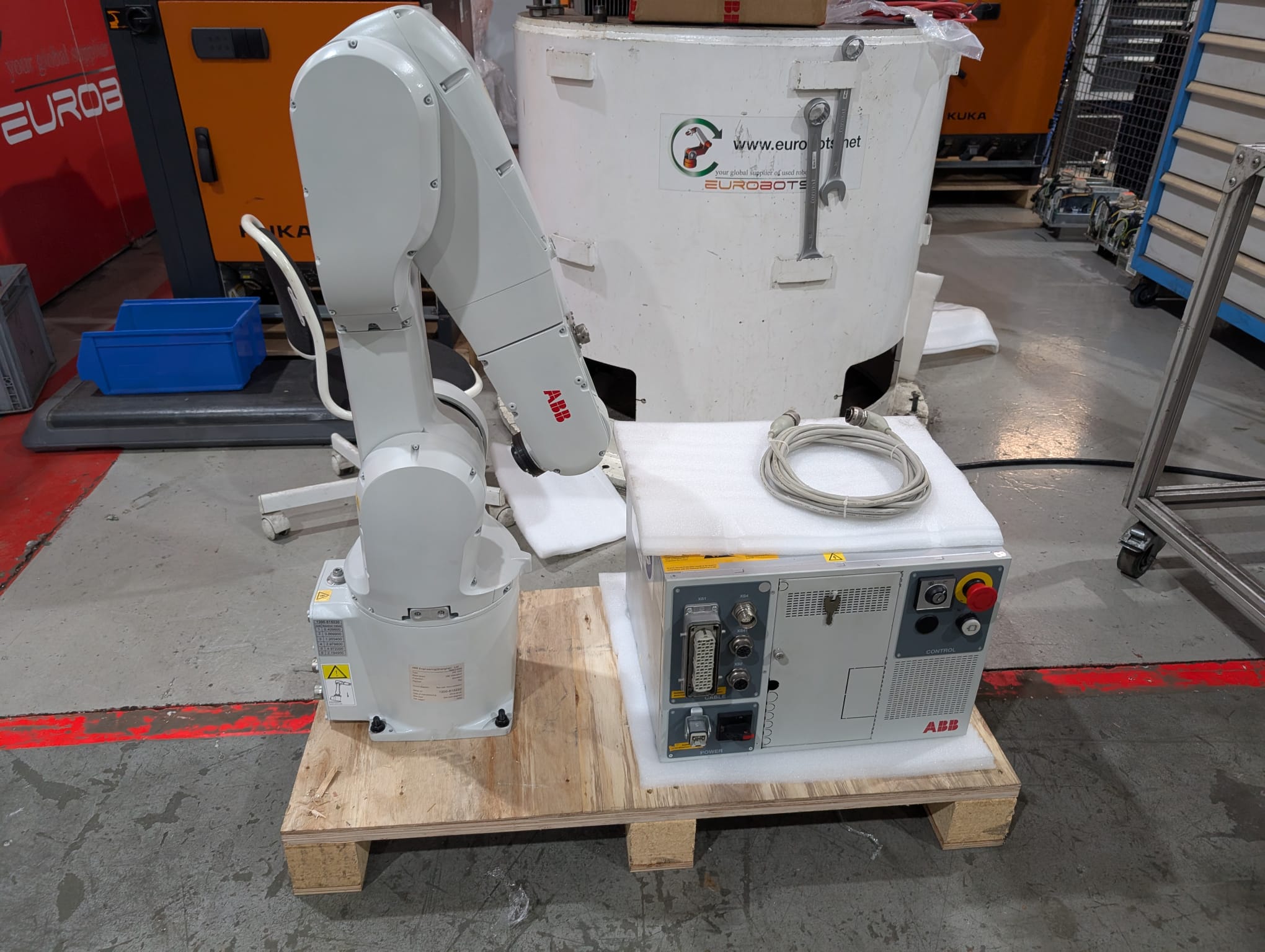
The ABB IRB 1300 is one of ABB’s most capable compact 6-axis robots for high-speed, precision applications. It is designed specifically for environments where floor space is at a premium, cycle time matters, and the application requires both speed and path accuracy — electronics assembly, machine tending, polishing, inspection, and testing.
This article covers the verified technical specifications of the ABB IRB 1300 family, explains the differences between variants, and outlines which applications benefit most from this platform.
ABB IRB 1300 Specifications
The IRB 1300 is available in four variants. Each combines a specific payload and reach configuration to match different application profiles. The specifications below are from ABB’s official product page.
| Variant | Payload | Reach | Best suited for |
|---|---|---|---|
| IRB 1300-12/1.4 | 12 kg | 1,400 mm | Higher payload at maximum reach — machine tending, handling |
| IRB 1300-11/0.9 | 11 kg | 900 mm | Compact cells, high load in small workspace — assembly, testing |
| IRB 1300-10/1.15 | 10 kg | 1,150 mm | Medium reach, balanced payload — general assembly, inspection |
| IRB 1300-7/1.4 | 7 kg | 1,400 mm | Long reach at lower payload — handling, pick and place |
The 12 kg variant offers the highest payload in its class for this footprint. The IRB 1300 family occupies a footprint of just 220 mm × 220 mm — approximately one-sixth of the floor space of ABB’s IRB 1600, while being nearly 60 percent lighter.
Controller
The IRB 1300 runs on ABB’s OmniCore controller, available in three form factors: the E10 ultra-slim, the C30 compact, and the C90XT rugged compact for harsh environment installations. The OmniCore platform provides advanced motion control, best-in-class path accuracy, and native support for ABB Integrated Vision.
Cycle Time
ABB specifies up to 27 percent faster cycle times for the IRB 1300 compared to previous generation compact robots. In high-duty-cycle applications — assembly, testing, polishing — that improvement directly translates to higher output per cell without changing the footprint.
Protection Variants
The IRB 1300 is available in standard, IP67, Foundry Plus 2, and cleanroom ISO Class 4 versions. The IP67 version handles washdown environments. Foundry Plus 2 adds stainless steel on the end-effector to resist corrosion in casting and forging environments. The cleanroom version meets ISO Class 4 contamination requirements for semiconductor and medical device production.
ABB IRB 1300 in Electronics Assembly
Electronics assembly is the application the IRB 1300 was designed around. The industry demands a specific combination of capabilities that few compact robots deliver simultaneously: speed to sustain high throughput, repeatability to handle components with sub-millimeter placement tolerances, and a compact footprint to fit into production cells alongside other equipment.
In PCB assembly and testing, the IRB 1300 handles component placement, functional testing, and end-of-line inspection. Its native integration with ABB Integrated Vision means the robot can perform visual position correction — identifying the exact position of a component before placing it — without requiring a separate vision controller. This simplifies the cell architecture and reduces the number of hardware dependencies.
For flexible circuit board (FPC) assembly specifically, ABB has documented applications where the IRB 1300’s combination of path accuracy and speed has reduced assembly cycle time compared to previous-generation compact robots. The specific cycle time improvement depends on the application and the previous baseline, but the platform’s official 27 percent cycle time improvement over its predecessor reflects its design intent for precisely this type of application.
The cleanroom ISO Class 4 variant makes the IRB 1300 directly deployable in semiconductor wafer handling and medical device assembly environments where contamination limits on the robot body itself are a qualification requirement.
ABB IRB 1300 in Machine Tending
Machine tending — loading and unloading CNC machines, injection molding presses, and testing equipment — is the second major application area for the IRB 1300. In this context, its compact footprint is particularly valuable. Many machine tending installations are retrofit projects where an existing machine tool needs a robot integration without a major cell redesign. The IRB 1300’s small base and wall-mount or desk-mount capability makes integration into an existing machine enclosure significantly more practical than larger platforms.
The 12 kg/1.4 m variant covers the payload and reach requirements of most small-to-medium part tending applications. For high-speed applications where the machine cycle is short and the robot needs to complete its loading and unloading task quickly, the IRB 1300’s improved cycle time performance directly reduces idle machine time.
For context on designing effective machine tending cells and how to avoid the most common bottleneck sources, see our article on how to robotize CNC machine loading and unloading without creating bottlenecks.
ABB IRB 1300 in Quality Control and Inspection
Vision-guided inspection is a growing application for the IRB 1300. The robot positions the part or the camera precisely, holds position while the vision system captures data, and moves to the next inspection point. Path accuracy is critical here — a positioning error during inspection produces a false result, not just a slower cycle.
The IRB 1300’s OmniCore controller integrates directly with ABB Integrated Vision and with third-party camera systems via standard interfaces. This allows the robot to serve as both the motion platform and the vision trigger in a single coordinated system, without requiring a separate camera controller. For a detailed look at how vision and robotic inspection integrate in practice, see our article on how to automate quality control with machine vision and robots.
How the IRB 1300 Compares to Alternatives
The compact 6-axis robot market includes competitive platforms from FANUC (LR Mate series), KUKA (KR Agilus), and Yaskawa (GP series, MH series). The IRB 1300 differentiates on three dimensions.
Payload-to-footprint ratio. The 12 kg variant offers the highest payload in its class for this footprint category. Competing platforms in the same footprint typically top out at 7 to 10 kg.
Native vision integration. ABB Integrated Vision runs natively on the OmniCore controller without a separate hardware module. On competing platforms, vision integration typically requires an external vision controller or a third-party software layer.
Protection variants. The availability of IP67, Foundry Plus 2, and ISO Class 4 cleanroom versions gives the IRB 1300 broader application coverage than many competitors at this payload class.
The tradeoff is cost. The IRB 1300 is not the cheapest platform in its class. For applications where the native vision integration and high payload-to-footprint ratio are genuinely required, the cost is justified. For simpler handling or tending applications that do not use vision, a competing platform at lower cost may deliver equivalent results.
New vs. Refurbished ABB IRB 1300
The IRB 1300 is a current-generation platform running ABB’s OmniCore controller. Refurbished units are not yet widely available, as the platform is relatively new. For established ABB compact robot applications, the earlier ABB IRB 1600 and IRB 2600 platforms are well-represented in the refurbished market and cover the same application types at larger payload and reach. For decision-making criteria on new versus refurbished equipment, see our article on new vs refurbished robots: when each option is appropriate.
FAQ
What is the maximum payload of the ABB IRB 1300?
The highest-payload variant is the IRB 1300-12/1.4, with a 12 kg payload and 1,400 mm reach. This is the highest payload available in its footprint class. The other variants are 11 kg/0.9 m, 10 kg/1.15 m, and 7 kg/1.4 m. The correct variant for a specific application depends on the part weight plus end-effector weight, and the required reach to all working positions.
Is the ABB IRB 1300 suitable for cleanroom environments?
Yes. The IRB 1300 is available in a cleanroom ISO Class 4 variant that meets the contamination requirements of semiconductor, medical device, and pharmaceutical manufacturing environments. This variant has sealed construction and controlled outgassing. Confirm with ABB that the specific cleanroom variant is the one being quoted — the standard IP67 version does not meet ISO Class 4 requirements.
What controller does the ABB IRB 1300 use?
The IRB 1300 uses ABB’s OmniCore controller, available as the E10 ultra-slim, C30 compact, or C90XT rugged compact. OmniCore provides advanced motion control, integrated vision support, and connectivity through standard industrial protocols including EtherNet/IP and PROFINET. The OmniCore platform is ABB’s current controller generation and replaces the older IRC5 across new robot lines.
How does the IRB 1300 compare to the ABB IRB 1600?
The IRB 1600 handles higher payloads (up to 10 kg standard, with longer reach options up to 1.45 m) and is available in a wider range of configurations. The IRB 1300 is newer, more compact, lighter, and faster in cycle time. For applications that fit within the IRB 1300’s payload and reach envelope, the IRB 1300 is the better choice. For applications requiring the IRB 1600’s extended reach or proven long-service track record in refurbished availability, the IRB 1600 remains relevant.
What applications is the ABB IRB 1300 not well-suited for?
The IRB 1300 is not suited for high-payload material handling or palletizing — its maximum payload of 12 kg limits it to lighter parts. It is also not the primary choice for heavy-duty arc welding, where dedicated welding robot platforms with hollow wrist cable management are more appropriate. For applications outside electronics, testing, machine tending, and small-part assembly, other ABB platforms at higher payload typically fit better.
Talk to URT About ABB IRB 1300 Equipment
At URT, we supply ABB industrial robots — including current and previous generation compact platforms — for electronics assembly, machine tending, inspection, and general manufacturing applications.
If you are evaluating the ABB IRB 1300 or an ABB compact robot alternative for your application, contact URT. We will give you a direct, technical answer based on your actual production requirements.