
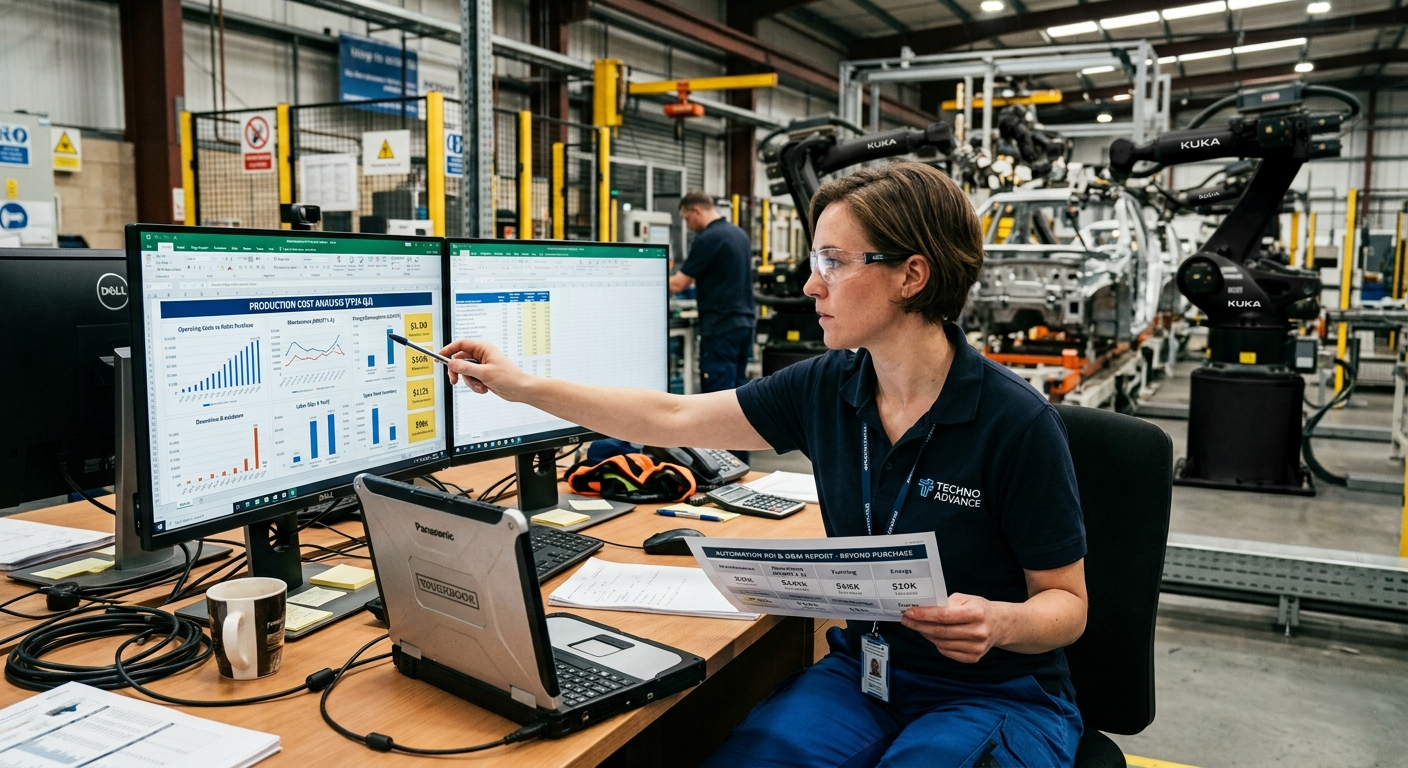
The Purchase Price Is Rarely the Largest Financial Risk
Companies often spend considerable time negotiating the price of an industrial robot while paying much less attention to the costs that appear after the purchase order is signed. The hidden automation costs that emerge during integration, commissioning, production ramp-up, and long-term operation frequently have a greater impact on return on investment than the robot itself.
This does not mean automation is more expensive than expected by default. Many projects deliver strong operational improvements. The challenge is that financial planning often focuses on equipment acquisition while overlooking the production conditions required for the system to perform reliably over many years.
A realistic automation business case should evaluate the entire production system rather than the robot alone. Fixtures, tooling, programming, operator training, maintenance capability, process stability, and production disruption all influence the real cost of ownership.
Integration Work Often Exceeds Initial Expectations
Industrial robots do not operate independently. Every robotic cell must communicate with surrounding equipment, safety systems, sensors, conveyors, machine tools, and production software. Each interface introduces engineering effort that may vary significantly depending on the existing production environment.
Integration costs can increase when legacy PLCs, proprietary communication protocols, aging machinery, or undocumented electrical systems require additional engineering before the robot can enter production.
Existing Equipment May Require Modification
Many manufacturers assume current production equipment can simply be connected to a new robot. In practice, machines may require additional sensors, updated control logic, guarding modifications, or mechanical redesign before stable automation is possible.
These improvements are not unnecessary expenses. They often eliminate reliability issues that would otherwise appear after commissioning.
Software and Validation Take Time
Programming extends beyond robot motion. Integrators must validate communication sequences, fault recovery, operator interfaces, safety functions, and production recipes. Acceptance testing can uncover process conditions that were not visible during project planning.
Downtime During Implementation Has a Real Financial Cost
Installing automation frequently requires planned production interruptions. Even well-managed projects may involve machine relocation, electrical work, fixture installation, commissioning, and production validation before normal throughput resumes.
If production schedules leave little flexibility, temporary capacity reductions may affect delivery commitments. Companies that include implementation downtime in their financial planning usually produce more realistic ROI projections.
The objective is not to avoid downtime completely. It is to minimize disruption through careful scheduling, phased commissioning, and realistic production planning.
Training Is an Operational Investment, Not an Optional Expense
Automation changes how operators, maintenance teams, and production supervisors interact with the manufacturing process. Without sufficient training, small operational issues can become extended production stoppages.
Operator Confidence Influences Productivity
Operators should understand normal operating procedures, alarm handling, changeovers, and basic recovery actions. When production teams lack confidence, unnecessary service calls and longer restart times often follow.
Maintenance Capability Reduces Long-Term Cost
Internal maintenance personnel should understand the robotic cell architecture, preventive inspection routines, backup procedures, and component replacement strategy. Building this capability reduces dependence on emergency external support.
Maintenance Costs Continue Throughout the Robot’s Life
Every automation project requires ongoing maintenance. Preventive inspections, wear components, calibration checks, software updates, and spare parts all contribute to the lifetime operating cost.
These expenses should not be viewed as unexpected. They are part of keeping production reliable. Delaying preventive maintenance often increases the likelihood of unplanned downtime, which is usually far more expensive than scheduled service.
Companies should also evaluate spare parts availability, controller support, and long-term serviceability when selecting automation equipment.
Process Stability Has a Direct Impact on ROI
A robot repeats programmed movements consistently, but it cannot compensate for uncontrolled process variation. If incoming parts vary significantly, fixtures are inconsistent, or upstream operations produce unstable results, automation may simply repeat defects more consistently.
Before investing, manufacturers should verify that part presentation, material quality, fixture repeatability, and production flow are sufficiently stable for robotic operation.
When these conditions are achieved, automation often improves consistency and predictability. When they are ignored, troubleshooting and production losses become hidden costs that were never included in the original business case.
Hidden costs also include organizational readiness.
Technology alone does not determine project success. Clear project ownership, defined performance metrics, maintenance planning, operator involvement, and realistic acceptance criteria all influence whether automation delivers the expected business outcome.
Projects frequently encounter delays when responsibilities remain unclear or production teams are introduced to the new system only after installation has begun.
Early collaboration between engineering, operations, maintenance, and management typically reduces implementation risk and shortens the path to stable production.
What to Evaluate Before Approving an Automation Project
The following checklist can help identify costs that may not appear in the initial quotation but can significantly influence total project value.
- Expected integration work with existing equipment.
- Production downtime is required during installation.
- Programming, testing, and commissioning effort.
- Operator and maintenance training requirements.
- Preventive maintenance strategy.
- Spare parts availability.
- Process stability before automation.
- Internal ownership of long-term support.
- Performance indicators that will measure project success.
Considering these factors before approving the investment creates a more realistic financial model and reduces the likelihood of unexpected costs after commissioning.
FAQ
Are hidden automation costs unavoidable?
No. Most hidden costs can be anticipated during project planning if companies evaluate the complete production system instead of focusing only on equipment purchase price.
Is integration usually more expensive than the robot?
It depends on the application. Complex production environments with legacy equipment, multiple machines, or custom communication requirements can require substantial engineering effort beyond the robot itself.
Why should training be included in ROI calculations?
Training reduces operational errors, improves recovery time, supports preventive maintenance, and helps production teams use the equipment efficiently over its service life.
Can automation improve an unstable manufacturing process?
Not by itself. Robots perform best when the underlying process is already stable. Significant variation in parts, fixtures, or material quality should usually be addressed before automation.
What is the most commonly overlooked automation expense?
Many manufacturers underestimate integration work, commissioning time, and the organizational effort required to support the system after installation. These factors often influence long-term ROI more than the initial purchase price.
Talk to URT About Automation Project Costs
If you are evaluating the real cost of an industrial automation project, contact URT. We will give you a direct, technical answer based on your actual production requirements.