
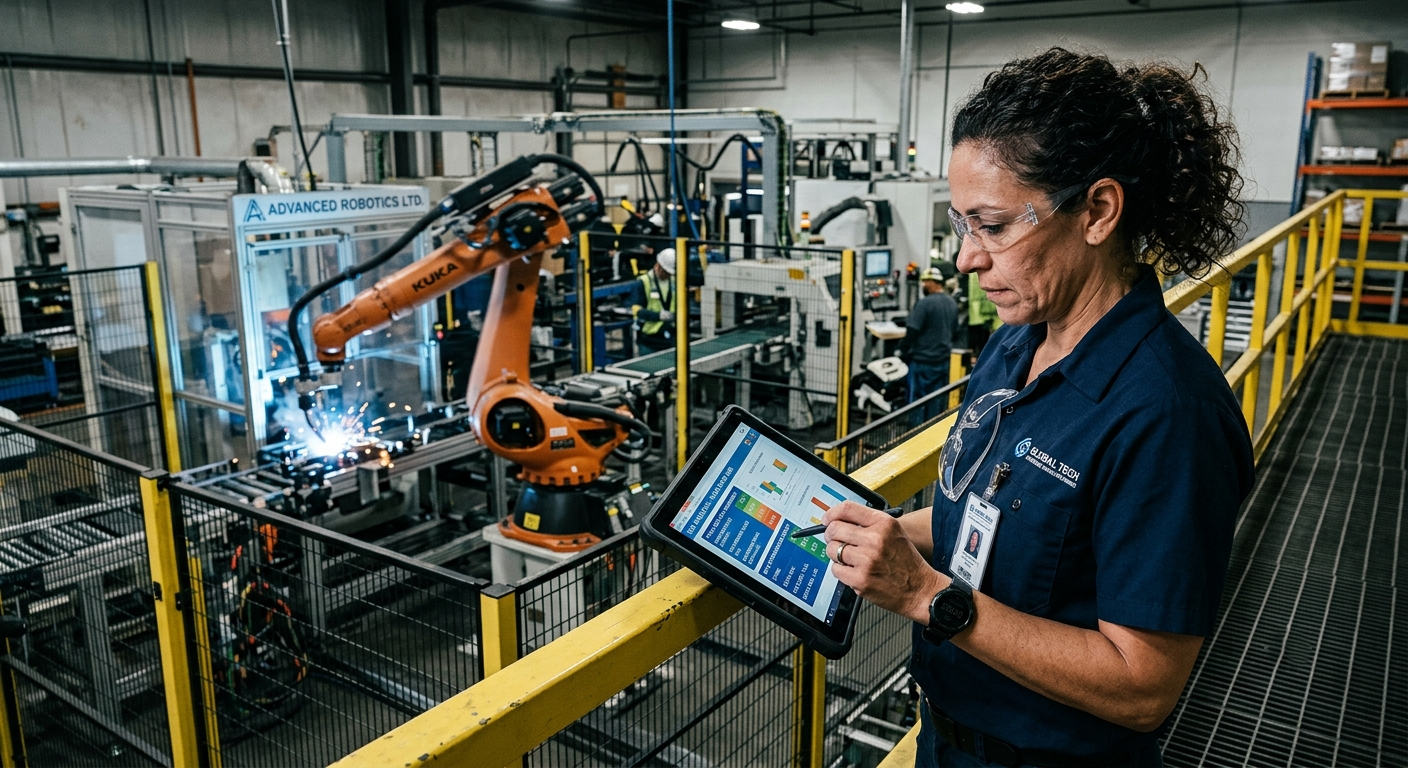
Why a Robot Rarely Pays for Itself in the Way Buyers Expect
The question is not whether an industrial robot will eventually recover its cost. The more important question is which production variables actually generate the return. A purchase price alone tells very little about the financial outcome if downtime, integration effort, scrap, maintenance capability, or production stability are ignored. A robot ROI calculator should therefore evaluate the complete manufacturing process rather than the robot as an isolated asset.
Many automation projects are approved or rejected using overly simple payback assumptions. While labor savings often receive the most attention, many successful robotic projects justify themselves through better machine utilization, more consistent cycle times, lower scrap rates, reduced ergonomic risk, or improved production predictability. These benefits only become meaningful when they can be measured before and after implementation.
What Should Be Included in a Robot ROI Calculator?
A practical ROI calculation begins by defining the current production baseline. Without reliable operating data, any financial projection becomes difficult to defend internally.
Current Production Costs
Document the existing production performance, including labor assigned to the process, average cycle time, scrap or rework levels, machine utilization, planned and unplanned downtime, overtime requirements, and production volume. These measurements establish the benchmark against which automation should be evaluated.
Project Investment
The robot purchase is only one part of the investment. A realistic calculation should also include end-of-arm tooling, fixturing, safety equipment, programming, commissioning, operator training, and production interruptions during installation. Omitting these costs may create an optimistic payback estimate that does not reflect the actual project.
Operating Costs
Maintenance, spare parts, energy consumption, software licensing, where applicable, and ongoing technical support should all be considered over the expected operating life of the system. These recurring costs influence total ownership more than the initial purchase price alone.
Where ROI Usually Comes From
Industrial robotics can create value through several operational improvements rather than a single dramatic cost reduction.
Labor Redeployment
Automation does not always eliminate labor requirements. In many facilities, employees move from repetitive manual work to higher-value production activities, allowing output to increase without proportional staffing growth.
Quality Consistency
If a repetitive process currently produces measurable scrap or rework because of manual variation, automation may improve consistency. This benefit depends on stable fixtures, controlled material variation, and clearly defined quality criteria. An unstable process will simply reproduce the same problems more consistently.
Machine Utilization
Robots frequently improve equipment utilization by reducing idle time between operations. Where machine availability is the production constraint, higher utilization may contribute more to ROI than labor savings.
Reduced Downtime
Projects that simplify material flow or reduce repetitive manual intervention can lower production interruptions. These improvements should be measured through historical downtime data rather than assumed during project planning.
Variables That Can Delay Payback
Not every automation project reaches its expected return within the planned timeframe.
Extended programming work, unstable part presentation, frequent engineering changes, inadequate maintenance capability, insufficient operator training, or unexpected integration challenges may increase implementation cost or delay production acceptance.
Similarly, highly variable product mixes or low production volumes may reduce the financial benefit of automation if flexibility requirements exceed the planned system capability.
A Practical ROI Evaluation Framework
The following checklist can help structure a realistic investment evaluation before requesting supplier quotations.
| Evaluation Area | Questions to Answer |
|---|---|
| Production Stability | Is the process repeatable enough for automation? |
| Current Performance | Are cycle time, scrap, downtime, and labor accurately measured? |
| Integration | Have tooling, safety, programming, and commissioning been included? |
| Support | Can the maintenance team support the new equipment? |
| Business Case | Which KPIs will confirm project success after implementation? |
Answering these questions before comparing equipment suppliers helps reduce the risk of basing the investment decision on incomplete financial assumptions.
When a Robot May Not Pay for Itself Yet
Automation is not automatically justified simply because labor costs are increasing. Projects should often be delayed when the underlying process remains unstable, production volumes fluctuate significantly, quality requirements are poorly defined, or upstream bottlenecks prevent the robot from operating efficiently.
Likewise, if the organization lacks clear project ownership or has not defined measurable acceptance criteria, proving the return after commissioning becomes considerably more difficult.
FAQ
Is labor reduction the biggest contributor to robot ROI?
Not always. Many projects achieve stronger returns through improved quality consistency, machine utilization, reduced downtime, and predictable production performance.
Should maintenance costs be included in ROI calculations?
Yes. Maintenance, spare parts, technical support, and training all contribute to the total cost of ownership and should be considered when evaluating long-term return.
Can a robot improve ROI if production volume remains unchanged?
Yes. Improved consistency, lower scrap, reduced rework, and better machine utilization can generate measurable financial benefits without increasing output.
Why do some automation projects miss their projected payback?
Common causes include underestimated integration work, unstable production processes, insufficient planning, inadequate operator training, and unrealistic assumptions about implementation time.
What should be measured before investing in automation?
Cycle time, labor allocation, downtime, scrap, machine utilization, quality performance, and production volume should all be documented before calculating expected return.
Talk to URT About Robot ROI Evaluation
If you are evaluating whether an industrial robot is financially justified for your production process, contact URT. We will give you a direct, technical answer based on your actual production requirements.