
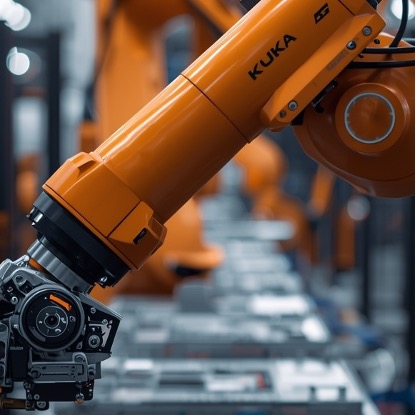
The rapid rise of electric mobility is transforming global manufacturing. Battery gigafactories demand high‑precision automation, controlled environments, and scalable production capacity. Yet many companies encounter a major challenge: high investment costs for industrial robots.
Refurbished robotics is eliminating this barrier—driving growth, sustainability, and accessibility in the EV sector.
Key Advantages of Refurbished Industrial Robots
- Cost reduction of 40%–60% compared to new robots
- High precision maintained (tolerances below 0.05 mm for ABB/FANUC models)
- Ideal for SMEs entering the EV supply chain
- Full compatibility with clean rooms, assembly lines, and testing stations
- Reprogrammable for multiple applications (cells, inverters, electronics)
- Environmentally sustainable, reducing CO₂ emissions by up to 75%
- Supports circular manufacturing via recycling and disassembly processes
Where Refurbished Robots Are Used in EV Battery Manufacturing
- Cell handling & positioning
- Module & pack assembly
- Laser welding and TIG welding
- Adhesive dispensing and sealing
- Electrical testing & inspection
- Automated packaging & palletizing
- Battery pack recycling and material recovery
Real‑World Applications
- In Europe, refurbished KUKA KR 60 robots with vacuum grippers assemble prismatic and pouch cells.
- In Asia, refurbished ABB IRB 4600 units are used for inspection and TIG welding of copper connectors.
These examples show that performance gaps between refurbished and new robots are minimal when calibration is executed by certified professionals.
Checklist: How to Select the Right Refurbished Robot
✔ Technical Requirements
- Payload capacity (kg)
- Reach and working envelope
- Required precision for the process
- Compatibility with tooling (grippers, welders, cameras)
✔ Application Fit
- Cell assembly
- Laser welding
- Automated testing
- Electronics assembly
- Clean‑room compliance
✔ Robot Condition & Certification
- Year of manufacture
- Total operating hours
- Replaced components (motors, bearings, cables)
- Calibration report provided?
- Warranty included? (recommended minimum: 6–12 months)
✔ Integration & Support
- Availability of spare parts
- Software version compatibility
- Training and documentation
- Post‑installation technical support
FAQ – Refurbished Robotics in EV Battery Manufacturing
1. Do refurbished robots perform as well as new ones?
Yes. When reconditioned and calibrated correctly, they offer the same precision, repeatability, and reliability.
2. Are refurbished robots suitable for clean‑room applications?
Absolutely. Certified units can operate in ISO class-controlled environments with no performance differences.
3. How much can companies save?
Typically 40% to 60% compared to buying new models.
4. Can a refurbished robot be reprogrammed for other tasks?
Yes. They can be reconfigured for new assembly lines, electronics processes, testing stations, and more.
5. Are refurbished robots sustainable?
Yes. Reconditioning reduces the environmental impact by up to 75% in CO₂, supporting green manufacturing practices.
6. Which brands offer the best refurbished options?
- ABB
- FANUC
- KUKA
- Yaskawa
Especially when refurbished by specialized companies like URT.
Conclusion
The electric vehicle industry demands speed, precision, and sustainability. Refurbished robotics delivers all three while making advanced automation accessible to more manufacturers—especially SMEs and innovators in the EV value chain.
By combining cutting‑edge engineering with intelligent cost optimization, refurbished robots accelerate the expansion of battery production and support a more sustainable, circular manufacturing ecosystem.