
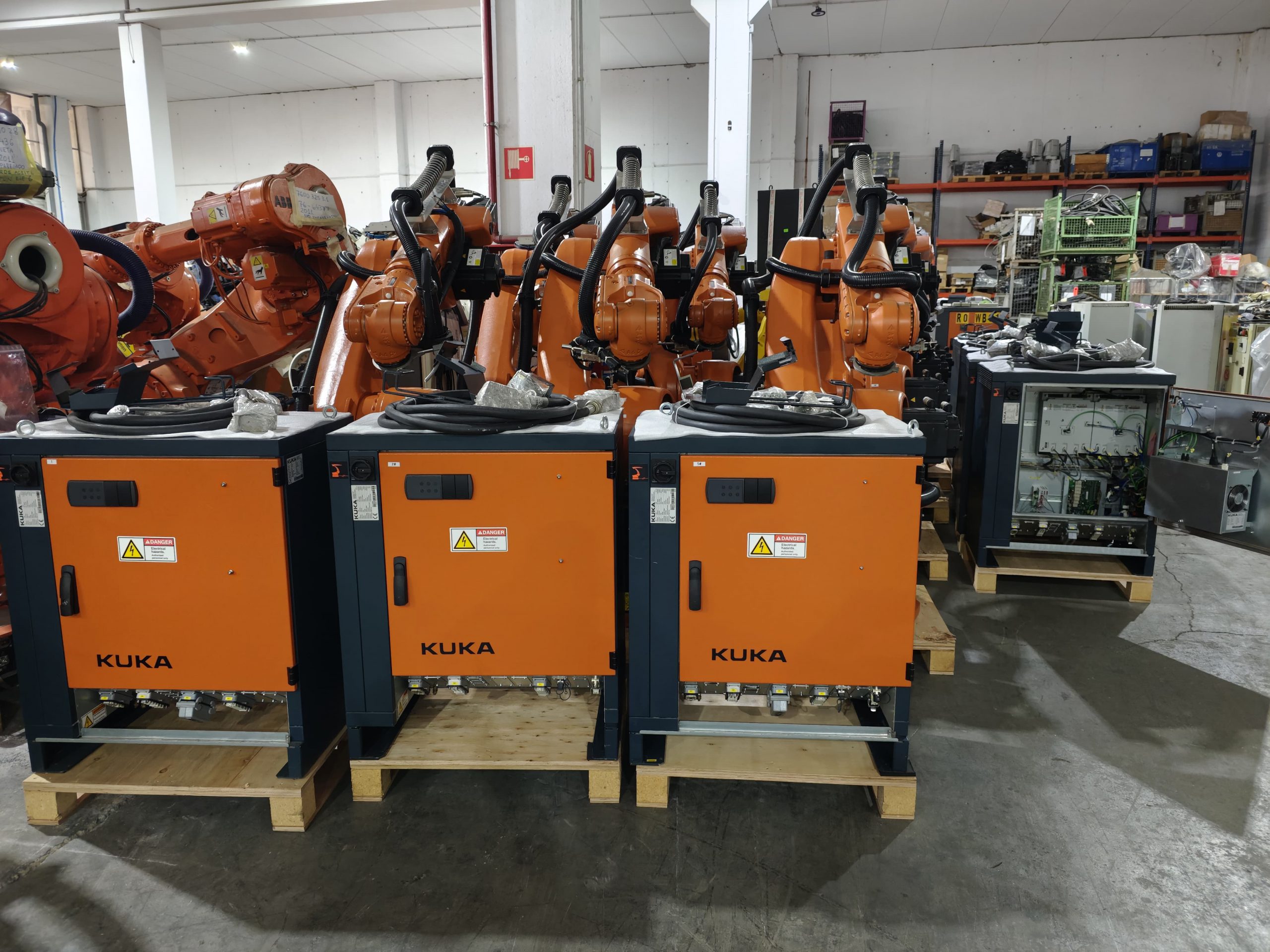
Modern agriculture faces a major challenge: producing more with fewer workers and with rising operational costs. Automation is no longer a luxury—it is a necessity. However, many medium and small farmers still believe robotic technology is beyond their reach. The reality is very different: refurbished industrial robots are opening a new era in precision agriculture, providing advanced, reliable, and cost-effective automation.
Today, agricultural robotics is no longer limited to large corporations or experimental projects. Refurbished robots from ABB, KUKA, FANUC, and Yaskawa are being adopted to automate sorting, fruit selection, cutting, packaging, palletizing, and even greenhouse maintenance. These refurbished units, restored to industrial standards, deliver the same precision and durability as new robots but with up to 60% lower investment.
In post-harvest processing, automation is transforming fruit and vegetable workflows. For example, in a citrus packing facility in southern Spain, a refurbished FANUC M-20iA robot equipped with a soft gripper and vision system was implemented to classify oranges by size and color. Previously, the task required manual labor and over 12-hour shifts. With the refurbished robot, sorting time decreased by 40% while eliminating human error due to fatigue.
In another case, a vegetable company in Italy integrated two refurbished ABB IRB 4600 robots to palletize tomato boxes on high-speed lines. Each robot handles more than 600 boxes per hour, freeing operators for quality control tasks. With a small initial investment, the plant achieved continuous, stable operation with fewer stoppages and improved traceability.
Greenhouses and indoor farming also benefit from robotic automation. Refurbished KUKA KR AGILUS robots equipped with proximity sensors and six-axis arms perform harvesting tasks in hydroponic systems. Their compact size and low energy consumption allow them to work efficiently in narrow rows, performing precise cuts without damaging plants.
A key advantage is that refurbished robots can be easily reprogrammed for new tasks or seasonal operations. A robot used for sorting today can be adapted tomorrow for packaging, spraying, or transporting trays. This flexibility makes refurbished robots a strategic tool for producers seeking automation without high upfront costs or long delivery times for new equipment.
Innovation is not about having the newest robot—it is about using technology intelligently. Refurbished robots offer the ideal balance of performance, reliability, and cost, while also supporting sustainability by extending the lifecycle of industrial equipment and reducing environmental impact.
In a market where labor shortages are increasing and quality standards are rising, refurbished robotics provide a real opportunity to modernize agriculture without taking on excessive financial risk.
At URT, we refurbish and certify ABB, KUKA, FANUC, and Yaskawa robots ready for agricultural, packaging, and post-harvest applications. If your agribusiness wants to improve efficiency, reduce costs, and stay competitive, accessible automation is now within reach.
Learn more at www.usedrobotstrade.com and transform your agricultural operations with real, efficient, and sustainable technology.
📌 1. INITIAL ANALYSIS
☐ Identify the process to be automated (e.g., sorting, packaging, palletizing, harvesting).
☐ Evaluate daily/weekly production volumes.
☐ Define the required operating speed (cycles/hour).
☐ Identify current waste or bottlenecks.
☐ Estimate cost reduction through automation.
☐ Verify the availability of personnel for quality control and supervision.
📌 2. TECHNICAL REQUIREMENTS
☐ Define the required payload (kg) and robot arm reach.
☐ Measure the available space in the working area.
☐ Assess the need for accessories:
- soft grippers
- machine vision
- proximity sensors
☐ Choose the type of robot: anthropomorphic, SCARA, collaborative, cartesian.
☐ Verify compatibility with existing lines, conveyors, and machinery.
📌 3. CHOOSING THE ROBOT (NEW OR REFURBISHED)
☐ Check CE certifications and refurbishment status.
☐ Request test reports and operating hours.
☐ Compare costs between new and refurbished units (expected ROI).
☐ Verify availability of spare parts.
☐ Check warranty and technical support options.
📌 4. INTEGRATION AND INSTALLATION
☐ Study the layout and robot positioning.
☐ Install safety barriers, scanners, or a collaborative-safe area.
☐ Calibrate the vision system.
☐ Program the complete operating cycle.
☐ Perform tests with real products.
☐ Optimize cycle times.
📌 5. STAFF TRAINING
☐ Training on basic programming.
☐ Training on routine maintenance.
☐ Emergency and safety procedures.
☐ Training on format changeovers / product changeovers.
📌 6. CONTROL AND MAINTENANCE
☐ Plan quarterly preventive maintenance.
☐ Check wear on grippers and tools.
☐ Perform periodic backups of programs.
☐ Monthly performance analysis (OEE).
☐ Update software/firmware when necessary.
📌 7. POST-INSTALLATION MONITORING
☐ Verify the reduction in human errors.
☐ Measure productivity increase.
☐ Monitor energy consumption.
☐ Check the quality of processed products.
☐ Evaluate expandability toward other processes.