
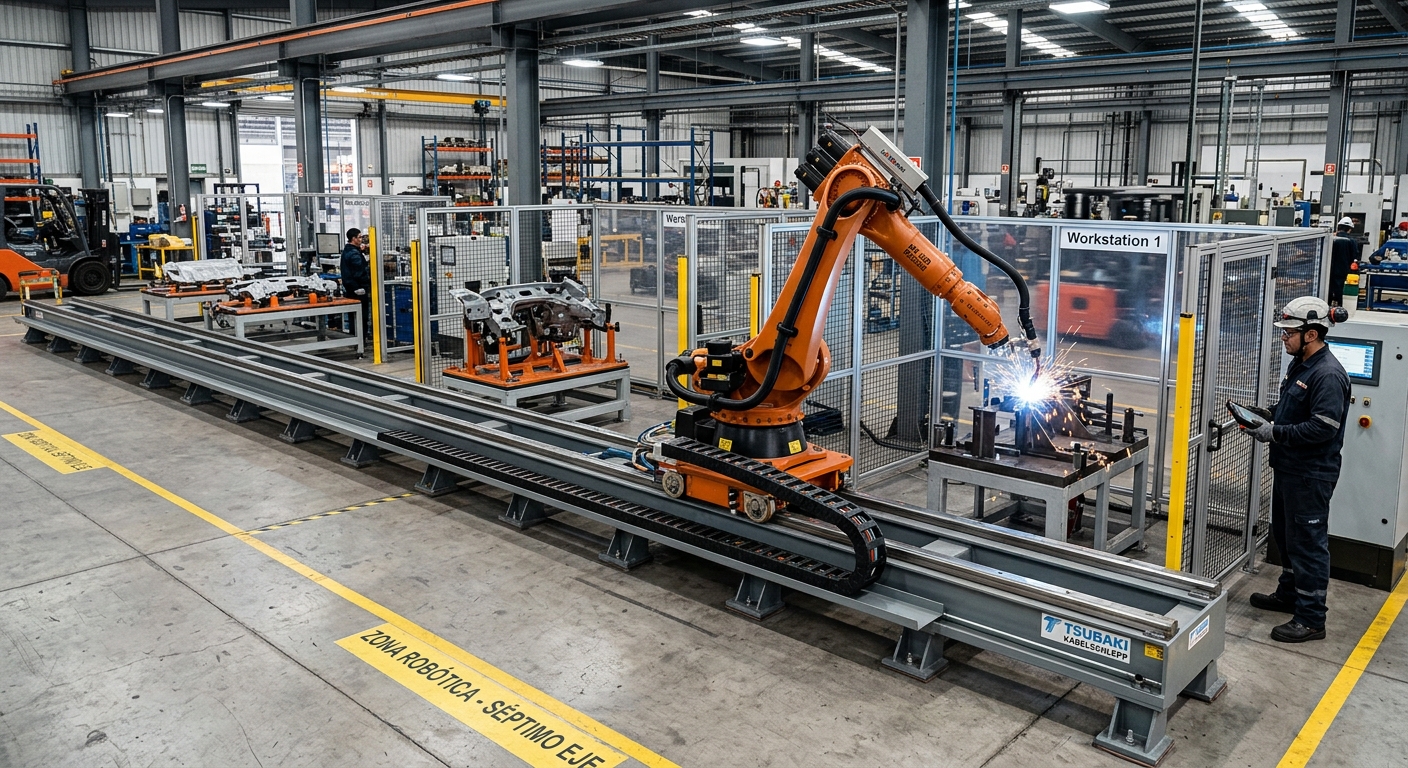
Industrial robot track systems can solve a genuine production constraint when a fixed robot cannot access every required working position. However, adding a seventh axis introduces another controlled movement, additional safety requirements, mechanical maintenance, and greater integration complexity. The decision is not simply whether the robot would benefit from a larger working area, but whether production can use that additional movement productively enough to justify the investment.
In some applications, a robot mounted on a linear track can serve several machines, cover long workpieces, or perform operations across multiple stations. In others, the same investment creates unnecessary travel time, increases the consequences of equipment failure, and complicates a process that fixed robots or better workstation positioning could handle more reliably.
Before specifying a seventh axis, manufacturers need to establish what limits the current cell, how often the robot must move between positions, and whether extending the working area will improve overall production performance.
How industrial robot track systems change the working envelope
A conventional six-axis articulated robot operates within a working envelope determined by its mechanical geometry, mounting position, tooling, and application constraints. A seventh-axis track adds controlled linear movement that allows the robot base to travel along a defined path.
This additional movement changes the relationship between the robot and production equipment. Instead of arranging every workstation around one fixed robot position, the integrator can position the robot at different locations along the track to reach separate working areas.
However, industrial robot track systems do more than extend the robot’s operating area. They introduce a separate mechanical assembly that must work with robot motion, process equipment, tooling, cable management, and safety controls.
Robot reach and track travel represent different capabilities
A robot’s nominal reach describes its ability to position its wrist relative to its mounting base under defined conditions. Track travel describes the distance over which that mounting base can move.
Combining these movements creates a larger overall working area, but it does not make every position accessible with the required tool orientation. Joint limits, wrist configurations, tooling dimensions, fixtures, and nearby equipment still determine whether the robot can perform the operation.
For example, a welding robot may travel along a large structure but still struggle to maintain the required torch angle at certain joints. Similarly, a handling robot may reach several machines without having sufficient clearance to extract components safely.
The correct evaluation therefore requires checking actual tool paths and operating positions rather than simply adding track length to the robot’s published reach.
Coordinated seventh-axis motion versus indexed positioning
Manufacturers should distinguish between a coordinated external axis and a positioning system that moves the robot between predefined stations.
With coordinated motion, the robot controller manages the external axis as part of the programmed movement, provided the controller and drive configuration support that function. This arrangement can be valuable when a process requires continuous movement along an extended workpiece.
In an indexed configuration, the track moves the robot to a predefined position and confirms its location before the robot performs the programmed operation.
Both arrangements can work, but they require different approaches to control, programming, accuracy, and commissioning. Buyers should never assume that every track marketed as a seventh axis supports continuous coordinated motion with their existing controller.
When industrial robot track systems deliver operational value
The strongest applications for industrial robot track systems are those where additional movement eliminates a measurable production limitation. The benefit must come from the process, not simply from installing a longer or more flexible robotic system.
Large workpieces that exceed a fixed robot’s working envelope
Long structures represent a natural application for linear robot tracks. Examples include structural steel assemblies, large fabricated frames, railway components, and other products with operations distributed across an extended working area.
Without a track, manufacturers may need several fixed robots, repositioning equipment, or repeated manual handling. Each alternative introduces costs and operational constraints.
A track-mounted robot can travel along the component while accessing different process locations. This configuration may reduce heavy workpiece repositioning and simplify certain fixture arrangements.
However, successful operation still depends on tool orientation throughout the working area. For welding applications, the integrator must evaluate torch access, joint geometry, cable routing, workpiece distortion, and fixture repeatability.
The track becomes valuable when it provides reliable access to operations that would otherwise require additional equipment or repeated workpiece movement.
One robot serving multiple CNC machines
Another application involves machine tending, where one robot travels between several CNC machines or processing stations.
This arrangement can reduce the number of robots required when machine cycles are sufficiently long and loading or unloading operations take relatively little time. The robot can complete a task at one machine and travel to another while the first continues processing.
Nevertheless, sharing a robot creates an operational dependency. When two machines require unloading simultaneously, one must wait. A failure in the track or robot can also interrupt automated handling across several machines.
Machine cycle variation, robot handling time, travel distance, and queue management therefore become central to the investment decision. Our guide to robotizing CNC machine loading and unloading without creating bottlenecks explains how to evaluate these production-flow constraints.
Multiple workstations with controlled production sequences
Track-mounted robots can also serve separate welding fixtures, assembly stations, or handling positions when the production sequence remains predictable.
For example, a robot may complete an operation at one fixture while operators prepare another station outside the active robotic working area. Once the safety system confirms the required conditions, the robot travels to the prepared station.
This arrangement can improve equipment utilization when fixture preparation and robotic processing remain balanced. Conversely, inconsistent preparation times can leave the robot waiting or force other stations to remain idle.
The central question is whether the production sequence allows the robot to remain productive across stations. Additional travel capability does not automatically create parallel production.
How track travel time affects production throughput
A common mistake in seventh-axis projects is evaluating robot processing time without accounting for movement between work positions.
Although a track allows one robot to cover a larger area, the robot cannot perform every operation simultaneously. Travel, acceleration, deceleration, positioning confirmation, and process preparation consume time.
Some applications allow coordinated movement during useful operations. Others require the robot to stop processing before changing stations.
Evaluate the complete operating sequence
Consider a cell where one robot serves multiple machines. The relevant cycle includes much more than gripping and placing a component.
The robot may need to receive a machine-ready signal, travel to the station, confirm a safe position, open the machine interface, unload the finished part, load a new component, and verify placement.
Afterward, the robot must release the machine to resume production and travel to its next destination. The analysis must also account for waiting periods caused by conflicting machine requests.
A useful evaluation compares actual machine cycle time, total robot service time, and variation in machine completion times. If the robot cannot reliably service every machine before its next required loading or unloading event, the track becomes a bottleneck rather than a productivity improvement.
Robot utilization does not guarantee system throughput
A track-mounted robot may achieve high utilization while the overall production system performs poorly.
For example, the robot could remain busy moving between machines while those machines wait for handling operations. Robot utilization would appear positive, but machine availability and total output could deteriorate.
The correct performance indicators include machine waiting time, completed parts per shift, robot travel time, process interruptions, and simultaneous service requests.
Manufacturers should connect the financial justification to measurable production outcomes. The KPIs used to measure robotic automation success should reflect system performance rather than robot activity alone.
Mechanical design and controller compatibility in industrial robot track systems
Industrial robot track systems change the mechanical and control architecture of a robotic cell. A robot that operates reliably on a fixed pedestal may require substantial additional engineering when installed on a moving carriage.
The integrator must evaluate the track structure, mounting interface, drive system, guidance components, energy supply, and dynamic loads generated during robot operation.
Track rigidity and positioning accuracy
The robot’s published repeatability does not describe the positioning performance of the complete track-mounted system.
When the robot moves along a linear axis, final tool positioning depends on both robot motion and track mechanics. Structural deflection, guide wear, drive backlash, installation alignment, and foundation movement can influence process accuracy.
These effects become especially relevant when the robot performs operations requiring consistent positioning across distant stations.
Welding applications may tolerate certain positioning variations differently from precision assembly or machining operations. Engineers must therefore define accuracy requirements at the process tool under representative operating conditions.
Track positioning repeatability, structural rigidity, and robot calibration require evaluation as parts of the complete system rather than independent equipment specifications.
Controller and external-axis compatibility
Not every industrial robot controller can operate every external-axis system.
Compatibility depends on the robot manufacturer, controller generation, motion-control functions, drive hardware, software options, and intended coordination method.
For coordinated motion, the controller must support the required external-axis configuration. Some indexed applications can use a separate track controller, but the integration must still manage positioning confirmation, fault states, and safe operating sequences.
This becomes especially important when evaluating used or refurbished robots. A mechanically suitable robot may require controller modifications, additional hardware, or software functionality before it can operate with the proposed track.
URT’s guide to refurbished robot compatibility with existing systems explains why controller generation and integration requirements deserve attention before equipment selection.
Cable management and energy supply
A moving robot requires reliable power, control signals, and process utilities throughout the complete track movement.
Depending on the application, these utilities may include electrical power, communication cables, compressed air, welding cables, shielding gas, or other process connections.
Cable carriers and routing systems must accommodate the intended travel without excessive bending, mechanical interference, or inaccessible maintenance points.
For welding applications, cable and hose routing can influence robot movement and torch access. Handling applications require reliable pneumatic and electrical connections across repeated travel cycles.
Engineers should design cable management together with the track rather than adding it after finalizing robot paths and workstation layouts.
Safety and maintenance requirements for seventh-axis installations
A track-mounted robot creates a working area that extends beyond the envelope of a fixed robot. The risk assessment must consider movement of both the robot arm and carriage, including access routes, maintenance positions, and potential interaction with adjacent equipment.
The larger working area may also change how operators enter, prepare, and service production stations.
Protecting multiple operating zones
When a robot travels between workstations, the safety architecture must account for personnel who may enter areas the robot could subsequently reach.
Depending on the cell design, engineers may need guarding, interlocked access points, safety-rated position monitoring, and controlled operating zones. The risk assessment and applicable machinery safety requirements determine the appropriate measures.
For example, an operator may need to prepare a fixture while the robot operates at another station. A validated safety concept must prevent hazardous movement into the operator’s accessible area.
For broader industrial robotic system safety considerations, OSHA’s robotics guidance provides a useful reference on hazards associated with robotic systems and related equipment.
Maintenance access and failure consequences
A seventh axis adds mechanical components that require inspection and maintenance. These may include linear guides, drive components, lubrication systems, cable carriers, position feedback devices, and mounting structures.
Specific maintenance requirements depend on the track manufacturer, operating environment, duty cycle, and mechanical configuration. Maintenance teams should follow the applicable equipment documentation rather than assume generic service intervals.
Failure consequences also deserve attention. If one track-mounted robot serves several machines, a single failure can interrupt multiple production assets.
Maintenance planning must therefore consider component reliability and the plant’s ability to continue operating when the shared robot or track becomes unavailable.
For critical applications, buyers should evaluate spare parts availability, recovery procedures, service access, and the possibility of operating individual stations independently during an extended interruption.
When industrial robot track systems are not the best solution
Industrial robot track systems are not automatically the best solution whenever a fixed robot lacks sufficient reach. Alternative cell architectures may provide better productivity, lower integration risk, or greater operational resilience.
The correct comparison depends on station requirements, process time, workpiece dimensions, production variation, and the consequences of equipment downtime.
Comparing the main alternatives
The following comparison helps engineering teams evaluate common cell architectures during early project planning. It identifies operational trade-offs rather than assigning a universal ranking to each configuration.
| Evaluation criterion | Track-mounted robot | Multiple fixed robots | Fixed robot with repositioning equipment |
|---|---|---|---|
| Working area | Extended along the track | Distributed across separate robot envelopes | Depends on workpiece repositioning |
| Simultaneous operations | Limited by the shared robot | Possible with independent robots | Depends on equipment and sequence |
| Integration complexity | External axis, travel coordination, cable management | Multiple controllers and station coordination | Positioner and fixture integration |
| Downtime exposure | Shared track or robot can affect several stations | Failures may affect individual stations | Positioning equipment can become a common constraint |
| Layout flexibility | Useful for distributed stations and long components | Useful for independent production areas | Useful when the workpiece can move reliably |
| Maintenance requirements | Robot and linear motion system | Multiple robotic systems | Robot and positioning equipment |
When several fixed robots are preferable
Multiple fixed robots may offer better performance when production stations require frequent or simultaneous operations.
Although this arrangement increases the number of robots, it can reduce waiting time and allow each station to operate more independently.
Separate robots can also improve fault isolation. A problem with one robot does not necessarily stop every station, provided the material flow and control architecture support independent operation.
Manufacturers should compare the additional capital cost with the production losses that could result from sharing a single robot across several high-demand stations.
When moving the workpiece is preferable
In some applications, repositioning the workpiece is more practical than moving the robot.
Welding positioners, rotary tables, transfer equipment, and other handling systems can bring different workpiece areas into a fixed robot’s working envelope.
This approach may simplify robot programming and cable management, particularly when the workpiece can move accurately without excessive handling complexity.
However, large or heavy structures may require substantial positioning equipment, additional floor space, and more demanding fixtures. Under those conditions, moving the robot along the workpiece may offer a more practical architecture.
The comparison must include the complete equipment arrangement rather than simply the purchase price of the robot or track.
How to justify investment in industrial robot track systems
The financial case for industrial robot track systems should rely on measurable production effects. A larger working envelope provides technical capability, but it creates financial value only when it improves labor utilization, throughput, handling operations, quality, or equipment availability.
The complete investment includes the track, carriage, drive system, controls, installation, safety equipment, programming, commissioning, maintenance preparation, and required modifications to existing production equipment.
Identify where the investment creates value
For large workpieces, value may come from reducing repositioning operations, simplifying material handling, or allowing one robot to complete work that previously required multiple setups.
For machine tending, the advantage may come from sharing robotic handling capacity across machines with sufficiently long processing cycles.
In multi-station welding or assembly, the benefit may come from reducing idle time between fixture preparation and automated processing.
Engineers must compare these potential gains against additional travel time, maintenance exposure, integration complexity, and production losses caused by shared equipment failures.
Compare total project cost rather than equipment price
Comparing a track-mounted robot with several fixed robots requires more than counting the number of robot arms.
The analysis should include mechanical installation, foundations, controller options, process tooling, safety integration, electrical infrastructure, operator training, and commissioning time.
Operating costs also matter. A shared robot may reduce the number of robotic systems requiring maintenance, but the linear track introduces additional components and can concentrate downtime risk across multiple stations.
When comparing new and refurbished equipment, buyers should consider controller compatibility, available support, mechanical condition, and the cost of adapting the selected robot to the track. The new versus refurbished robot decision must therefore reflect the complete application.
A practical evaluation checklist
Before approving a seventh-axis project, engineering and production teams should use this checklist to identify assumptions that require verification. Layout studies, process measurements, equipment documentation, and integration testing should support the answers where appropriate.
- Working area: Confirm that the robot and track combination can reach every required process position with the correct tool orientation.
- Production sequence: Establish whether the robot can serve all stations without creating unacceptable waiting time.
- Track movement: Determine whether the application requires continuous coordinated motion or indexed station-to-station positioning.
- Controller compatibility: Verify the exact controller generation, external-axis functionality, drives, and software requirements.
- Mechanical structure: Evaluate track rigidity, foundation requirements, positioning repeatability, and dynamic loading.
- Process utilities: Confirm that cables, hoses, and other connections can operate reliably throughout the complete travel range.
- Safety: Define working zones, access requirements, safeguarding architecture, and validation responsibilities.
- Maintenance: Check component accessibility, spare parts availability, service requirements, and failure recovery options.
- Investment comparison: Compare total cost and production performance against fixed robots, repositioning equipment, and alternative layouts.
- Acceptance criteria: Define the throughput, accuracy, availability, and operating conditions that the completed cell must demonstrate.
A seventh axis makes sense when these checks demonstrate that the larger working area solves a real production constraint without introducing disproportionate complexity or operational risk.
FAQ
What is a seventh axis on an industrial robot?
A seventh axis adds controlled movement beyond the conventional six axes of an articulated industrial robot. It commonly takes the form of a linear track that moves the robot base between working positions. Depending on the controller and configuration, the robot may coordinate this movement with its arm or use it to travel between separate stations.
Do industrial robot track systems increase robot reach?
Industrial robot track systems extend the overall working area by moving the robot’s mounting base. They do not change the mechanical reach of the robot arm relative to that base. Actual tool access still depends on robot geometry, joint limits, tooling, fixtures, and the required process orientation.
Can any six-axis industrial robot operate on a linear track?
Not automatically. Engineers must verify mechanical mounting, dynamic loading, controller compatibility, drive integration, and safety requirements. Some robots and controllers support external-axis configurations more readily than others. The exact model and controller generation determine the available integration options.
Is one robot on a track cheaper than multiple fixed robots?
It can be, but the result depends on the application. A track-mounted system adds mechanical equipment, motion controls, installation work, and maintenance requirements. Multiple fixed robots may deliver higher throughput or better fault isolation. Buyers should compare total project cost and expected production performance rather than robot purchase price alone.
Are seventh-axis systems suitable for robotic welding?
Yes, particularly when welding operations extend along large structures or across multiple fixtures. Suitability depends on torch access, joint geometry, fixture repeatability, cable routing, process stability, and controller coordination. A track cannot compensate for poor part fit-up or unstable welding conditions.
Can a track-mounted robot serve several CNC machines?
Yes, provided the combined loading, unloading, and travel time allows the robot to service each machine without unacceptable delays. Machine cycle variation and simultaneous service requests require careful evaluation. A shared robot can become a bottleneck when machine demand exceeds its handling capacity.
What maintenance do industrial robot track systems require?
Maintenance depends on the track design and operating conditions. Relevant components may include linear guides, drives, lubrication systems, cable carriers, position feedback devices, and mounting structures. Maintenance teams should follow the manufacturer’s inspection procedures and service intervals.
When should manufacturers avoid installing a seventh axis?
A seventh axis may not justify its cost when fixed robots can perform the required operations more independently, when travel creates excessive waiting time, or when production does not require an extended working area. Controller limitations and high integration costs can also make alternative layouts more appropriate.
Talk to URT about industrial robot track systems
If you are evaluating industrial robot track systems, contact URT. We will give you a direct, technical answer based on your actual production requirements.