
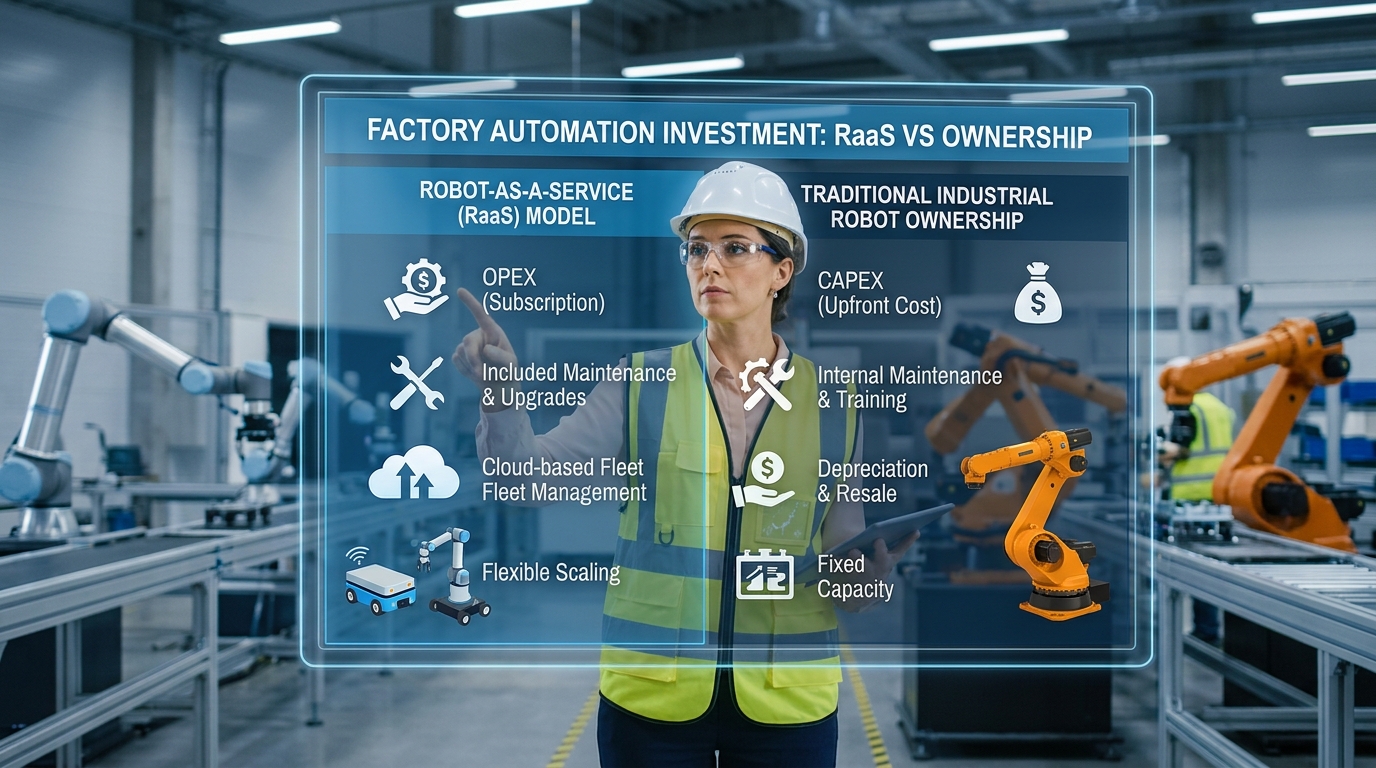
A repetitive manufacturing process may offer a clear automation opportunity, but the investment can still create financial uncertainty. The Robot-as-a-Service vs buying decision requires manufacturers to compare capital exposure, production stability, integration requirements, and long-term operating costs. A lower initial payment does not necessarily produce a lower total project cost.
Robot-as-a-Service (RaaS) allows manufacturers to access robotic equipment through recurring payments. Equipment ownership gives companies greater control over their assets, maintenance strategies, and future modifications. Both approaches require careful planning because the complete robotic cell determines production performance, not the financing model.
Robot-as-a-Service vs Buying: What Changes for Manufacturers?
The main difference concerns how manufacturers manage equipment costs, ownership responsibilities, and financial risks. Under RaaS, companies pay recurring fees for robotic equipment or automation services. With ownership, manufacturers purchase the equipment and manage its operating costs directly.
Some RaaS providers include maintenance, technical support, software, and monitoring in their agreements. Others charge separately for these services. Manufacturers must examine the contract before assuming that a subscription covers every operational requirement.
Capital Investment and Financial Flexibility
RaaS can reduce initial capital requirements, making automation more accessible when investment budgets remain limited. This approach may also help manufacturers test automation in applications with uncertain future demand.
Equipment ownership normally requires a larger initial investment. However, manufacturers can continue using the robot after recovering their investment and may redeploy it when production requirements change.
The financial advantage depends on utilization, maintenance expenses, and the expected operating period. Neither approach offers a universal cost advantage.
When Robot-as-a-Service Fits Manufacturing Requirements
RaaS can provide value when manufacturers face uncertain production demand, temporary capacity requirements, or limited internal robotics expertise.
Temporary Production and Seasonal Demand
Seasonal orders and short-term manufacturing contracts can create temporary automation requirements. RaaS may help companies increase production capacity without purchasing equipment for permanent use.
However, manufacturers must include installation, programming, commissioning, and equipment removal in their calculations. Short operating periods can make these costs difficult to recover.
Limited Maintenance Resources
Manufacturers without specialized robotics teams may benefit from service agreements that include maintenance and technical assistance. External support can reduce the workload of internal maintenance personnel.
Nevertheless, service coverage varies between providers. Companies should verify response times, spare parts availability, repair conditions, and emergency support before signing an agreement.
Uncertain Product Demand
New products often create uncertainty about future manufacturing volumes. RaaS may reduce the financial risk of purchasing equipment that later operates below its expected capacity.
However, minimum contract periods and cancellation penalties can limit flexibility. Manufacturers should confirm whether the agreement allows them to adjust capacity when production requirements change.
Robot-as-a-Service vs Buying for Stable Production
Equipment ownership may offer stronger long-term economics when manufacturers operate stable processes with predictable production volumes.
Companies that use robots consistently can distribute the initial investment across many productive operating hours. Once they recover the investment, they may achieve lower operating costs than they would under a continuing subscription.
High-Utilization Manufacturing Processes
Robotic welding, palletizing, material handling, and machine tending can support equipment ownership when production conditions remain stable.
For example, a robotic welding cell can deliver consistent operation when manufacturers control part geometry, fixture repeatability, welding parameters, and material presentation.
Before selecting equipment, manufacturers should evaluate which process to robotize first. This assessment helps identify applications with measurable production benefits and manageable integration risks.
Applications Requiring Custom Integration
Some robotic applications require specialized fixtures, end-of-arm tooling, safety systems, and communication with existing production equipment.
These requirements can increase integration expenses regardless of the financing model. A subscription may offer limited financial advantages when the manufacturer must still fund extensive customization.
Ownership may provide greater flexibility for applications that require frequent technical modifications or long-term integration with existing machinery.
How Robot-as-a-Service vs Buying Affects Total Cost
Manufacturers should compare both alternatives over the same operating period. Purchase prices and subscription fees alone cannot establish which model offers better value.
| Evaluation Factor | Robot-as-a-Service | Equipment Ownership |
|---|---|---|
| Initial investment | Potentially lower | Generally higher |
| Recurring costs | Subscription and service fees | Maintenance and operating expenses |
| Maintenance | Depends on contract coverage | Owner manages support |
| Equipment control | Subject to contractual restrictions | Greater modification flexibility |
| Long-term utilization | Continuing payments may increase costs | May favor ownership |
| Residual value | Provider generally retains ownership | Potential resale or redeployment value |
Calculate the Complete Investment
For RaaS, manufacturers should calculate subscription payments, installation charges, maintenance exclusions, additional service fees, and contract termination costs.
For ownership, companies should include equipment acquisition, integration, financing, maintenance, spare parts, software, and training.
Both calculations must consider production downtime. A lower equipment cost offers little advantage when technical failures interrupt critical manufacturing operations.
Robot-as-a-Service vs Buying Refurbished Robots
Manufacturers should also consider purchasing used or refurbished industrial robots. This alternative can reduce initial equipment expenditure while preserving the advantages of ownership.
Refurbished robots may offer suitable performance for stable manufacturing applications that do not require the latest controller technology.
However, buyers must examine mechanical condition, controller compatibility, spare parts availability, and technical support before purchasing equipment.
URT explains the main considerations in its comparison of new and refurbished industrial robots.
Compatibility and Integration Risks
Used equipment can create additional integration challenges when controllers, software, or communication interfaces do not match existing production systems.
Manufacturers should verify the exact robot model and controller version before approving the investment. They should also evaluate maintenance support and future spare parts availability.
URT’s guide to refurbished robot compatibility with existing systems explains the technical checks that influence successful integration.
When Neither Financing Model Makes Sense
Neither RaaS nor ownership can compensate for an unstable manufacturing process. Inconsistent part positioning, inadequate fixtures, and uncontrolled production variation can prevent reliable robotic operation.
Manufacturers should resolve these problems before selecting equipment or signing service agreements.
They must also define measurable production targets, maintenance responsibilities, and integration requirements. Without these conditions, both financing models can expose the company to unnecessary operational risk.
Use the following checklist to evaluate project readiness before making an investment decision.
- Production stability: Confirm consistent part presentation and process requirements.
- Utilization: Estimate realistic productive operating hours.
- Integration: Identify tooling, programming, and safety requirements.
- Maintenance: Establish technical support responsibilities.
- Total cost: Compare both alternatives over the same operating period.
- Contract flexibility: Review cancellation fees and service exclusions.
- Performance: Define measurable production acceptance criteria.
If the plant cannot confirm these conditions, management should postpone the investment until the technical and financial risks become clearer.
FAQ
Is Robot-as-a-Service cheaper than buying industrial robots?
Not always. RaaS can reduce initial investment requirements, but recurring payments may increase total costs over longer operating periods. Manufacturers should compare utilization, maintenance, integration, and contract expenses.
Which manufacturing processes are suitable for RaaS?
RaaS can suit repetitive processes with clear production requirements, especially when demand remains uncertain or manufacturers need temporary automation capacity.
When should manufacturers purchase industrial robots?
Ownership may offer better value when production remains stable, utilization stays predictable, and companies expect long-term equipment operation.
Does Robot-as-a-Service include maintenance?
Service coverage depends on the provider and contract. Manufacturers should verify maintenance responsibilities, spare parts coverage, technical response times, and additional charges.
Can refurbished robots offer better value than RaaS?
Yes. Refurbished equipment can reduce acquisition costs while allowing manufacturers to retain ownership. However, buyers must verify equipment condition, compatibility, and maintenance requirements.
Does RaaS eliminate integration costs?
No. Providers may include integration services, but manufacturers should confirm the agreement’s scope. Tooling, programming, safety systems, and commissioning can still generate additional expenses.
Talk to URT About Your Robot Investment Strategy
If you are evaluating Robot-as-a-Service vs buying for your manufacturing operation, contact URT. We will give you a direct, technical answer based on your actual production requirements.